Market Depth shows the quantity of buy and sell orders available at different price levels for a security. It gives traders a more detailed view of the order book than simply looking at the current market price.
By showing where orders are concentrated, Market Depth can help traders understand available liquidity zones and how a larger order may interact with existing orders.
Understanding this information can be particularly useful when order size, liquidity, and price movement matter. However, Market Depth does not guarantee that displayed orders will remain available or that an order will execute at a specific price.
What Market Depth Shows in a Trading Environment
Market Depth displays available buy and sell interest across multiple price levels rather than focusing on one quoted price.
Depending on the trading platform, the display may show:
- Price levels above and below the current market
- Quantity available at each price
- Number of orders at certain levels
- The best available bid and ask
- Additional levels further away from the current price
This information helps traders see how much visible liquidity exists near the current market.
How the Order Book Is Organized
The order book is generally divided into two sides: buyers and sellers.
The bid side represents buy orders, while the ask side represents sell orders. Each side can contain multiple price levels, with different quantities available at each level.
For example:
| Price Level | Buy Orders | Sell Orders |
|---|---|---|
| $99.90 | 1,200 shares | 300 shares |
| $99.95 | 800 shares | 400 shares |
| $100.00 | 700 shares | 600 shares |
| $100.05 | 500 shares | 1,000 shares |
| $100.10 | 300 shares | 1,500 shares |
The displayed quantities are not necessarily permanent. Orders can be added, modified, canceled, or executed as market conditions change.
Market Depth vs. the Basic Bid-Ask Quote
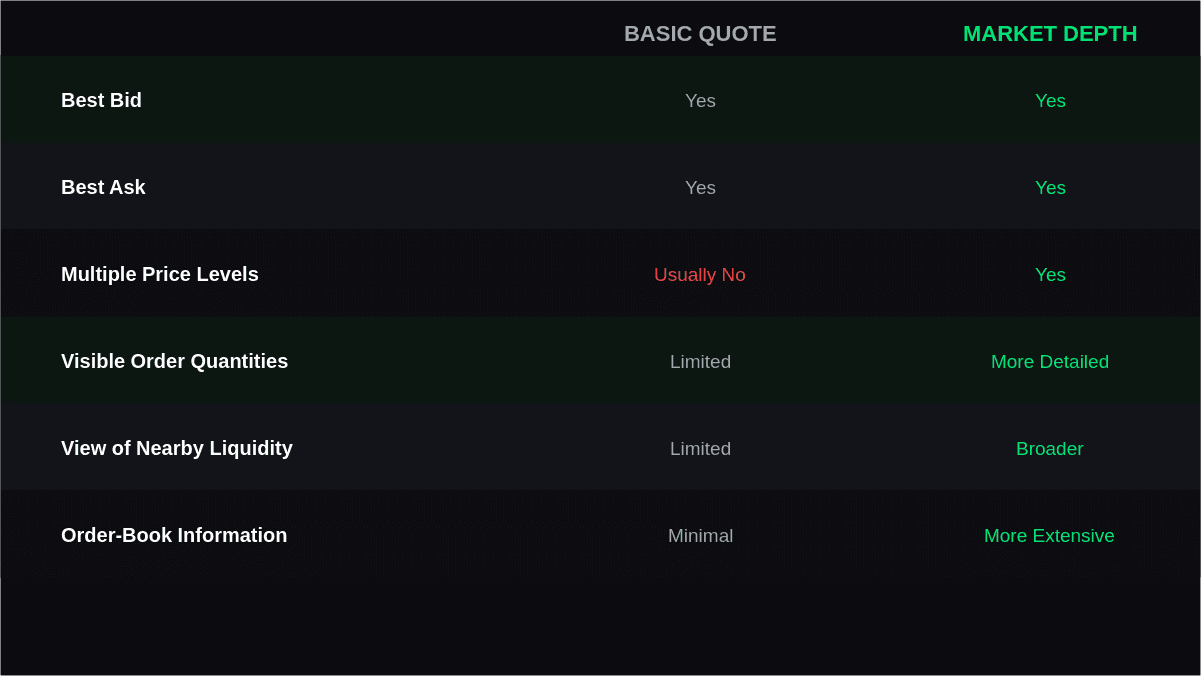
A basic quote usually provides the best available bid and ask, while Market Depth can reveal multiple levels beyond those prices.
| Feature | Basic Quote | Market Depth |
|---|---|---|
| Best bid | Yes | Yes |
| Best ask | Yes | Yes |
| Multiple price levels | Usually no | Yes |
| Visible order quantities | Limited | More detailed |
| View of nearby liquidity | Limited | Broader |
| Order-book information | Minimal | More extensive |
This distinction matters because the best quoted price does not show everything that may happen when an order interacts with the book.
How Order Size Can Change Execution Price
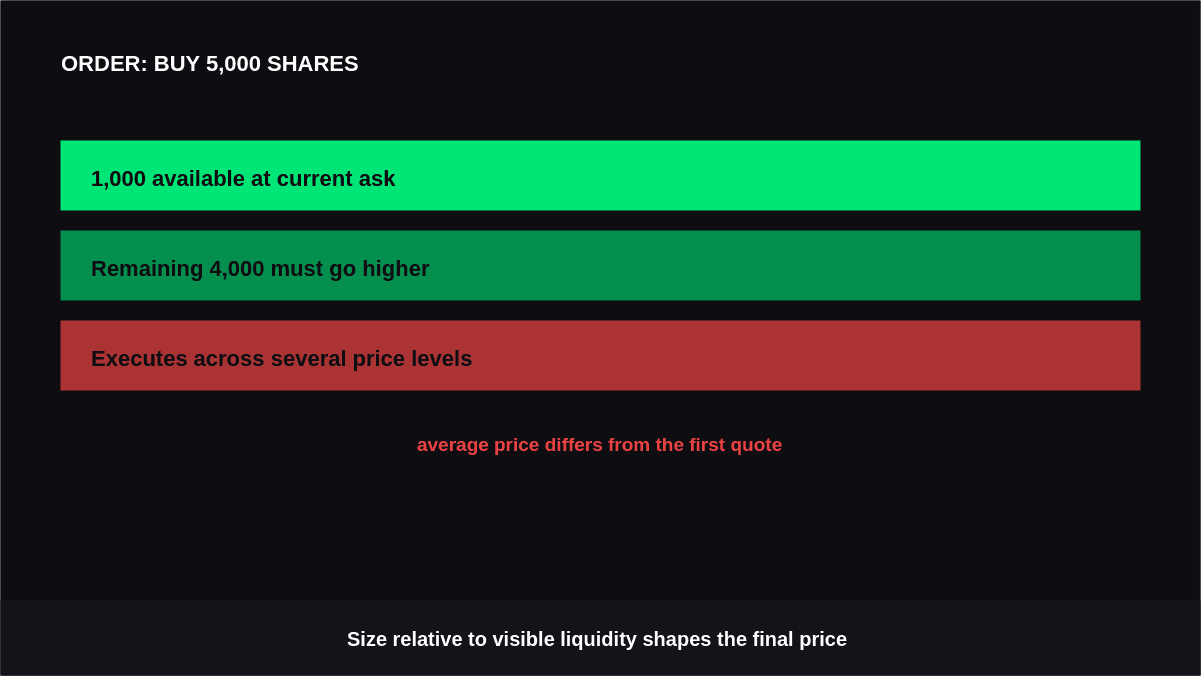
Order size is one of the most important factors when considering trade execution.
Suppose a trader wants to buy 5,000 shares, but only 1,000 shares are available at the current ask. If the order is marketable and there are no other matching orders at that price, the remaining quantity may execute at progressively higher prices.
This can create a difference between the expected execution price and the average price actually received.
The effect becomes more relevant when:
- The order is large relative to available liquidity
- Nearby price levels contain limited quantity
- Trading activity is relatively thin
- Market conditions are changing quickly
Why Liquidity Matters When Reading Market Depth
Liquidity refers to how easily an asset can be bought or sold without causing a substantial change in price. A deeper visible book may provide more available quantity across nearby price levels.
A thinner book may contain less displayed liquidity, meaning relatively modest orders can interact with several levels. However, traders should avoid treating the displayed depth as a complete measure of liquidity.
Some trading activity may occur away from the visible book, and displayed orders can disappear before execution, which is an important consideration in supply and demand trading.
How Market Orders Interact With Available Liquidity
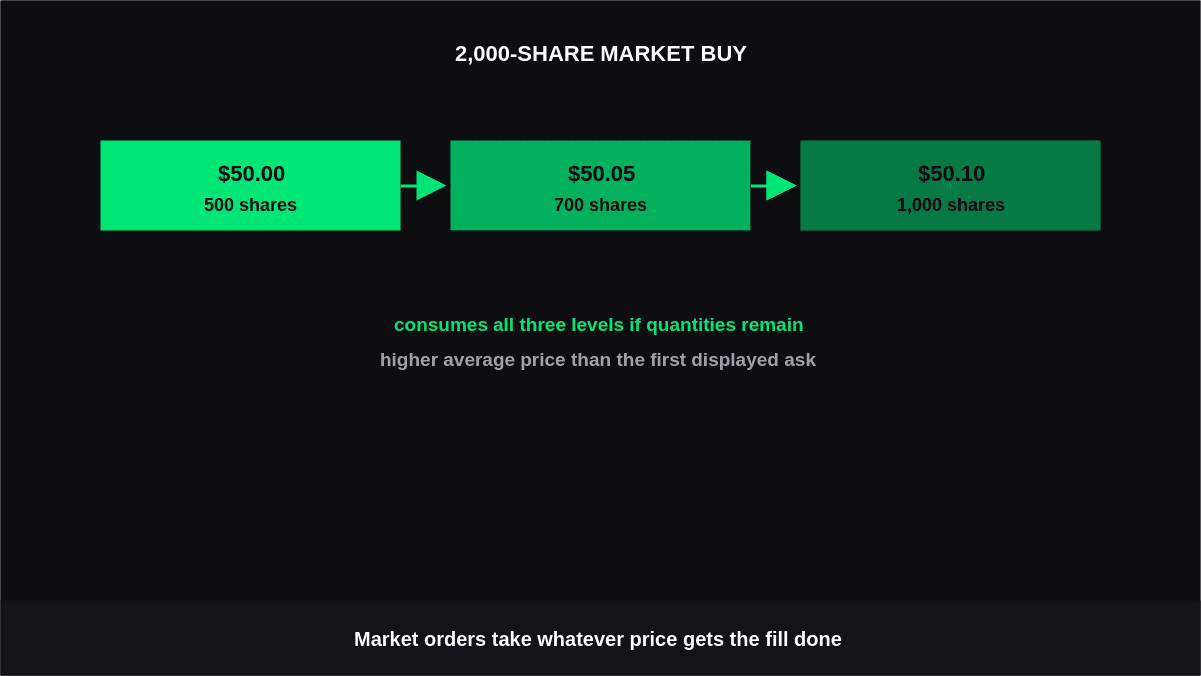
A market order generally seeks immediate execution rather than a specific price.
When a market buy order reaches the order book, it can consume available sell orders beginning with the lowest available ask. A sufficiently large order can therefore execute across several price levels.
For example:
500 shares available at $50.00
700 shares available at $50.05
1,000 shares available at $50.10
A 2,000-share market buy could interact with all three levels if those quantities remain available when the order reaches the market.
The result is a higher average purchase price than the first displayed ask.
How Limit Orders Use Market Depth Information
Limit orders allow traders to specify the maximum price they will pay when buying or the minimum price they will accept when selling.
Market Depth can help traders see the visible orders surrounding their chosen price.
A trader might use the information to understand:
- Where other visible orders are positioned
- How much quantity exists near a potential limit price
- Whether the desired price has substantial displayed competition
- How far the order sits from the current market
Market Depth does not determine whether a limit order will fill. Execution depends on factors such as price priority, order priority, available liquidity, and subsequent market activity.
Factors That Can Make Displayed Depth Misleading
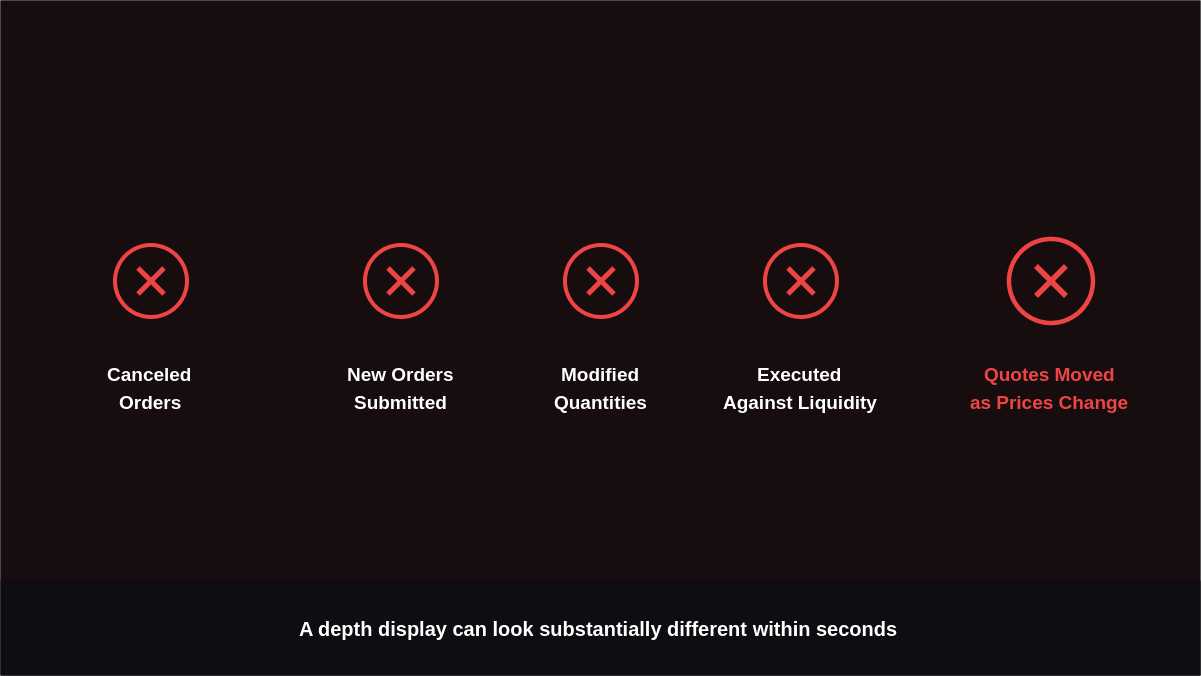
Visible orders should be treated as information about the current book, not a guarantee of future trading activity.
Market Depth can change because participants:
- Cancel existing orders
- Submit new orders
- Modify order quantities
- Execute against available liquidity
- Move their quotes as prices change
Rapid changes can make a depth display look substantially different within seconds. Traders therefore need to consider the timing of the information rather than assuming that every displayed order will eventually transact.
A Practical Way to Read Market Depth Before an Order
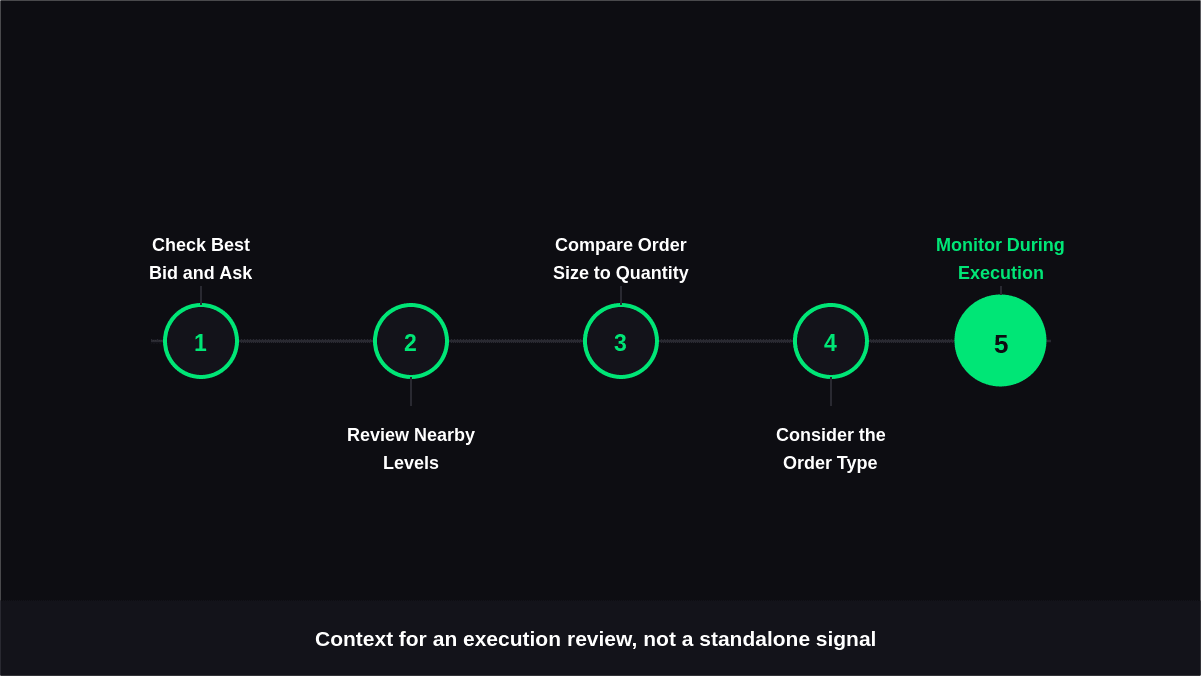
Market Depth can be incorporated into an execution review without relying on it as a standalone trading signal.
Step 1: Check the Best Bid and Ask
Identify the current prices where buyers and sellers are willing to transact.
Step 2: Review Nearby Levels
Look beyond the best prices to see how much visible quantity exists around the current market.
Step 3: Compare Order Size With Available Quantity
Consider whether the intended order is small or large relative to the visible liquidity.
Step 4: Consider the Order Type
A market order and a limit order can interact with the book differently, so execution expectations should reflect the selected order type.
Step 5: Monitor Conditions During Execution
Fast-moving markets can change the available quantities while an order is being processed.
Does Market Depth Predict Where Prices Will Go?
Market Depth describes visible orders rather than providing a guaranteed forecast of future prices.
A large quantity at one price may indicate substantial displayed interest, but that interest can change or disappear. Similarly, a thin area of the book does not necessarily mean price will move through it.
For this reason, Market Depth is better understood as execution and liquidity information rather than a standalone prediction tool.
Conclusion
Market Depth gives traders a more detailed view of available orders surrounding the current market. By examining visible liquidity, order size, and different price levels, traders can better understand how an order may interact with the book during execution.
It can also help explain why the final execution price may differ from the first displayed quote.
At the same time, Market Depth is dynamic rather than permanent. Orders can disappear or change, and visible liquidity does not represent every possible source of market activity.
Used alongside an understanding of order types, liquidity, volume profile, and trade execution, it can provide useful context for evaluating how orders may be filled.