A Closing Auction is a trading mechanism used by many financial markets to determine an official closing price for a security.
Instead of allowing the final traded price to be determined solely by the last individual transaction, the auction brings together eligible buy and sell orders and uses them to establish a price where the available supply and demand can be matched.
The mechanism is particularly important near the end of a trading session because substantial trading activity can occur around the close.
Investors, funds, and other market participants may need to execute orders at or near the official closing price, making the process an important part of daily market structure.
In this blog we will explore what a closing auction means, why exchanges use it, and how orders move through the process.
What Is Meant by Closing Auction?
A closing auction is a scheduled market mechanism in which eligible orders are collected and evaluated to determine a single price for the end of a trading session.
Unlike continuous trading, where orders can be matched throughout the session as buyers and sellers interact, an auction temporarily brings relevant orders together.
The exchange then applies its matching rules to determine the price that can generally execute the greatest amount of available trading interest, depending on the Market Orders vs Limit Orders submitted by participants.
The exact timing, eligible order types, and matching rules vary between exchanges and markets. Therefore, traders should always check the specific exchange's rulebook before assuming that every closing auction operates in exactly the same way.
Closing Auction vs. Continuous Trading
The main difference lies in how orders are brought together and how prices are formed. Continuous trading allows eligible orders to execute throughout the session, whereas a closing auction concentrates order activity into a defined period near the market close.
This distinction also affects how traders interpret the final price, since the closing auction uses accumulated eligible orders rather than relying only on the last continuous trade.
| Feature | Continuous Trading | Closing Auction |
|---|---|---|
| Order matching | Takes place throughout the session | Concentrated around the scheduled close |
| Price formation | Changes as orders interact | A single auction price is calculated |
| Main purpose | Ongoing execution | Establishing the market's closing price |
| Order interaction | Immediate matching when conditions are met | Orders are collected before the final match |
| Market impact | Can vary throughout the session | Trading interest can become concentrated near the close |
The distinction matters because an order submitted during an auction may not behave in exactly the same way as one submitted during continuous trading.
7 Steps to Know How the Closing Auction Works
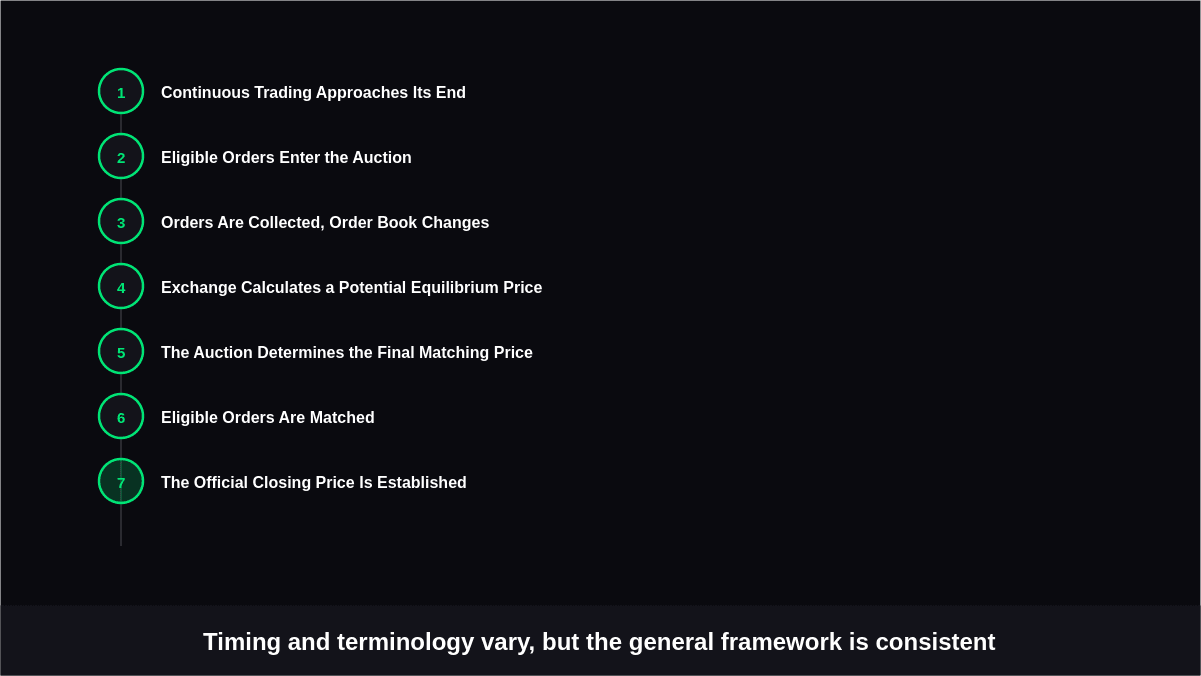
The closing auction process can be understood as a sequence of stages. While individual exchanges may use different terminology and timings, the general framework follows these seven steps.
1. Continuous Trading Approaches Its End
The normal trading session first moves toward its scheduled closing phase.
At this point, traders and investors may already have orders resting in the order book. Some participants may also decide to submit new orders because they want execution close to the market's official closing price.
Key points include:
- The continuous session has a defined ending time.
- Existing orders may become relevant to the auction.
- New auction-eligible orders can enter according to exchange rules.
- The transition time differs between markets.
2. Eligible Orders Enter the Auction
Once the closing auction phase begins, the exchange accepts orders that meet its eligibility requirements.
These can include buy and sell interest submitted specifically for the auction, along with certain orders carried from the preceding trading session.
Important considerations are:
- Not every order type is necessarily eligible.
- Exchanges can impose price or quantity restrictions.
- Participants can have different instructions for how their orders should behave.
- Order submission deadlines depend on the individual market.
This stage creates the pool of trading interest from which the auction price can be calculated.
3. Orders Are Collected and the Order Book Changes
During the auction period, eligible orders may continue to enter, change, or be canceled depending on the exchange's rules.
The visible order book can therefore provide information about potential buying and selling interest, but it does not necessarily represent the final outcome.
For example:
- A large buy order can affect the potential equilibrium price.
- Additional sell orders can change the available supply.
- Cancellations can alter the balance between buyers and sellers.
- The indicative price may move as the order book changes.
This stage is important because the eventual result depends on the collection of orders at the relevant cutoff.
4. The Exchange Calculates a Potential Equilibrium Price
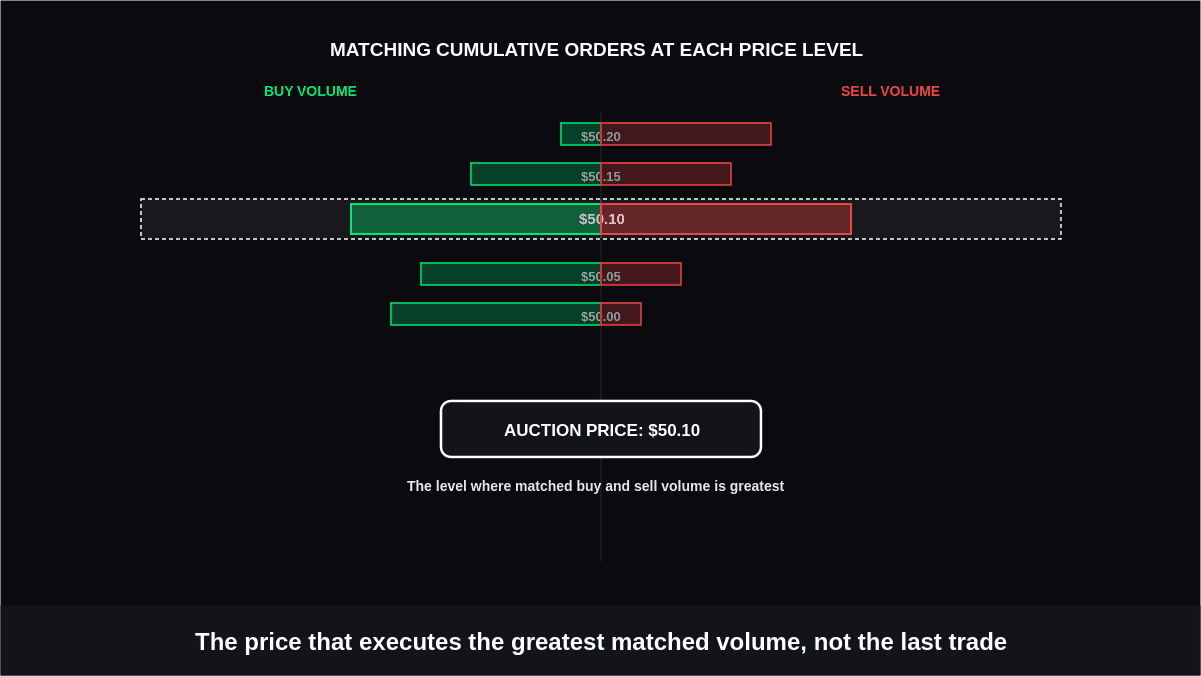
The exchange evaluates the eligible buy and sell orders to identify a price at which the auction can generate an appropriate match.
The calculation generally considers how much buying and selling interest could be executed at different prices.
A simplified example:
- Buyers are willing to purchase 10,000 shares at or above a particular price.
- Sellers are willing to sell 8,000 shares at or below that price.
- The exchange evaluates this and other available prices to determine the applicable auction price.
Actual exchange algorithms can involve additional tie-breaking criteria and specific rules.
5. The Auction Determines the Final Matching Price
After the relevant auction period ends, the exchange applies its published price-discovery methodology.
The selected price becomes the basis for matching executable orders. The objective is generally to establish a price that provides the greatest possible executable volume while following the exchange's rules.
Factors used by a particular exchange may include:
- Executable volume
- Remaining imbalance
- Price priority
- Time priority
- Reference prices
- Other exchange-specific tie-break conditions
This is why the closing auction price should not simply be assumed to equal the last continuously traded price.
6. Eligible Orders Are Matched
Once the auction price has been established, executable orders are matched according to the market's priority and allocation rules.
Not every order submitted to the auction will necessarily receive a fill.
An order can remain partially executed or completely unexecuted depending on factors such as:
- Available opposing liquidity
- Order price
- Order quantity
- Priority rules
- Auction eligibility
- Allocation methodology
Participants should therefore distinguish between submitting an order and actually receiving an execution.
7. The Official Closing Price Is Established
The final stage produces the market's official closing result according to the exchange's published methodology.
The resulting price can be used for several market and investment purposes, although its exact uses vary by market.
The closing result can influence:
- Daily performance calculations
- Portfolio valuation
- Index calculations
- Fund accounting
- Performance reporting
- Reference prices used in subsequent analysis
Once the auction concludes, the market may transition into a post-close phase or remain closed until the next trading session, depending on the exchange.
Why Does a Market Use a Closing Auction?
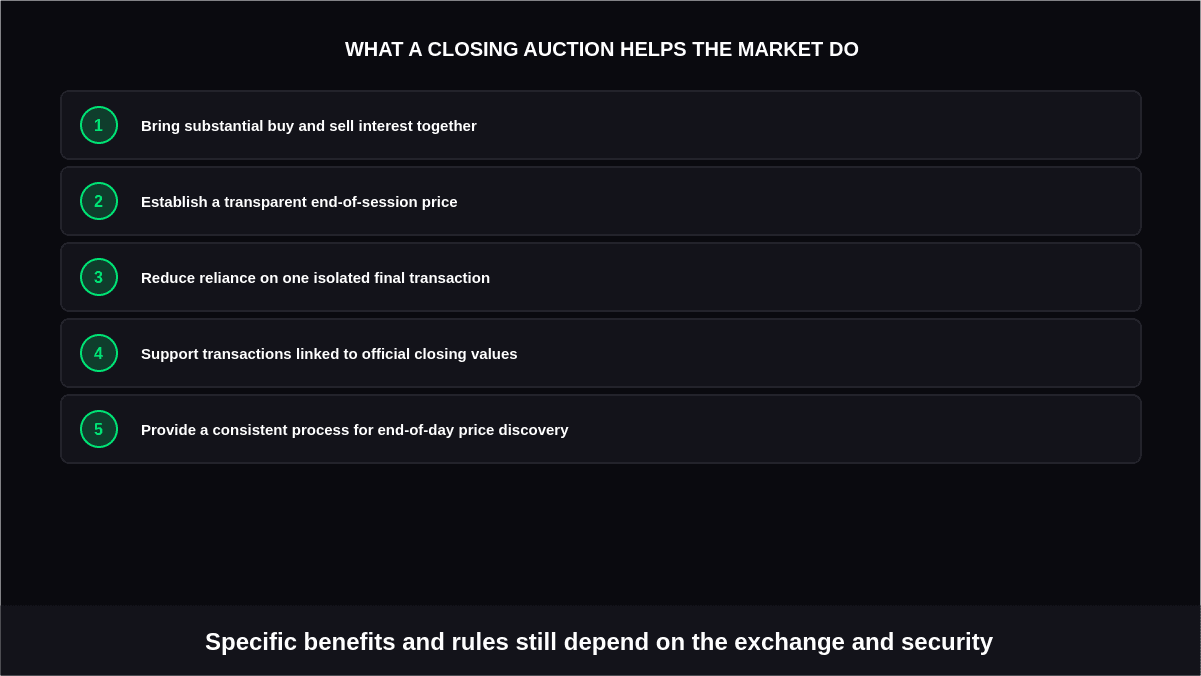
A closing auction can help concentrate liquidity and provide a structured method for establishing the end-of-day price.
This can be particularly relevant when many market participants want execution around the same time.
The mechanism can help the market:
- Bring substantial buy and sell interest together.
- Establish a transparent end-of-session price.
- Reduce reliance on one isolated final transaction.
- Support transactions linked to official closing values.
- Provide a consistent process for end-of-day price discovery.
However, the specific benefits and rules depend on the exchange and security being traded.
What Can Influence the Closing Auction Price?
Several factors can affect the eventual auction result because the price is derived from the eligible orders available at the relevant time.
These may include:
- The quantity of buy and sell orders.
- The prices specified by participants.
- New orders entered during the auction.
- Cancellations or modifications where permitted.
- Imbalances between supply and demand.
- Market-wide developments occurring near the close.
For this reason, the final price can differ from the price observed shortly before the auction begins.
What Traders Should Check Before Using a Closing Auction
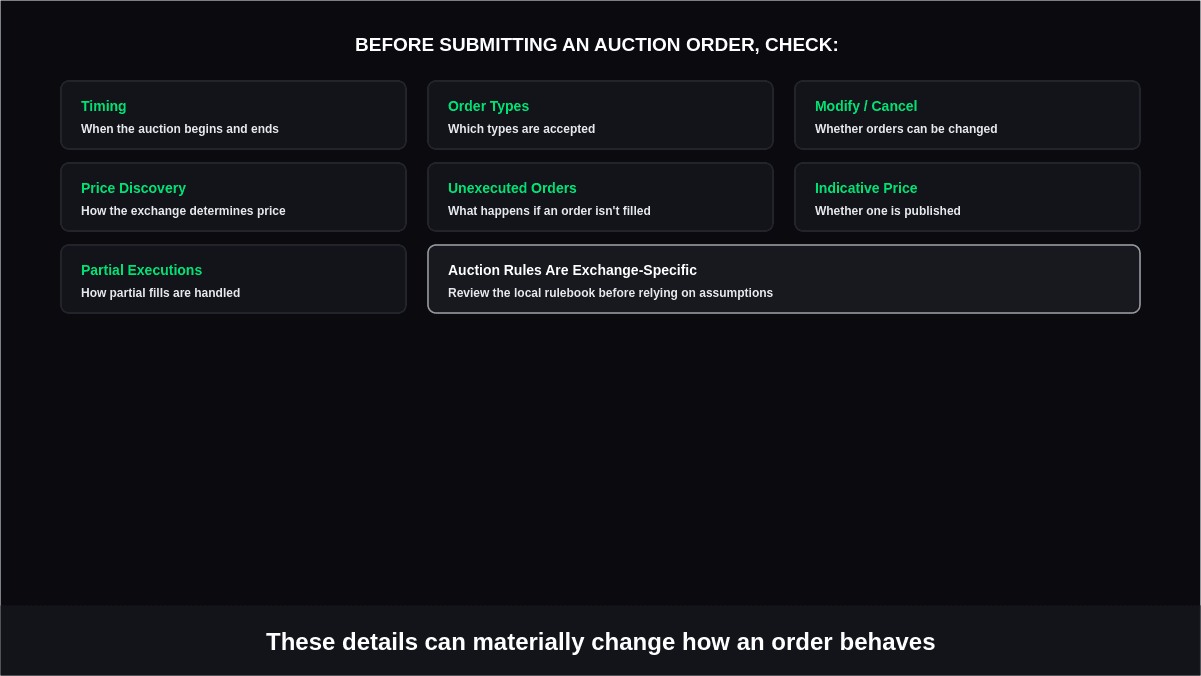
The mechanics of an auction are exchange-specific, so understanding the local rules is essential.
Before submitting an order, traders should check:
- When the auction begins and ends.
- Which order types are accepted.
- Whether orders can be modified or canceled.
- How the exchange determines the auction price.
- What happens to unexecuted orders?
- Whether an indicative price is published.
- How partial executions are handled.
These details can materially change how an order behaves.
Conclusion
A Closing Auction provides a structured way to bring buying and selling interest together and establish an official end-of-session price. Rather than relying entirely on the final transaction in continuous trading, the mechanism uses eligible orders and an exchange-defined price-discovery process.
Understanding the seven stages, from the end of continuous trading through order collection, price calculation, matching, and final publication, can help traders interpret what happens around the market close.
Because auction rules vary between exchanges, participants should always review the relevant market's specifications before placing an auction order and understand the principles behind Auction Market Theory.