Wondering what is algorithmic trading? It is a strategy that uses computer algorithms to make trading decisions based on preset conditions.There is no need to keep track of the markets and execute trades personally by the trader. The algorithms assist in analyzing the information about the markets and trading automatically.
The conditions that become the foundation of algorithmic trading may be the price, volume, timing, technical indicators or any other condition on the market. The aim is not only to automate the process of trading but to create an effective way of analysis and trading.
This approach is popular in the stock exchange, foreign exchange, futures, options and cryptocurrency markets. Algorithmic trading can differ from rather simple algorithms to quite complex ones handling a lot of information from the market.
How Algorithmic Trading Works
In simple terms, the algorithmic trading process involves the execution of a specific set of steps.
Collection of market data takes place: The system receives information such as prices, volumes, orders, or other information.
Evaluation of conditions is carried out: The algorithm determines if the current market conditions meet the preset conditions.
Trading decision making is done: In case the conditions are met, a decision for buying, selling, or holding is made by the system.
Order submission is done: The order is sent to a broker or to the exchange depending on the nature of the algorithmic trading system.
Monitoring of trades is possible: The system can monitor open positions and execute certain exit criteria that were preset.
For instance, the algorithm could be programmed to buy when the short-term moving average crosses above the long-term moving average, utilizing integrated TradingView indicators for precision.
The important point is that the computer follows the rules it has been given. It does not automatically understand whether those rules are sensible in every market environment.
Common Algorithmic Trading Strategies
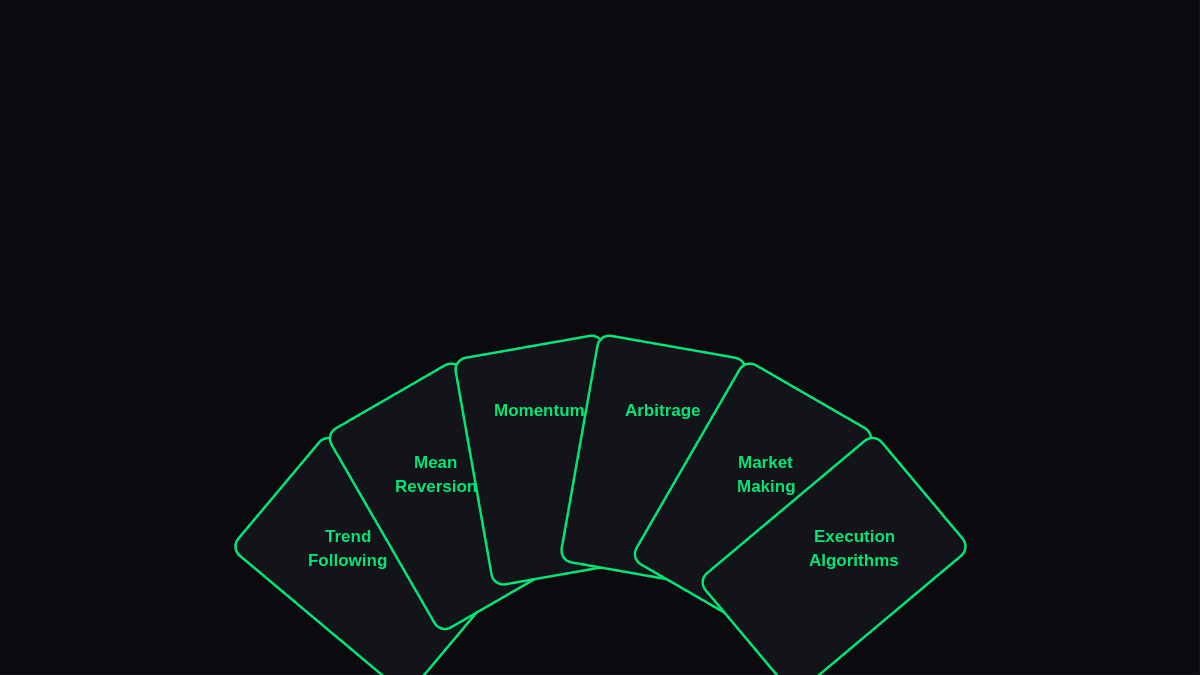
It is worth acknowledging that there is no one way of approaching algorithmic trading. This means that each strategy is developed based on certain objectives, certain time horizons, and certain market conditions.
Some of the most common algorithmic trading strategies include:
- Trend following - tries to find and trade in the direction of a trend that is already established.
- Mean reversion - looks to take advantage of price deviations from a mean value.
- Momentum trading - tries to join assets that have strong momentum.
- Arbitrage - tries to capitalize on any price difference in two identical or similar assets on various markets.
- Market making - tries to place buying and selling orders with the objective of increasing market liquidity.
- Execution algorithms - tries to execute a large order without impacting the market.
Strategy can be very simple or very complicated. Nevertheless, it should be noted that a complicated strategy is not necessarily a good strategy.
What Are the Benefits of Algorithmic Trading?
The fact that computers can execute predefined actions and process market information efficiently is one of the main reasons why traders prefer algorithms.
The following list summarizes some of the main algorithmic trading benefits:
- Speed: A computer can perform analysis and place orders more rapidly compared to a human performing those actions manually.
- Consistency: The system remains consistent in applying the rules regardless of any emotions that could affect a trader’s behavior.
- Automation: Trading actions that are repetitive can be automated.
- Backtesting: A strategy can be backtested based on historical data before being implemented with actual funds.
- Scalability: An automated system can track several markets or assets at the same time.
- Efficient execution: Some algorithms are able to split or schedule orders using execution rules.
While these factors can benefit the trading process, they cannot guarantee profits.
Algorithmic Trading vs. Manual Trading
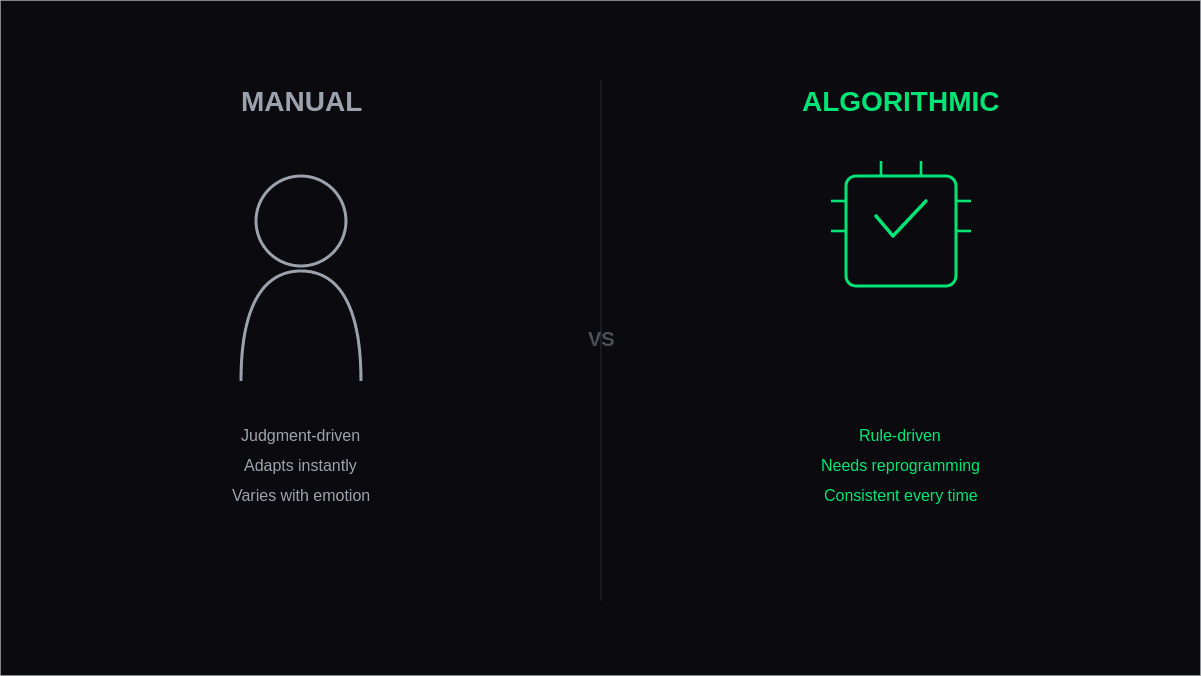
Manual trading depends heavily on a person's ability to analyze information, make decisions, and execute orders. Algorithmic trading shifts some or all of these tasks to a computer system.
| Factor | Manual Trading | Algorithmic Trading |
|---|---|---|
| Decision-making | Human judgment | Predefined rules or models |
| Execution | Manually placed | Automated or semi-automated |
| Speed | Depends on the trader | Usually much faster |
| Consistency | Can vary with emotions | Rules can be applied consistently |
| Backtesting | More difficult manually | Usually easier to automate |
| Flexibility | Easy to adapt immediately | Requires programmed changes |
Neither approach is automatically superior. The right choice depends on the trader's objectives, skills, resources, and risk tolerance.
What Are the Risks of Algorithmic Trading?
While automation can eliminate some of the mistakes made by humans, it comes with risks of its own.
An inefficient algorithm can continually make bad decisions quickly. Even if the strategy is working well in historical tests, it can underperform during times of changes in market dynamics.
Additional risks may include the following:
- Overfitting: A strategy can be fine-tuned excessively to historic data so that it works poorly on the new data.
- Technical issues: Software, hardware, connection to the Internet, and brokerage system can fail.
- Poor quality data: Incorrect or untimely market data can influence decisions.
- Unusual market behavior: The algorithm can perform differently during unusual market conditions.
- Price difference: The real price can be different from the expected price.
- Lack of adequate risk control measures: A system with no proper sizing of positions, stop orders or exposure can result in substantial losses.
For all these reasons, automation cannot serve as a replacement for risk management.
How to Build a Basic Algorithmic Trading System
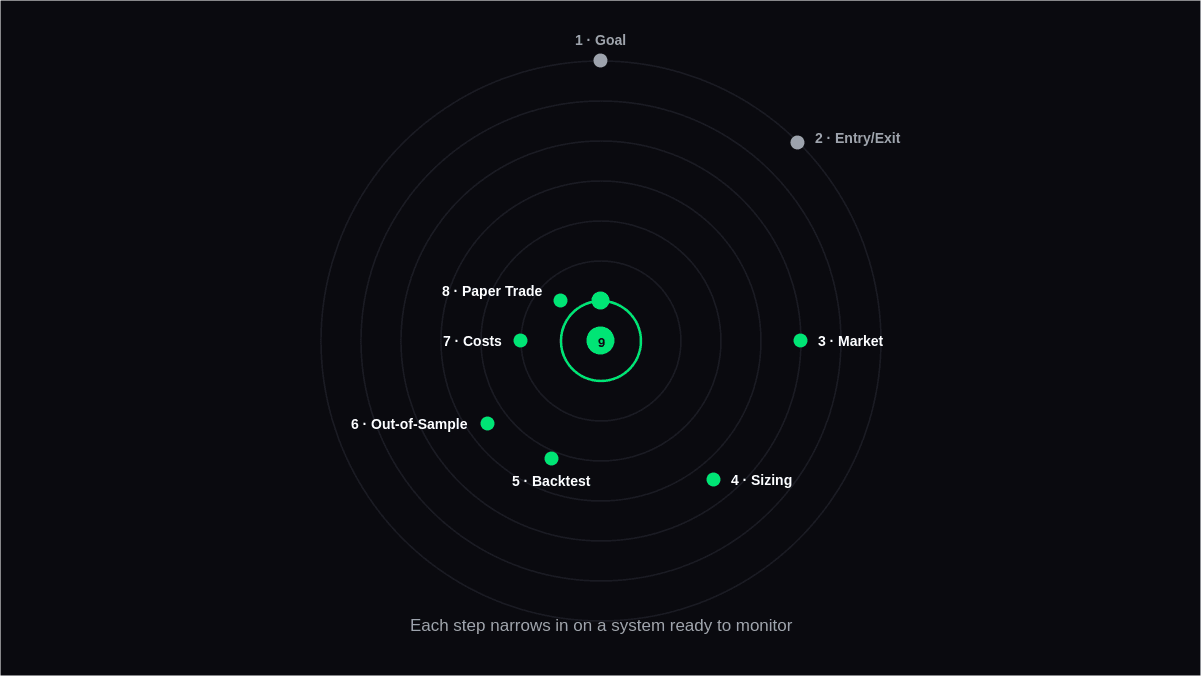
A good starting point for developing an effective system usually involves having a trading idea, not code.
- A practical development process is:
- Identify the goal of your trading.
- Set entry and exit conditions.
- Identify market and time frame.
- Identify position sizing and risk rules.
- Backtest the strategy using past data.
- Backtest the strategy on data not used in building the strategy.
- Calculate transaction costs and assumptions for the trading.
- Paper trade or test the system under controlled conditions.
- Keep track of its performance once it is deployed.
The most crucial part of the development process is the testing phase. A profitable backtest does not necessarily guarantee future profits.
Is Algorithmic Trading Suitable for Beginners?
Algorithmic trading can be learned by beginners; however, it is essential that they know the trading concepts first prior to automation.
Good places to start include:
- Basic market jargon
- Order types
- Risk management
- Technical analysis
- Quantitative analysis
- Basic programming knowledge
- Backtesting
- Costs and slippage
New traders should also understand the difference between a trading idea and a validated trading system. Writing code around an untested idea does not make the idea reliable.
Common Mistakes in Algorithmic Trading
New traders can make several mistakes when moving from manual trading to automation.
- Treating backtest results as guaranteed future returns
- Over-optimizing strategy parameters
- Ignoring transaction costs and slippage
- Using poor-quality historical data
- Building complicated systems without a clear purpose
- Failing to test the strategy outside the original dataset
- Neglecting technical and operational failures
- Using excessive risk because trades are automated
Conclusion
When it comes to what is algorithmic trading, it is important to remember that algorithms are systems based on certain rules, but not a formula for profitable trading itself. They can perform automated analysis and trading, cut down certain human mistakes, and help to test a particular trading strategy.
On the other hand, there is much more to automation than coding your trading rules. Testing, risk management, good-quality data, and regular monitoring are required for successful automation. An algorithm can enhance the trading process, but its effectiveness still relies on the strategy itself.
Frequently Asked Questions
1. Is algorithmic trading the same as automated trading?
However, there is some similarity between them, but they are not necessarily the same. In algorithmic trading, trading decisions are done based on programmed algorithms/models, whereas automated trading is a wider term for the automation of trading processes.
2. Can algorithmic trading be profitable?
It could be, although profitability is not assured. It all depends on the approach, market situation, quality of implementation, costs, and risk management. Past performance must never be considered a guarantee of future results.
3. Do you need programming skills for algorithmic trading?
Programming skills are handy, especially if you develop and test your own systems. Nonetheless, a trader may choose to work on available trading platforms that come with automated options.
4. What markets can use algorithmic trading?
The algorithmic system can be applied in different markets such as stock markets, foreign exchange markets, futures markets, options markets, and cryptocurrency markets among others.
5. Is algorithmic trading better than manual trading?
Not necessarily. Algorithmic trading provides rapid execution, consistency, and automation, while manual trading provides room for human discretion and understanding of information. Both have their strengths and weaknesses.