A Trading Plan is a written framework that defines how you will approach the market before placing a trade. It can outline your preferred markets, setups, entry conditions, risk limits, position management, and rules for reviewing performance.
Instead of making decisions from scratch during every market move, a plan gives you a consistent process to follow. This does not guarantee profitable trades, but it can make your decisions more structured and measurable, including how you define entry exit signals before entering a position.
A useful plan should be specific enough to guide your actions while remaining flexible enough to account for changing market conditions.
What Is a Trading Plan?
A Trading Plan is essentially a personal rulebook for executing and evaluating trades. It converts broad ideas such as “I want to trade trends” into defined conditions that can be observed and tested.
For example, rather than entering whenever a market appears bullish, a plan might require a particular trend condition, a confirmed setup, a predetermined entry point, and a defined maximum loss.
A complete plan typically answers questions such as:
- Which markets will you trade?
- Which timeframes fit your approach?
- What conditions create an entry?
- Where will you exit if the trade moves against you?
- How much capital can you risk?
- When will you take profits?
- What situations should prevent you from trading?
- How will you measure whether the approach is working?
The goal is not to predict every market movement. It is to establish a repeatable decision-making process.
Why Traders Need a Defined Process
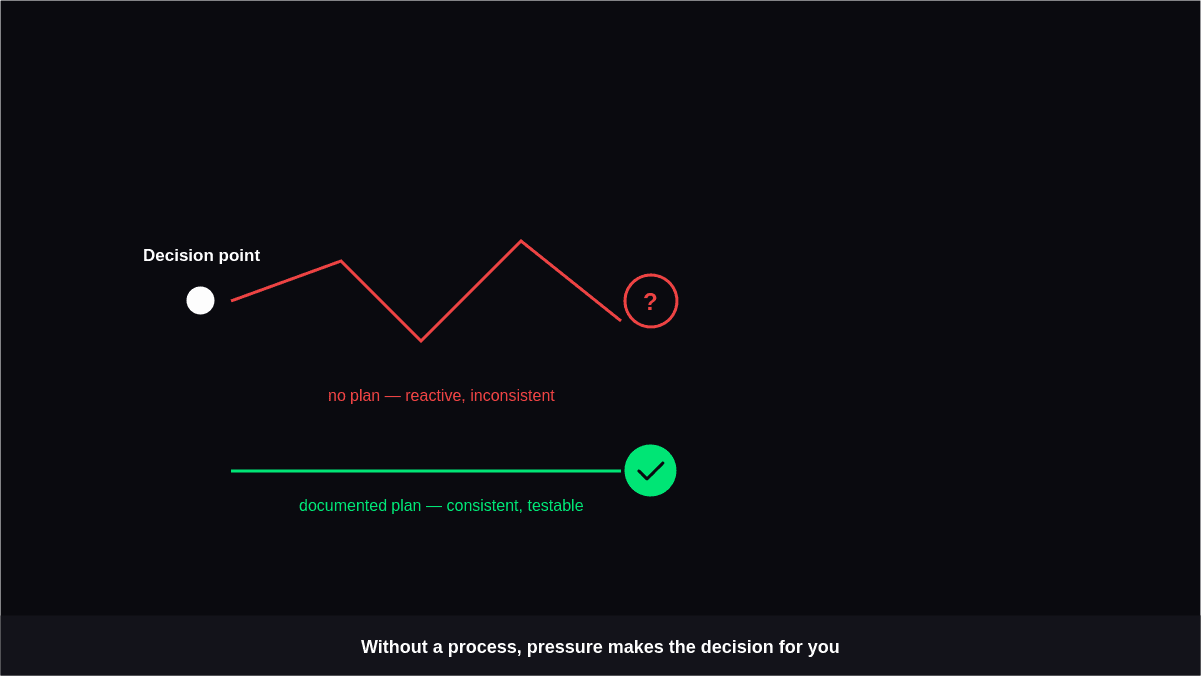
Markets can change quickly, and decisions made under pressure may be influenced by fear, excitement, or the desire to recover a previous loss. A documented process creates a reference point for those situations.
A plan can help you stay consistent by defining things such as:
- Entry conditions: What needs to happen before you consider entering a trade.
- Risk limits: How much capital you are willing to put at risk on a single position.
- Exit rules: The conditions for taking profit or closing a trade when the setup changes.
- Review process: What you will record and evaluate after each trade.
A plan can also make your results easier to analyze. If you change your entry method, position size, and exit rules from one trade to another, it becomes difficult to determine what actually contributed to the outcome.
Consistency creates cleaner data. Over a series of trades, you can examine whether your approach performs differently across:
- Different market conditions
- Different assets or markets
- Different timeframes
- Different entry and exit setups
This is where a trading strategy and a Trading Plan differ. A strategy describes how you identify potential opportunities, while the plan can cover the broader process surrounding those opportunities, including risk controls, execution, and review.
The Core Elements to Include
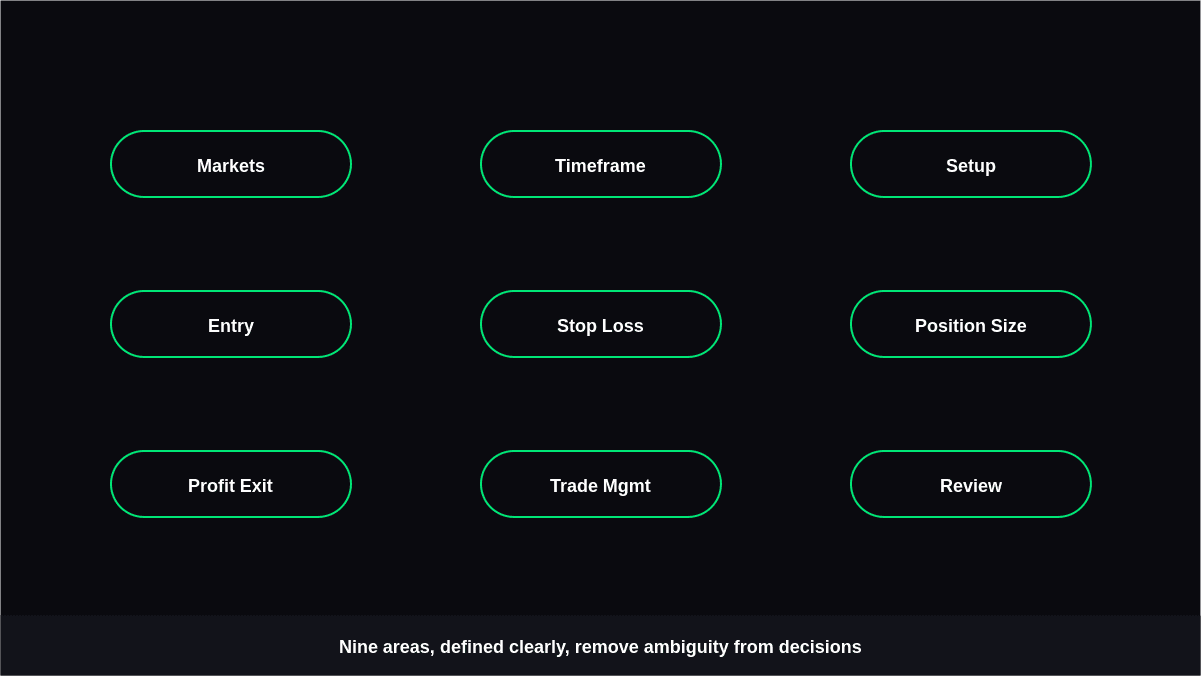
A useful plan does not need dozens of complicated rules. It needs enough detail to remove ambiguity from important decisions.
| Planning Area | What to Define | Example Question |
|---|---|---|
| Markets | Assets or instruments you trade | Which markets fit my approach? |
| Timeframe | Chart and holding period | Am I trading intraday or swing setups? |
| Setup | Conditions required before entry | What must happen before I consider a trade? |
| Entry | Specific trigger | What confirms the entry? |
| Stop Loss | Maximum acceptable trade loss | Where is the trade idea invalidated? |
| Position Size | Amount committed to each trade | How much capital should this setup use? |
| Profit Exit | Conditions for closing a winning trade | What determines my target or exit? |
| Trade Management | Performance evaluation | What information will I record afterward? |
This framework helps separate decision criteria from assumptions. If a rule cannot be clearly described, it may be difficult to test or follow consistently.
5 Steps to Build a Proper Trading Plan

Building a Trading Plan involves more than writing down an entry signal. You need to define how you identify opportunities, control risk, manage open positions, and evaluate your decisions afterward.
The five steps below turn those areas into a practical framework that you can document and refine over time.
1. Define Your Trading Goals and Market Focus
Start by deciding what type of trading you want your plan to support. Your preferred holding period, available time, and markets can all influence how the rest of the plan should be structured.
Avoid trying to create rules for every possible market or trading style at once. A narrower focus can make your initial framework easier to understand and evaluate.
Your plan can define:
- Markets or instruments you intend to trade
- Preferred trading sessions
- Typical holding period
- Timeframes used for analysis and execution
- Amount of time available for monitoring trades
These choices create the boundaries within which your other trading decisions will operate.
2. Define Your Entry and Exit Conditions
Your next step is to establish exactly what needs to happen before you open a position. Entry conditions should be based on observable information rather than subjective impressions about where the market might go.
Consider which combination of price structure, momentum, volatility, volume, support and resistance, or other signals forms a valid setup.
Your entry and exit rules can address:
- Conditions required before entering
- Specific confirmation signals
- The point at which the setup becomes invalid
- Planned profit-taking conditions
- Situations that require an early exit
Separating these conditions makes it easier to distinguish between a planned trade and an impulsive decision.
3. Establish Risk Rules Before Choosing Position Size
Risk management should be determined before deciding how much capital to place into an individual position. The amount you trade should follow your predefined risk limits rather than being based on how confident you feel about a setup.
Position size can then be calculated according to factors such as your acceptable loss and the distance to your invalidation point.
Your risk section can include:
- Maximum risk per trade
- Position-sizing method
- Stop-loss rules
- Maximum number of open positions
- Maximum daily or weekly loss
- Leverage or exposure limits
Defining these boundaries in advance can prevent a single position from having an outsized effect on your overall trading results.
4. Decide When to Trade and When to Stay Out
A complete plan should explain not only when a trade qualifies but also when you should avoid entering one. Markets may present situations that do not fit your chosen approach, even when they appear attractive at first glance.
Create specific conditions that tell you when remaining on the sidelines is the appropriate action.
These conditions might include:
- Trading outside your preferred market hours
- Entering when liquidity is unusually low
- Taking setups that fail one or more required conditions
- Trading immediately before events that could significantly affect price
- Entering a position when you cannot properly monitor it
Having clear no-trade rules can reduce the temptation to force opportunities that do not match your predefined setup.
5. Record, Test, and Review Your Decisions
The final step is to create a system for evaluating whether your plan is being followed and where it may need refinement. Keeping a trading journal gives you a record that can be reviewed instead of relying on memory.
Your journal can track:
- Date, asset, and timeframe
- Entry and exit prices
- Position size and planned risk
- Setup and reason for entering
- Reason for exiting
- Whether each rule was followed
- Financial outcome
- Relevant market conditions
- Screenshot of the trade
Review the results over a meaningful sample rather than changing the plan after an isolated loss. Historical testing, paper trading, and live trade records can provide different forms of evidence about how your rules behave.
Turn Your Rules Into an Execution Checklist
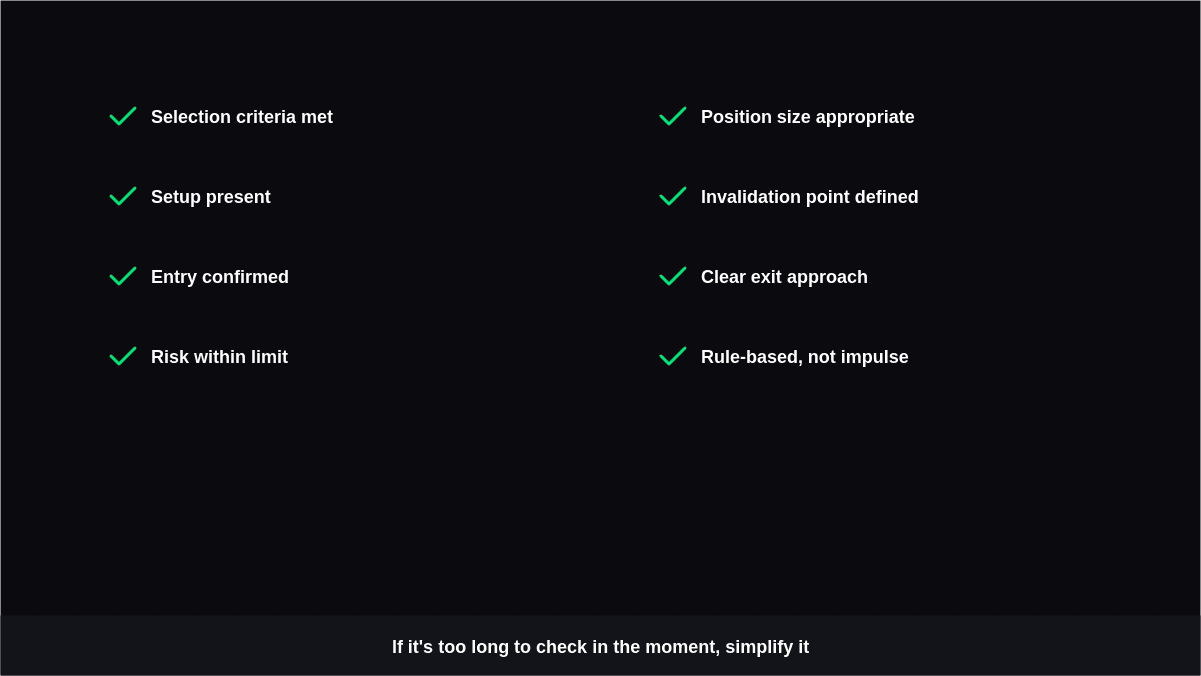
Once the plan is developed, reduce the most important rules into a short checklist.
Before entering, you might verify:
- Does the market meet my selection criteria?
- Is the required setup present?
- Has my entry condition been confirmed?
- Is the planned risk within my limit?
- Is the position size appropriate?
- Is the invalidation point defined?
- Is there a clear exit approach?
- Am I entering because of my rules rather than an impulse?
The checklist should be practical enough to use during actual market conditions. If it becomes so long that you cannot realistically follow it, simplify it.
Common Mistakes When Creating a Trading Plan
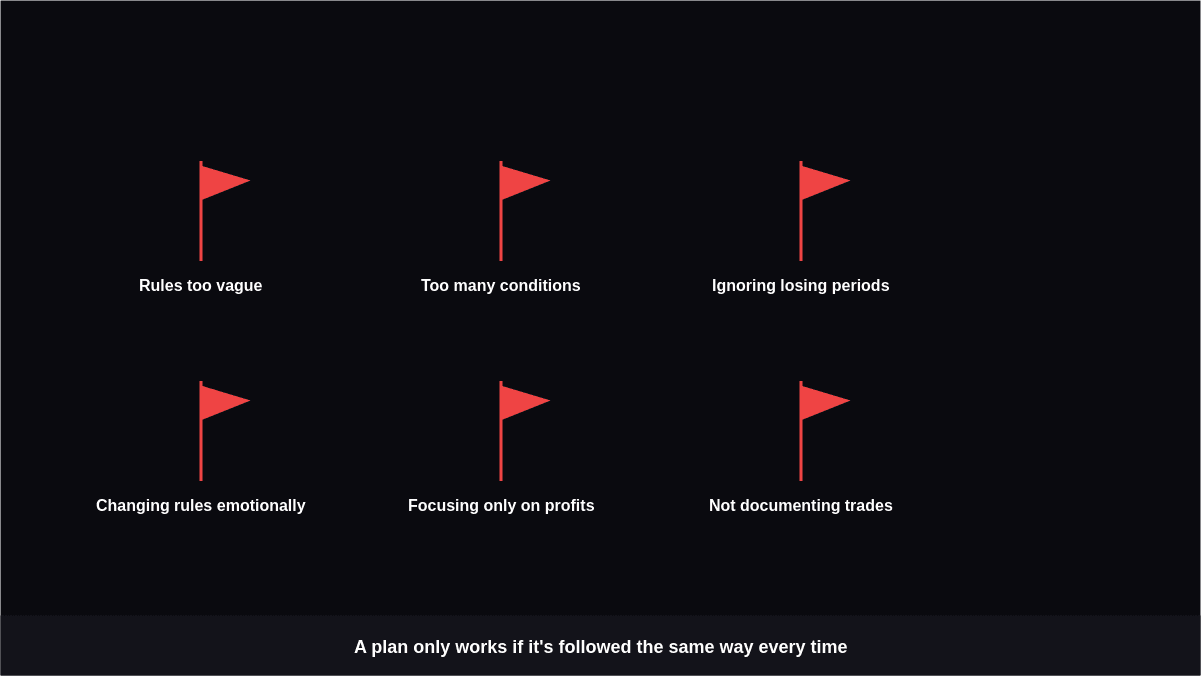
Even a well-structured Trading Plan can become ineffective when its rules are unclear, overly complicated, or applied inconsistently. Avoiding common planning mistakes can make the framework easier to follow and review.
- Making rules too vague
- Adding too many conditions
- Ignoring losing periods
- Changing rules emotionally
- Focusing only on profits
- Failing to document trades
Conclusion
A Trading Plan gives traders a structured way to make decisions before, during, and after a position is opened. The most useful plans define specific setups, entry and exit conditions, risk limits, position-sizing rules, no-trade situations, and review procedures. Building one does not remove uncertainty from financial markets, but it can make your process more consistent and easier to evaluate.
Start with a manageable set of rules, document your trades, study the results, and refine the framework when the evidence supports a change. The objective is to create a process you can understand, test, and consistently execute while you validate trading strategies.