In this modern era larger volumes of data and computational power are available to traders now than ever before, but having access to more data does not automatically mean that traders have better strategies for trading. The point is to understand what changes actually bring additional value and what changes help them improve their past performance.
Applying artificial intelligence (AI) for trading strategy optimization helps traders to analyze datasets, identify useful patterns, adjust parameters, and build up strategies in a much more efficient way. Traders can optimize trading strategies with AI by using it to support different stages of the strategy development process while still applying appropriate validation methods.
AI may come in handy during the whole process of trading strategy optimization starting from feature selection and going up to evaluating non-repainting buy sell signals, signal analysis, backtesting, and performance monitoring. However, using AI does not mean that trading becomes any less risky business.
This article will help you explore how to apply AI trading strategy optimization and backtesting.
What Does It Mean to Optimize Trading Strategies with AI?
The process to optimize trading strategies with AI employs computing power to evaluate and optimize the components of the trading system. Instead of testing all possible combinations manually, it is possible for AI technology to make analysis from big data and discover links between variables such as price, volume, momentum, volatility, and market conditions.
It allows the trader to find out what variables make a difference, which parameters are fixed, and whether the strategy works under various market circumstances by means of analysis such as directional dependence analysis.
Where AI Can Help
AI may be helpful in different aspects of the strategy development process, ranging from searching for the relevant inputs to testing the system performance in different scenarios. The main point here is that AI should be used as a research tool in order to ensure transparency, control and measurability.
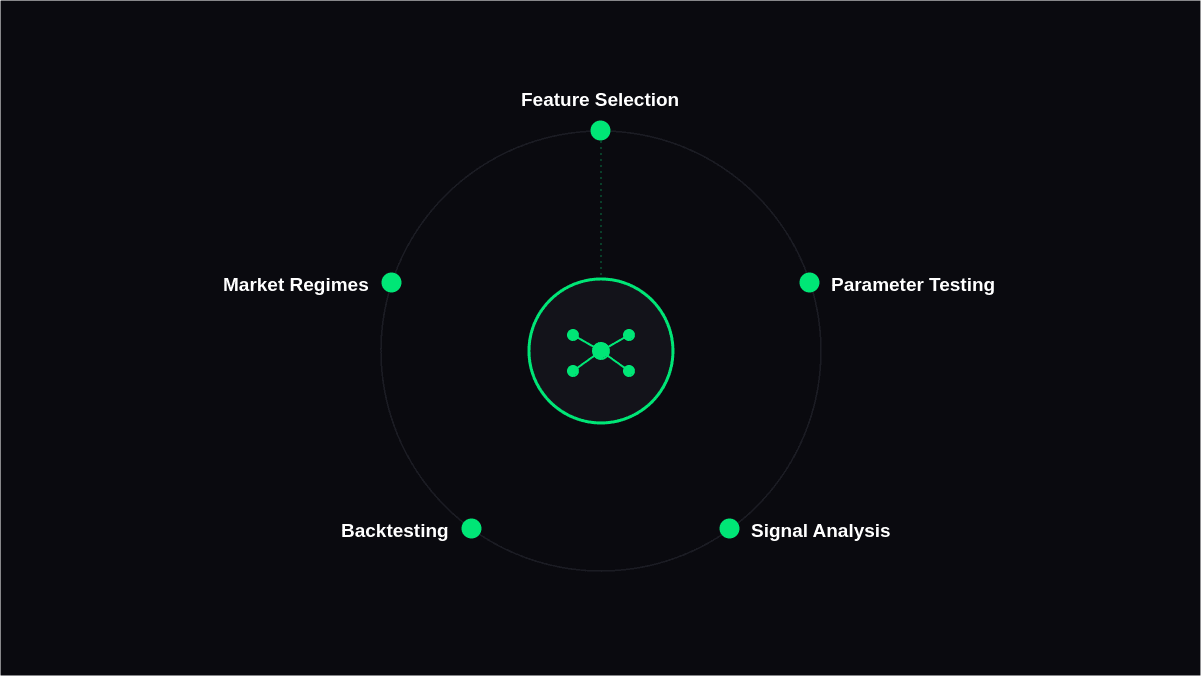
Combining AI strategy research with smart algorithmic trading indicators helps traders eliminate market clutter while maintaining clarity in signal generation.
| Area | How AI Helps | What to Watch |
|---|---|---|
| Feature selection | Identifies potentially useful variables | Too many features can cause overfitting |
| Parameter testing | Compares different strategy settings | Extreme settings may fit historical noise |
| Market regimes | Finds patterns across market conditions | Historical regimes may not repeat |
| Signal analysis | Evaluates relationships between inputs and outcomes | Correlation does not guarantee future performance |
| Backtesting | Tests large numbers of configurations | Excessive testing increases false discoveries |
The idea is not to find the configuration that historically demonstrates the best performance. It might be more appropriate to look for the configuration that would perform sufficiently in different scenarios.
A Practical AI Optimization Process
A proper practical AI optimization process can assist the trader in improving their trading rather than entirely doing it manually and getting into loss. The function of each and every step should be defined from setting the goal of the trading strategy to testing it.
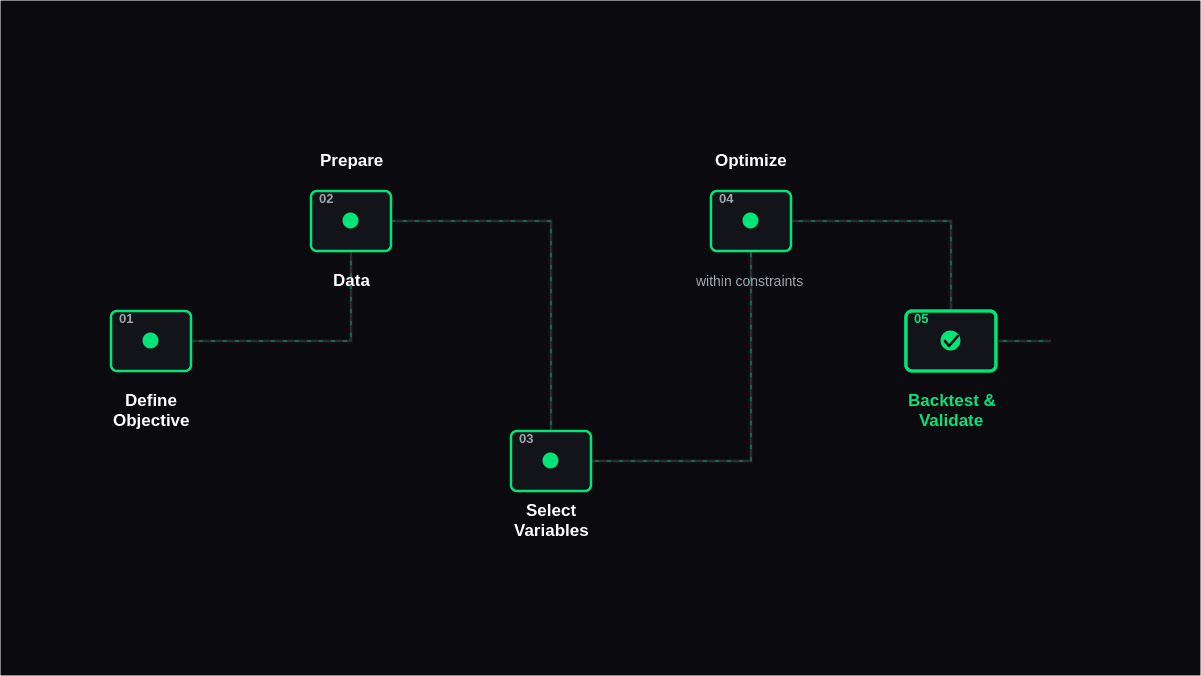
Below you will find the steps to follow:
1. Define the Objective
To begin with, define what needs to be accomplished with this strategy. It may include trend capture, drawdown reduction, increased consistency, or portfolio management.
Having a specific goal will save the optimization process from turning into a hunt for the best-looking backtest.
2. Prepare Reliable Data
Machine learning algorithms require good quality data. The historical data needs to be validated for missing values, duplicate entries, inaccurate timestamps, and other discrepancies.
Realistic elements like transaction costs, spread, commission, and trade execution need to be considered while conducting backtest.
3. Select Relevant Variables
Features that make sense to a particular strategy need to be included. For instance, a momentum strategy can help you analyze past returns, strength of trend, volatility, and volume.
Adding additional parameters will not necessarily enhance the model.
4. Optimize Within Constraints
Evaluate the strategy using more than total return. After optimization, test it against unseen data to determine whether the results hold outside the development sample.
Walk-forward testing can provide an additional layer of validation by repeatedly optimizing on one period and testing on the following period.
5. Backtest and Validate
Evaluate the indicator using past data under various market conditions. Consider realistic commissions, spreads, and slippages when doing your assessment.
Perform back-testing of the strategy on new data to verify its robustness beyond the initial sample. Do not focus only on a single successful time period.
Optimization Methods Compared
Different ways of optimization provide varying degrees of speed, flexibility, and control. Selection of an appropriate tool will be determined by the type of strategy, data set, and complexity.
Here you will find different optimization methods comparison:
| Method | Main Advantage | Main Limitation |
|---|---|---|
| Manual testing | Easy to understand | Time-consuming |
| Systematic search | Reproducible | Can involve excessive testing |
| AI optimization | Handles complex relationships | Higher overfitting risk |
| Walk-forward testing | Tests performance across periods | Requires more computation |
Avoid Overfitting During AI Optimization
Overfitting can be a serious problem when you optimize trading strategies with AI.
An algorithm can become too fitted to the past data points, which would lead to poor results once new data points appear. This will certainly happen when the researchers continue to change the indicators, parameters, and models using the same set of data history, thereby accelerating the strategy edge decay.
To prevent overfitting:
- Train and test data should be separated
- Minimize unnecessary variables
- Prevent unnecessary parameter testing
- Perform out-of-sample testing
- Consider various market scenarios
- Keep track of all experiments
How AI Backtesting Can Improve Strategy Research
AIBacktesting trading strategies would be useful for researchers in their analysis of a larger number of configurations.
For instance, an AI-assisted method could investigate the behavior of a signal in various volatility conditions, holding times, or market states. This could reveal some flaws that may go unnoticed in a regular backtest.
Nevertheless, automation increases the possibility of making unnecessary tests. Conducting hundreds of iterations may make the occurrence of impressive statistical results more likely, yet only because they happen to coincide with past noise.
The documentation of hypotheses, experiments, parameters, and validations would keep researchers on track.
Risk Management Should Be Part of Optimization
The success of a trading strategy cannot be determined based on just entry signals.
Position sizing, risk per trade, and stop-loss can greatly impact the actual performance of the system. The optimization of a system that solely depends on entry and exit signals will give a flawed result.
Take for instance two trading systems that give the same profit but have distinct drawdowns. The system with a lower drawdown can be considered more practical even though it has a lower rate of return.
Risk management is therefore an important component of the trading system.
Algorithmic Trading Optimization: What Should You Measure?
Algorithmic trading optimization needs to concentrate on a number of performance and robustness measures, rather than a single headline statistic.
Think about measuring the following:
- Return: How much capital did the algorithm make or lose?
- Drawdown: How big were the historical losses?
- Risk/return ratio: Is the return commensurate with the risk assumed?
- Consistency: Is performance dependent on a brief period?
- Number of trades: Is the performance achieved through many trades or few exceptional trades?
- Parameter sensitivity: Is the performance still acceptable with a slight change?
- Out of sample performance: Is there anything left of the performance of the algorithm on unseen data?
Taking into account all these measures will give you a more objective assessment of the strategy.
Common Mistakes When Using AI for Strategy Optimization
By avoiding the following mistakes, you can make the most use of AI for strategy optimisation:
- Optimization for maximum profits: While maximizing historical profit, one may overlook the high drawdown level.
- Using too many variables: Too many variables can complicate the analysis without offering any new predictive value.
- Forgetting about transaction costs: A profitable strategy before cost considerations will not necessarily remain profitable afterwards.
- Experimentation on the same sample: Excessive experimentation can make all of historical data a subject of optimization.
- Faith in model complexity: More sophisticated artificial intelligence is not necessarily more accurate.
- Human oversight error: Statistical success should be supplemented by human comprehension of the market and strategy.
Final Thoughts
AI can accelerate strategy development, but time does not necessarily lead to better outcomes. The true value will come when AI is used for testing theories, evaluating patterns, comparing parameters, and finding weaknesses, while not letting history rule the strategy entirely.
An effective process involves reliable data, optimization, realistic assumptions, and out-of-sample testing. The purpose to optimize trading strategies with AI is not to create a fancy strategy but a robust one.
Frequently Asked Questions
1. Can AI automatically optimize a trading strategy?
AI can be used for automated feature selection, parameter optimization, model development, and performance analysis. The trader must decide on the goals, limitations, risks, and verification methods.
2. What data is needed for AI strategy optimization?
Depending on the system chosen, data such as past prices, volumes, volatility, technical indicators, and regime data could be helpful. Quality data is important.
3. How can AI optimization avoid overfitting?
Do not use the same dataset for training and testing. Keep the system from becoming overly complicated. Set proper parameters.
4. Is AI better than traditional strategy optimization?
Not necessarily. AI is good at dealing with complicated connections, but sometimes a simpler approach is more transparent and verifiable.
5. Should profitability be the main optimization goal?
No. In addition to drawdown and consistency, profitability needs to be taken into account.