Trading psychology is the psychological aspect of trading. It determines the way traders interpret the information, react to profits and losses, deal with uncertainties, and make decisions under financial pressure. However, a trading strategy provides the conditions for taking and managing a trade.
Fear, thrill, frustration, self-confidence, and uncertainties are typical responses to the risks of trading. The idea is to acknowledge those emotions and learn to act accordingly.
In this guide, you will find the key psychological aspects of trading, the methods of coping with them, ways of forming your trading psychology system, the importance of risk management, and how to track your progress in this area.
Quick Answer
Trading psychology is the mixture of thoughts, feelings, and behaviors that affect decision-making while trading. Trading psychology can be improved through the identification of one’s triggers, setting behavior guidelines, managing risks in terms of money, and analyzing one’s trading behavior.
What Is Trading Psychology?
The concept of trading psychology relates to the mental activities and behavior of traders in relation to decision-making.
It consists of three core components:
- Thoughts: How traders perceive price action and market information.
- Feelings: Emotions like fear, excitement, frustration, confidence, and uncertainty.
- Behavior: Behavior is driven by thoughts and feelings.
For instance, a trader could perceive a sharp fall in prices and interpret that the position will definitely fail. This perception may instill fear in the trader, making him/her exit the position despite the fact that everything is still the same.
Trading Psychology vs. Trading Strategy
The trading strategy specifies the criteria for making a trade, which could be anything from the setup, the entry, the exit, the target, the stop loss, and the invalidation point.
The psychology of trading refers to the psychological issues involved in making those decisions.
This means that even when there is a perfect technical trading strategy, poor trading psychology could lead to poor trading execution.
Why Trading Psychology Matters
Trading is a risky business. Trading in accordance with all requirements of a trading strategy may be unprofitable.
It implies that the quality of a trading decision should not be assessed solely on the basis of financial results.
A trade resulting in losses despite compliance with all aspects of the strategy might be properly carried out, while a trade resulting in profits without adherence to the strategy might have generated profits accidentally.
Assessment of decisions according to the process allows traders to identify situations where losses were the consequence of regular market behavior and those cases when there was something wrong with execution.
The issue becomes important in the context of performance review as constant alteration of strategies after every unsuccessful deal hampers assessment of efficiency of the strategy itself.
Common Psychological Challenges in Trading
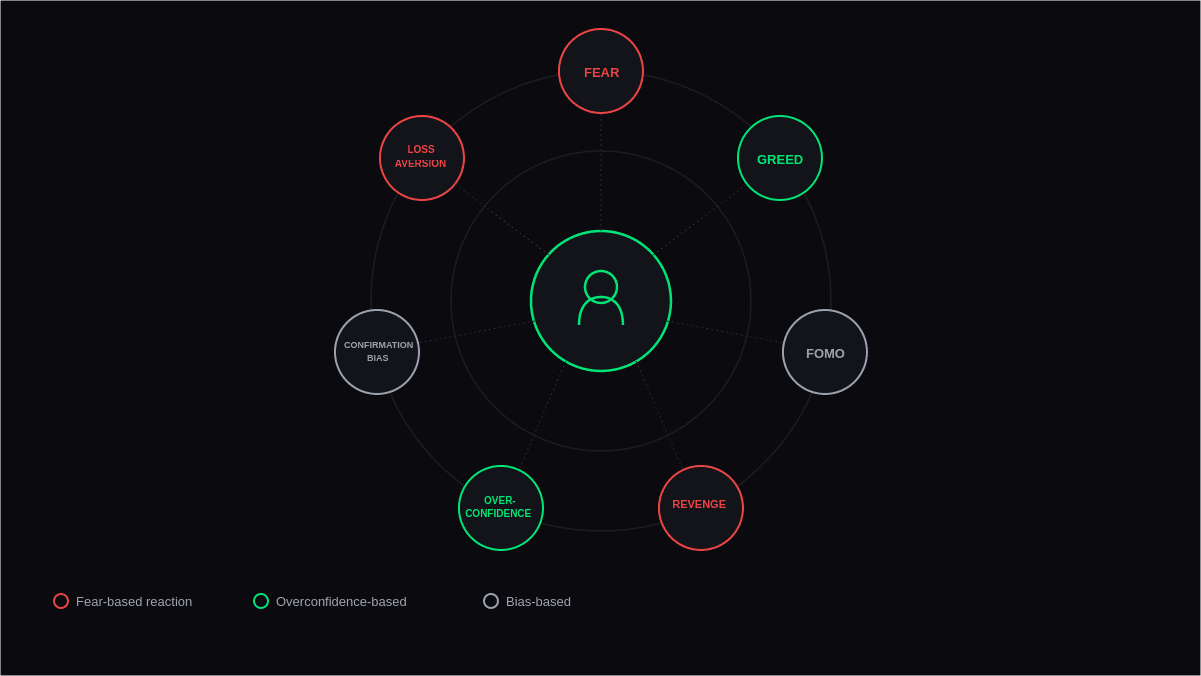
Different emotional and cognitive patterns can influence trading behavior.
Fear
Fear makes one hesitate before executing a valid trade or makes one exit the position before time.
In such cases, the trader is so afraid of losing money that he is not concerned with the analysis of trade as per the preconditions set.
Greed
Greed can make a person want to earn beyond the set trading limits.
This will be seen in making unnecessary trades, earning more profit, or changing the position without any specific reason.
FOMO
Fear of missing out is when a trader feels compelled to join a price movement since it is happening.
Here the fear of missing out is more than the normal analysis of the setup.
Revenge Trading
Revenge trading is where one executes a trade to get back his loss made in the earlier trade.
Here the intention is not to get a good opportunity but to get back the money lost previously.
Overconfidence
Overconfidence comes when one executes many trades successfully.
One gets so much confidence about his trading and gets ready for anything that is considered riskier or unnecessary normally.
Confirmation Bias
Confirmation bias is the phenomenon where a trader tends to give more importance to those pieces of information which support his/her existing market view rather than those which contradict it.
This can sometimes make it difficult to understand whether or not the logic underlying the trade has become weak.
Loss Aversion
Loss aversion refers to the notion that losses have more psychological importance than equivalent gains.
Trading Psychology Strategies for Common Challenges
The most useful trading psychology strategies turn common emotional challenges into specific actions and predefined rules.
| Psychological Challenge | Practical Strategy |
|---|---|
| Fear | Decide the trade conditions, invalidation point, and planned exit before entering. This reduces the need to make major decisions during rapid price movements. |
| Greed | Define in advance when exposure or trade objectives can be adjusted. Avoid increasing position size or extending a trade simply because price is moving favorably. |
| FOMO | Accept that some trades will be missed. If price has moved beyond the planned entry, avoid changing your criteria just to participate. |
| Revenge Trading | Create a mandatory pause after a loss that triggers an urge to recover money. Set the pause using a specific time period, trade limit, or other predefined condition. |
| Overconfidence | Apply the same evaluation standards after winning streaks. Do not assume recent success makes future outcomes easier to predict. |
| Confirmation Biase | Examine evidence that challenges your trade idea before entering. Identify what circumstances would invalidate your original thesis. |
| Loss Avertion | Define exit conditions before opening a position. An objective exit rule provides a reference point when the trade moves against expectations. |
How to Build a Trading Psychology Plan
Trading psychology is about setting yourself a plan in order to know how to react prior to any emotion affecting your trading decisions. Rather than having rules for all sorts of situations, it would be better to identify those situations which have already led you astray.
1. Identify Your Personal Triggers
Review your previous trades and look for situations that repeatedly affected your decisions.
Common triggers include:
- Several consecutive losses
- Missing a potential entry
- Rapid market movements
- Large unrealized gains
- Unexpected news
- Pressure to recover losses
- Opinions from other traders
- Unusual market conditions
2. Decide How You Will Respond
As soon as you pinpoint your main triggers, define a certain reaction for each trigger.
For instance, you may choose to stop trading after exceeding a certain losing level per day, move on to another setup when you miss an entry, or refrain from entering when the setup doesn’t fit your requirements.
What matters most is that you make these decisions prior to the trigger happening.
3. Define When You Will Not Trade
Your plan should also include situations where staying out of the market is the appropriate decision.
These may include:
- No qualifying setup
- Market conditions outside your strategy
- Trading outside your planned hours
- Daily trading limit reached
- Difficulty concentrating
- Inability to follow your trading process
Having clear conditions for not trading can prevent emotional decisions from turning into unnecessary positions.
4. Review the Plan Regularly
Find recurring behavioral patterns using your trading journal and determine whether your rules are effective.
If a rule does not work to solve the problem, change it accordingly but do not alter it right after a win or loss.
A solid plan for trading psychology should be easy enough to implement even in tough market times and adaptable enough to evolve as you learn more about your trading behaviors.
The Role of Risk Management in Trading Psychology
Risk management defines the amount of financial exposure a trader takes.
The amount of risk of losses may affect psychological pressure. If exposure is too great for a trader's condition, normal market fluctuations might become hard to manage.
Determine Risk Before Entering
Establish:
- Maximum acceptable loss
- Position size
- Stop-loss level
- Maximum overall exposure
- Conditions for reducing or closing the position
The appropriate level depends on strategy backtesting, account capital, and personal risk tolerance. Utilizing automated risk management tools helps enforce preset position sizing and stop-loss boundaries automatically before emotional bias sets in.
Establish a Maximum-loss Limit
Having a daily or session loss limit helps determine when one should cease trading.
Once the limit is reached, further trading activities become unnecessary for that day or session.
Keep Exposure Consistent During Performance Reviews
Continuous fluctuations in the amount invested per trade make comparisons difficult.
Consistency in an acceptable range of trades becomes useful in assessing performance.
A Step-by-Step Trading Psychology Routine
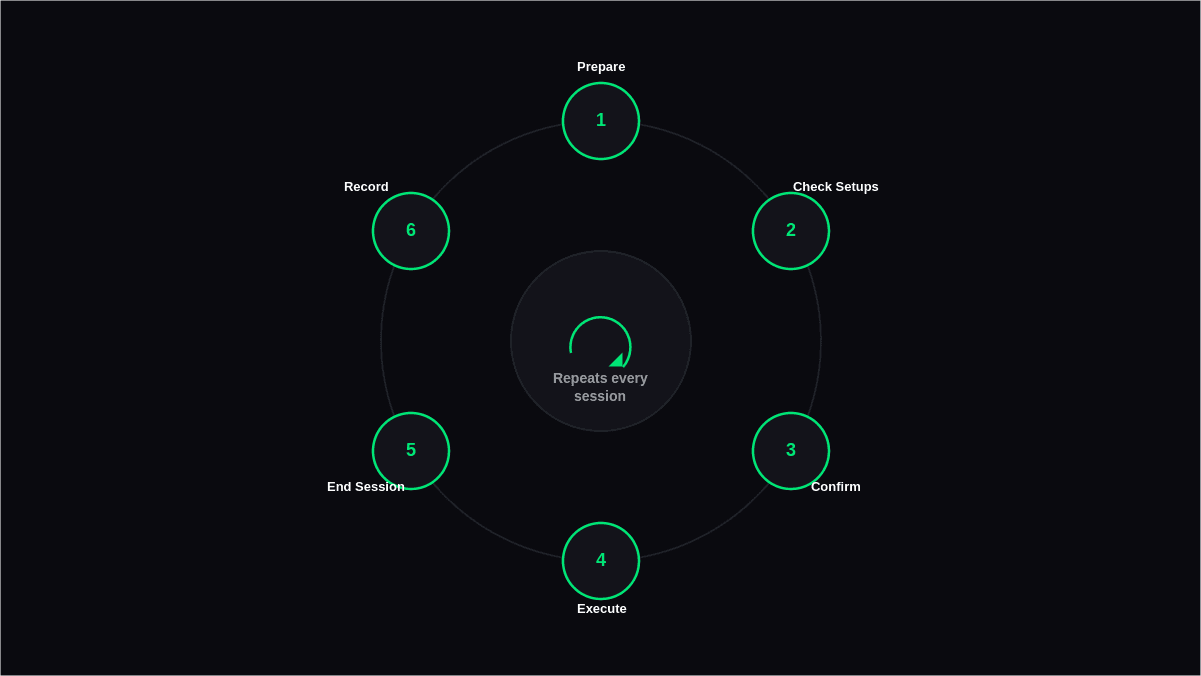
A routine helps create structure for the trading session by repeating the same actions every time.
Step 1: Prepare for the session
Study the markets and the trading conditions.
Step 2: Check for qualifying setups
Assess the trading opportunities based on the strategy.
Step 3: Confirm the trade
Make sure that the setup fulfills the criteria of your trading method.
Step 4: Execute the position
Implement the trade based on your pre-trade decision-making process.
Step 5: End the session when required
Quit trading when the pre-defined trading session ends.
Step 6: Record the session
Take notes on trades, decision making, results, and behavior during the session.
It offers structure without forcing the trader to make any significant changes to his process in the market.
Emotional Trading vs. Disciplined Trading
Discipline does not require the absence of emotions. It means emotions do not automatically determine trading actions.
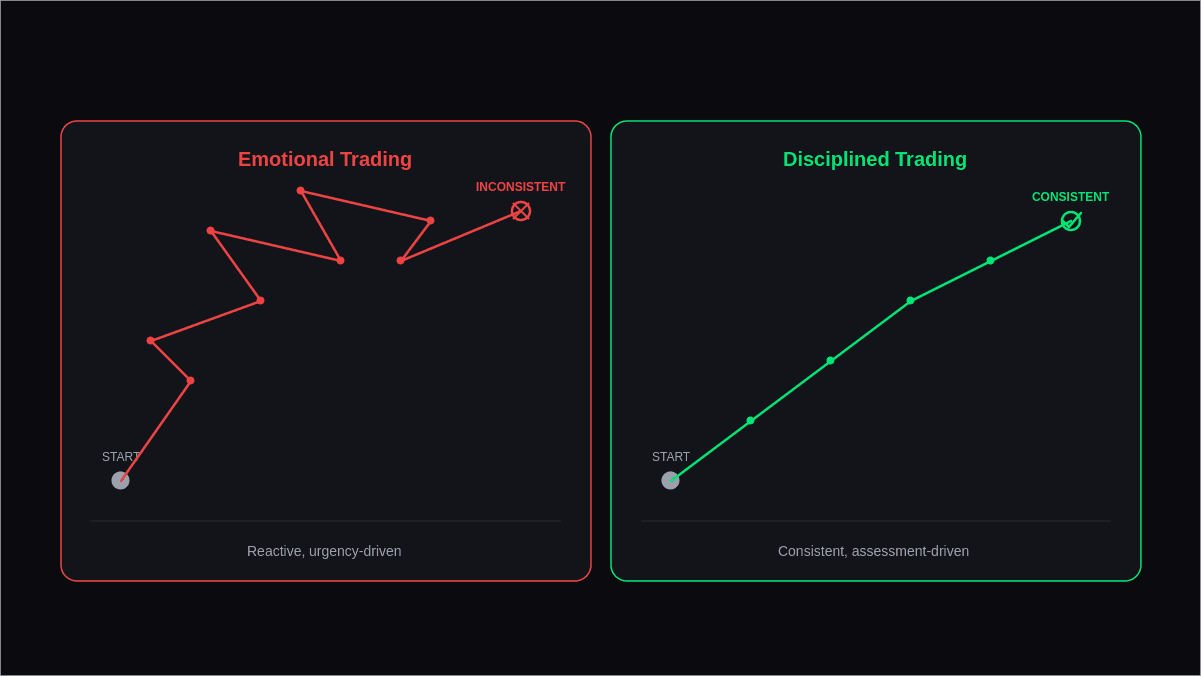
| Decision Area | Emotional Trading | Disciplined Trading |
|---|---|---|
| Setup | Looks for reasons to trade | Evaluates the required conditions |
| Entry | Acts from urgency | Acts after assessment |
| Position | Changes reactively | Changes for defined reasons |
| Missed opportunity | Attempts to catch the move | Accepts the missed opportunity |
| Loss | Focuses on immediate recovery | Follows the planned response |
| Winning streak | Becomes more aggressive | Maintains normal standards |
| Review | Judges mainly by profit or loss | Examines the decision and execution |
How to Improve Trading Psychology Over Time
Psychological progress requires recognizing patterns of behavior and assessing whether adjustments made in your process truly improve performance.
Review a Meaningful Sample of Trades
It is not advisable to make decisions based on one or two trades.
A bigger sample may help in identifying patterns of behavior which can be hard to spot when looking at individual results.
Separate Execution Problems from Strategy Outcomes
Classify unsuccessful trades according to what happened.
For example:
- Valid loss: The strategy was followed and the trade still lost.
- Rule violation: The trade did not meet the required conditions.
- Execution error: The setup was valid but the position was handled incorrectly.
- Strategy issue: The setup itself may require further testing.
This classification helps identify the appropriate response.
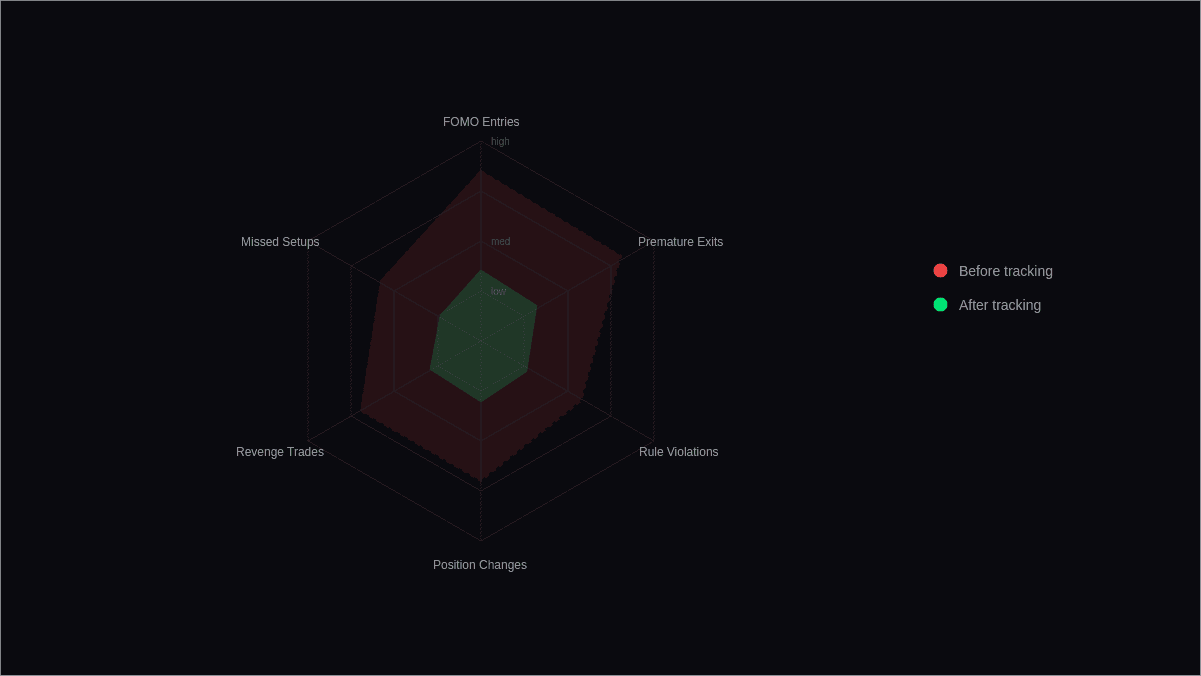
Track Behavioral Metrics
Useful measures include:
- FOMO entries
- Premature exits
- Rule violations
- Unplanned position changes
- Revenge trades
- Missed qualifying setups
- Trades outside planned hours
These measurements can show whether specific behaviors are becoming more or less frequent.
Test Changes before Using Real Capital
Practice trading and simulation might help assess any changes to your system prior to risking your actual capital.
This can be done through testing out a new checklist or session rule on a selected sample.
Tools That Can Support Better Trading Discipline
Trading tools can help to arrange information and facilitate an existing process. The use of trading tools is not supposed to substitute the strategy building process or personal decision making.
Trading journals
The journal contains all kinds of information related to trading activities. This helps to create the history that could be reviewed later without memorizing it.
Alerts
Alerts can help traders to receive notifications about certain price or technical indicator signals. It allows reducing the necessity to monitor each and every short-term change.
Trading indicators
Trading indicators can help to determine certain market conditions based on specific criteria. Their function will depend on their use within the trading system.
Final Takeaway
Trading psychology influences trader thoughts, feelings, and behaviors during decision-making in uncertain situations. Identification of typical issues is useful for traders in understanding their behavioral shifts in different market circumstances.
The solution is the development of individual reaction to particular triggers, the setting of correct financial boundaries, the adherence to the trading routine, and monitoring of behavior.
The aim is not to avoid emotions at all but rather to develop a system where decisions are made regardless of them.
FAQs
What is trading psychology?
Trading psychology is the mental and behavioral side of trading that influences how traders interpret information and make decisions.
Why is trading psychology important?
It affects how consistently traders execute their trading strategies when outcomes are uncertain.
How can I improve my trading psychology?
Identify personal triggers, establish behavioral responses, control financial exposure, and measure recurring behaviors over time.
How do I stop revenge trading?
Use a predefined pause after emotionally difficult losses and avoid making recovery the objective of the next trade.
How do I stop FOMO trading?
Accept that some market movements will occur without producing a valid entry and wait for opportunities that meet your criteria.
How do I control fear when trading?
Define important trade conditions before entry and keep potential losses within a level you can reasonably manage.
What is the biggest psychological mistake traders make?
There is no single mistake that applies to every trader. Allowing emotional reactions to override established decision-making is a common problem.
How long does it take to improve trading psychology?
There is no fixed timeframe. Improvement depends on practice, tracking, review, and correcting recurring behavioral patterns.