When working with financial or other sequential datasets, Time Series Cross Validation provides a way to evaluate whether a model can perform on observations that occur after the data used for training.
Unlike conventional cross-validation, it must account for chronology because future observations should not influence earlier decisions.
This distinction matters in trading, forecasting, and other applications where the order of observations carries information. A model can appear highly accurate during testing while producing unreliable results if the validation process accidentally exposes it to future data or ignores changes over time.
This makes in-sample vs out-of-sample testing important for evaluating whether model performance holds on unseen data.
In this blog, we will explore the key principles of Time Series Cross Validation. We will also cover six important considerations for building a reliable and realistic model evaluation process.
What Is Time Series Cross Validation?
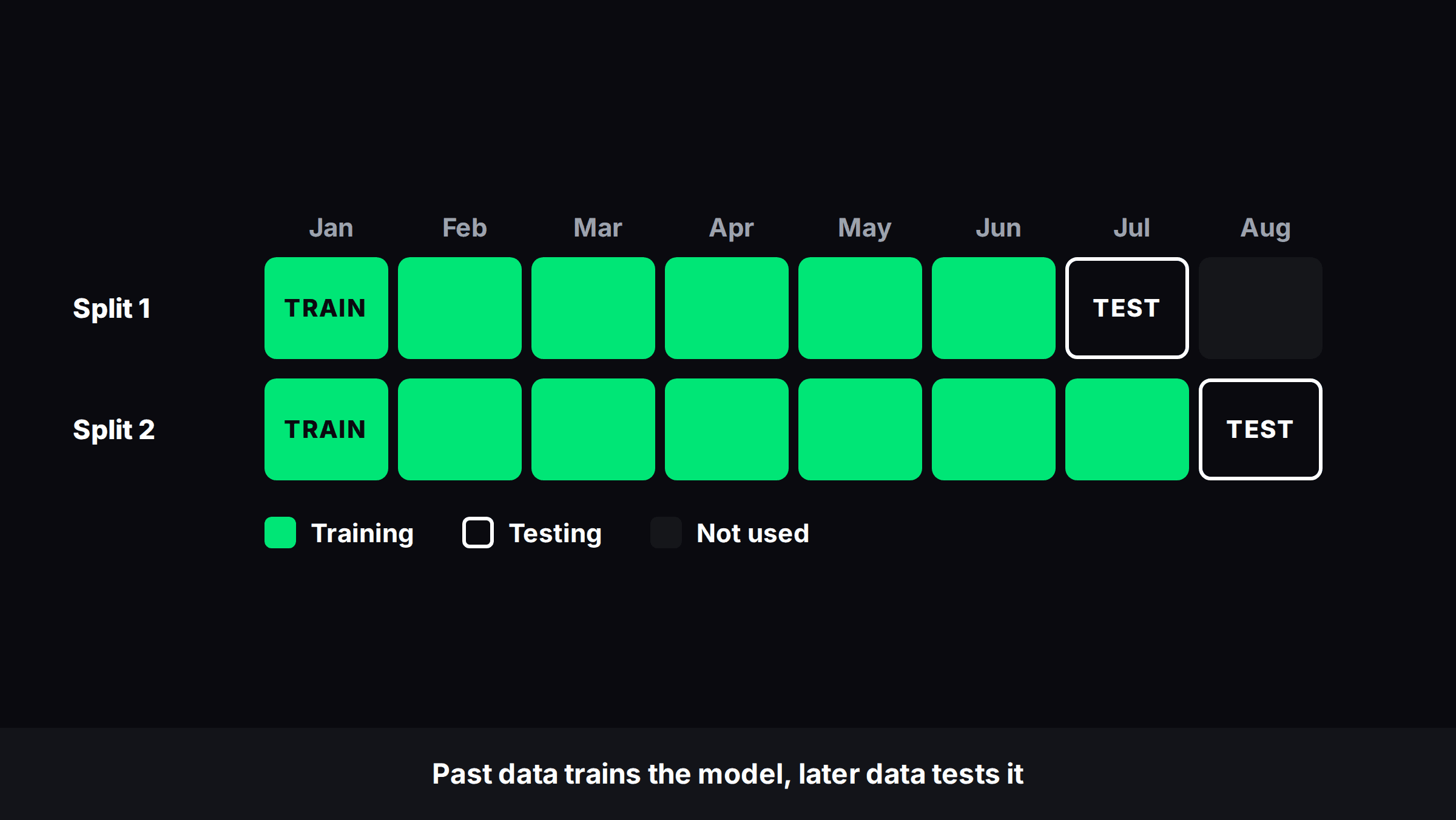
Time Series Cross Validation is a model evaluation approach designed for datasets where observations follow a meaningful sequence. Instead of randomly distributing records between training and testing sets, the data is divided according to time.
For example, a model could be trained on January through June data and evaluated on July data. The next evaluation might extend the training period through July and test the model in August.
This structure better reflects how a model would operate in practice: information from the past is available when making a prediction, while information from the future is not.
6 Things to Know About Time Series Cross Validation

Time-dependent validation involves more than simply separating historical data into two sections. The way observations are selected, training periods are constructed, and results are interpreted can materially affect the evaluation.
The following six considerations can help create a more realistic testing process.
1. Chronological Order Must Stay Intact
The defining principle of sequential validation is that the model should only learn from information that would have existed at the prediction point.
Randomly shuffling observations can break this relationship. A training set could contain information from a later period while the test set contains earlier observations, creating an unrealistic evaluation.
A chronological split avoids this problem by keeping the temporal sequence intact.
- Training data comes before the corresponding validation data.
- Later observations are not used to explain earlier outcomes.
- Features should be constructed using information available at that historical point.
- The same timing rules should apply during both training and testing.
This is particularly important when variables are influenced by information released after a trading decision would have been made.
2. Walk Forward Validation Mirrors Repeated Forecasting
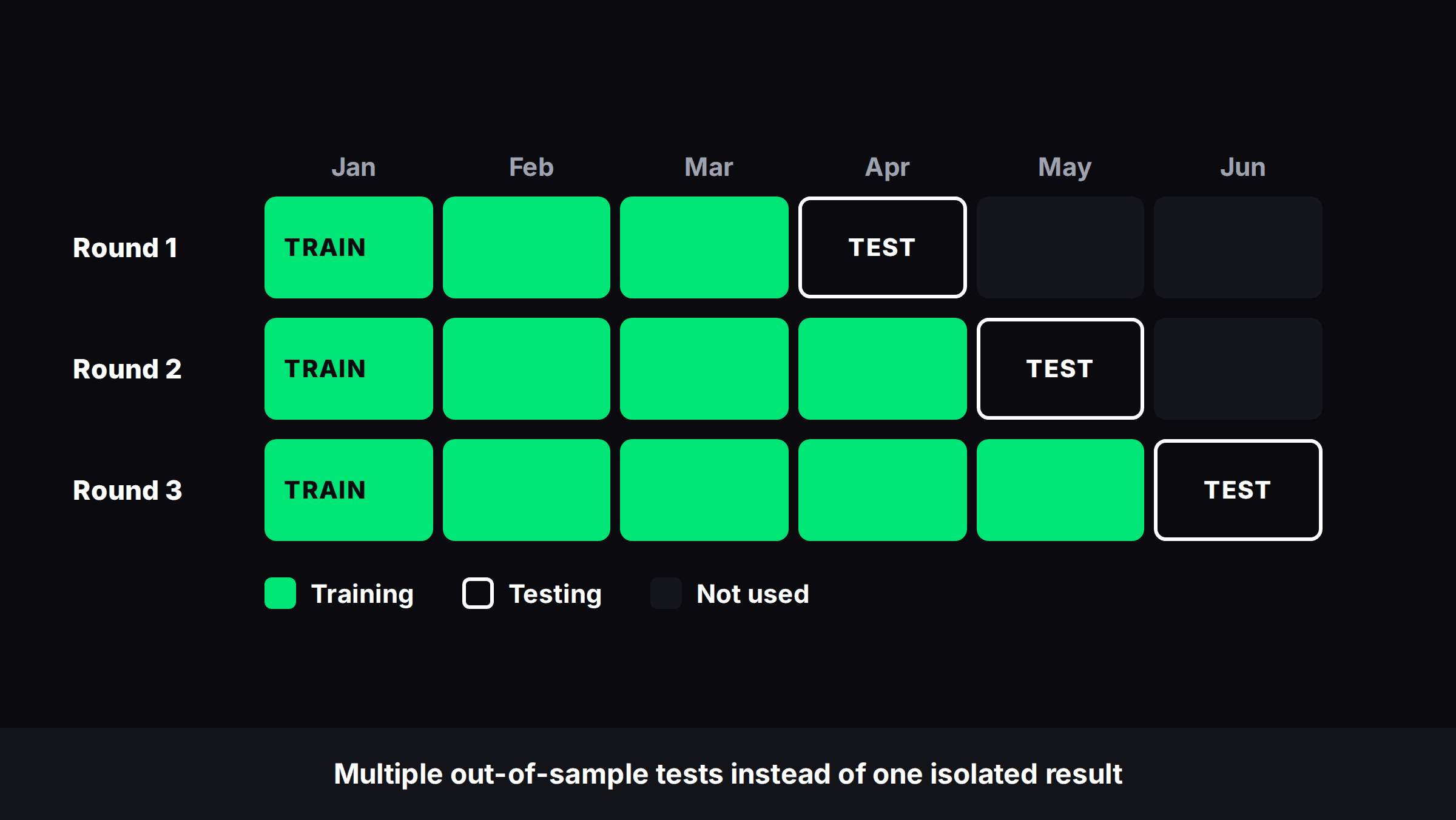
Walk forward validation repeatedly trains a model on historical observations and then evaluates it on a subsequent period. After each evaluation, the process moves forward through the dataset.
A simple example could look like this:
Training: January–March → Test: April
Training: January–April → Test: May
Training: January–May → Test: June
This approach allows researchers to examine performance across multiple out-of-sample periods rather than relying on one isolated test.
- Each test period occurs after its corresponding training period.
- The evaluation progresses through time.
- Results can be compared across different historical intervals.
- Expanding or rolling windows can be used depending on the research objective.
Walk-forward testing is especially useful when the goal is to understand how a model behaves as new information becomes available.
3. Data Leakage Can Invalidate the Evaluation
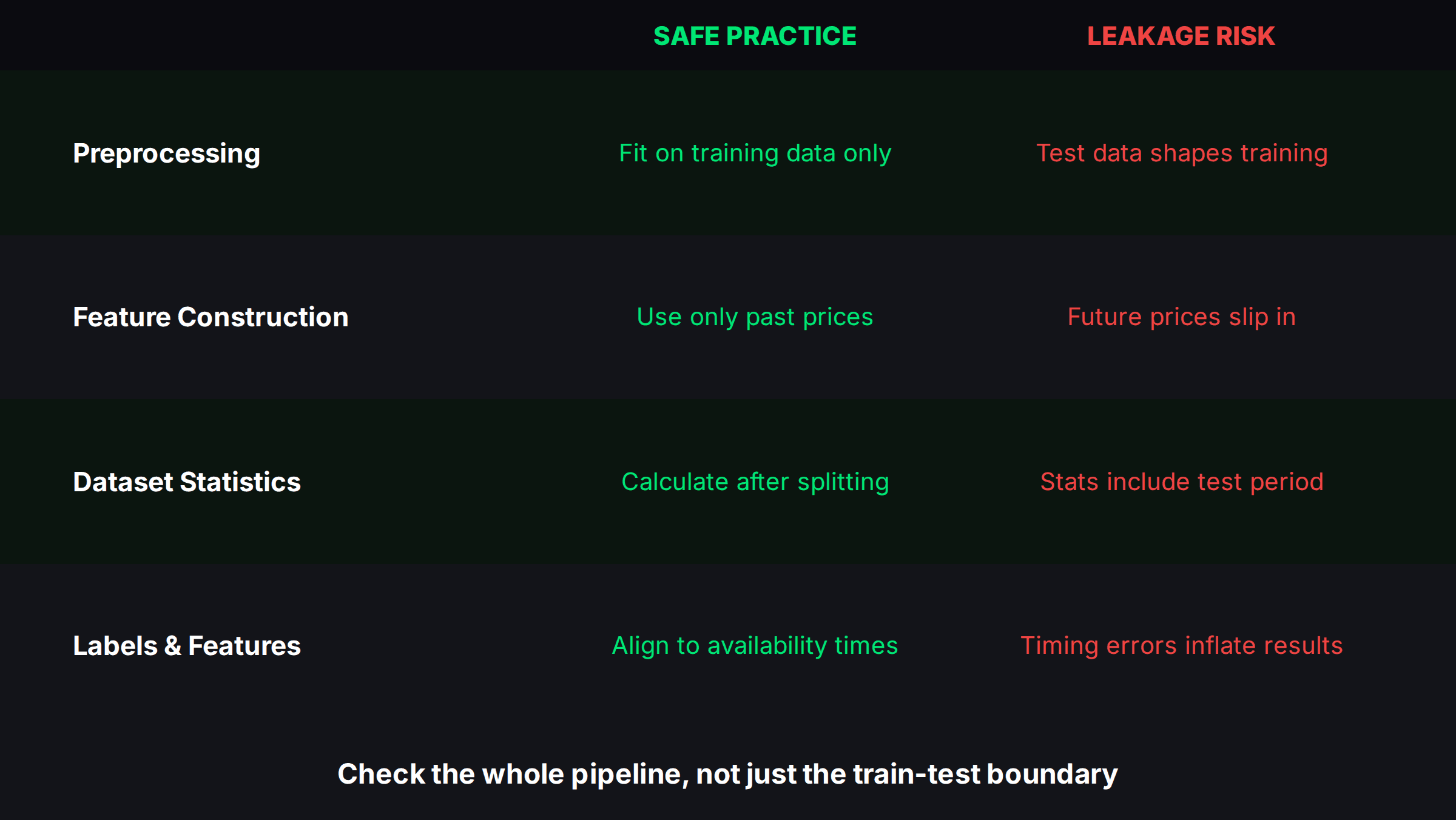
A technically correct split can still produce misleading results if information from the future enters the model through feature construction, preprocessing, or other parts of the research pipeline.
For example, calculating a normalization parameter using the entire dataset before splitting it can allow information from the test period to influence the training process.
Researchers should therefore examine the complete workflow, not just the train-test boundary.
- Fit preprocessing steps using training data only.
- Check whether features use future prices or outcomes.
- Avoid calculating statistics from the complete dataset before validation.
- Make sure labels and features are aligned with their actual availability times.
Controlling leakage is essential because even a small timing error can make historical performance look stronger than it would have been in live use.
4. The Training Window Changes What the Model Learns
The amount of historical data used for training can affect model behavior. An expanding window continuously adds older observations to the training set, while a rolling window keeps the training period at a fixed length.
For instance, a rolling 12-month window might train the model only on the most recent year before each test period.
The choice should reflect the problem being studied rather than being selected simply because it produces better historical results.
- Expanding window: Keeps previously available observations and adds newer ones.
- Rolling window: Removes older observations as newer data enters.
- Short windows: May adapt more quickly but provide fewer observations.
- Long windows: Provide more historical information but may include outdated relationships.
Testing different window designs can reveal whether model performance depends heavily on a particular historical period.
5. Market Conditions Can Change the Results
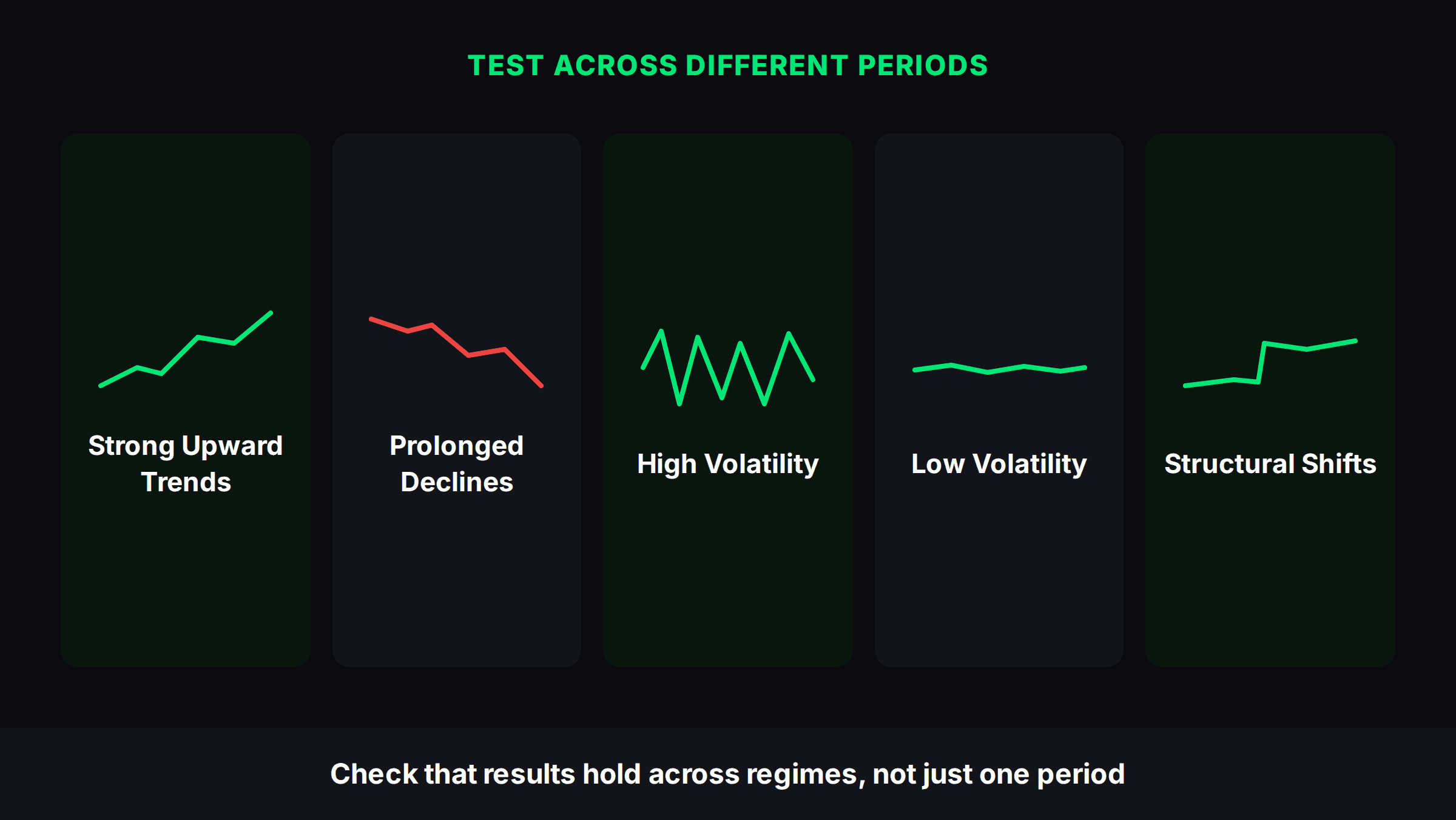
Financial relationships are not necessarily stable over time. A strategy that performs well during one type of market environment may behave differently during another.
For this reason, time series model validation should examine results across multiple periods rather than treating one aggregate figure as sufficient evidence.
A useful evaluation can separate periods with meaningfully different conditions, such as:
- Strong upward trends
- Prolonged declines
- High-volatility periods
- Low-volatility periods
- Major structural or economic shifts
Looking at performance by period can help identify whether the model is consistently useful or whether its results are concentrated in a narrow historical regime.
6. Evaluation Should Go Beyond One Performance Metric
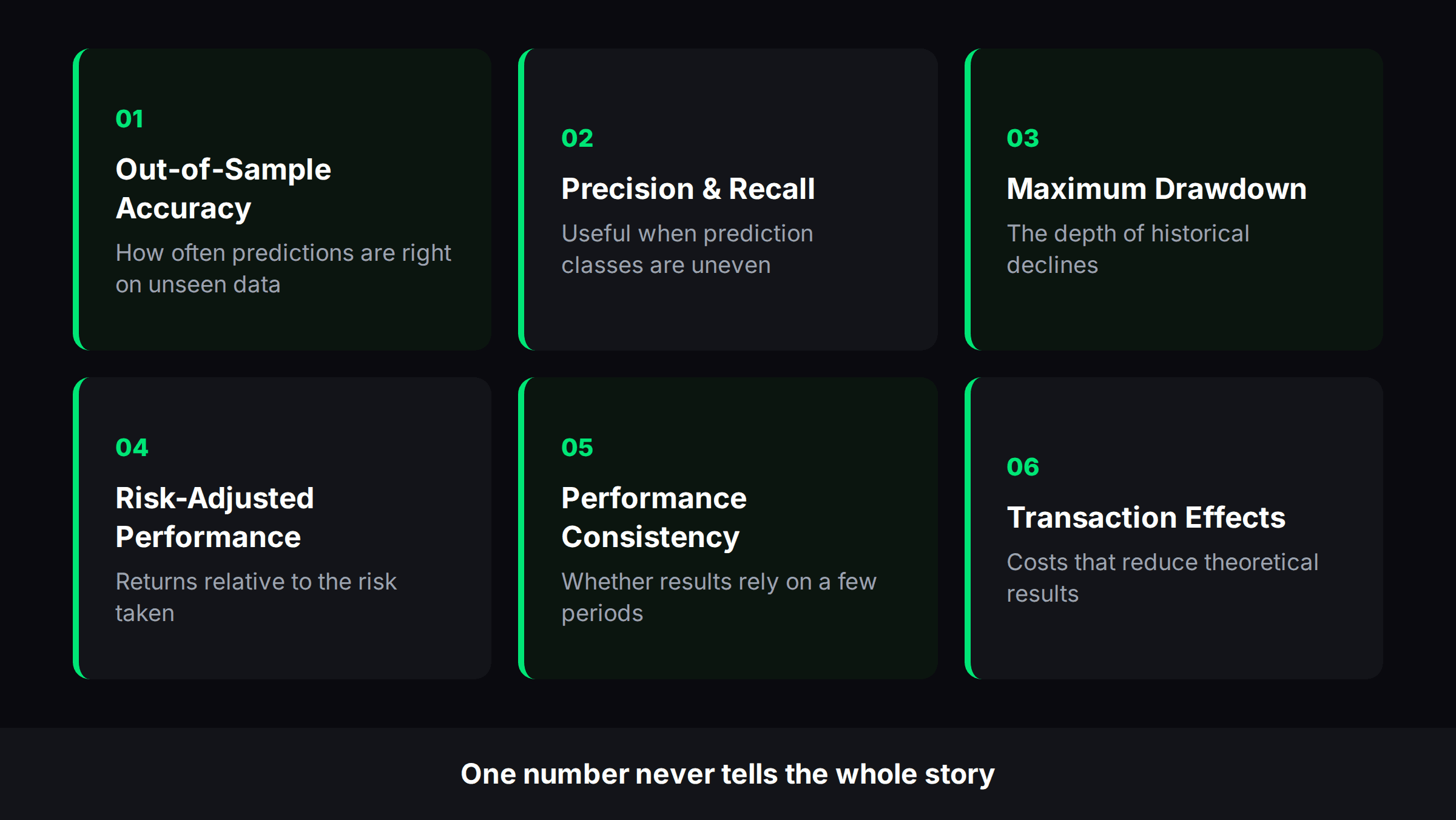
A validation process should not depend on a single measure. Accuracy may be relevant for classification, but it does not necessarily describe the practical quality of a trading strategy.
For financial models, researchers may also examine metrics related to returns, risk, consistency, and trading behavior.
Consider reviewing:
- Out-of-sample accuracy: How often predictions are correct on unseen observations.
- Precision and recall: Useful when prediction classes are uneven.
- Maximum drawdown: Indicates the depth of historical declines.
- Risk-adjusted performance: Helps relate returns to the risk taken.
- Performance consistency: Shows whether results are concentrated in a few periods.
- Transaction effects: Accounts for costs that can reduce theoretical results.
Using several relevant measures creates a broader picture of how the model behaves outside its training data.
How the Six Considerations Fit Together
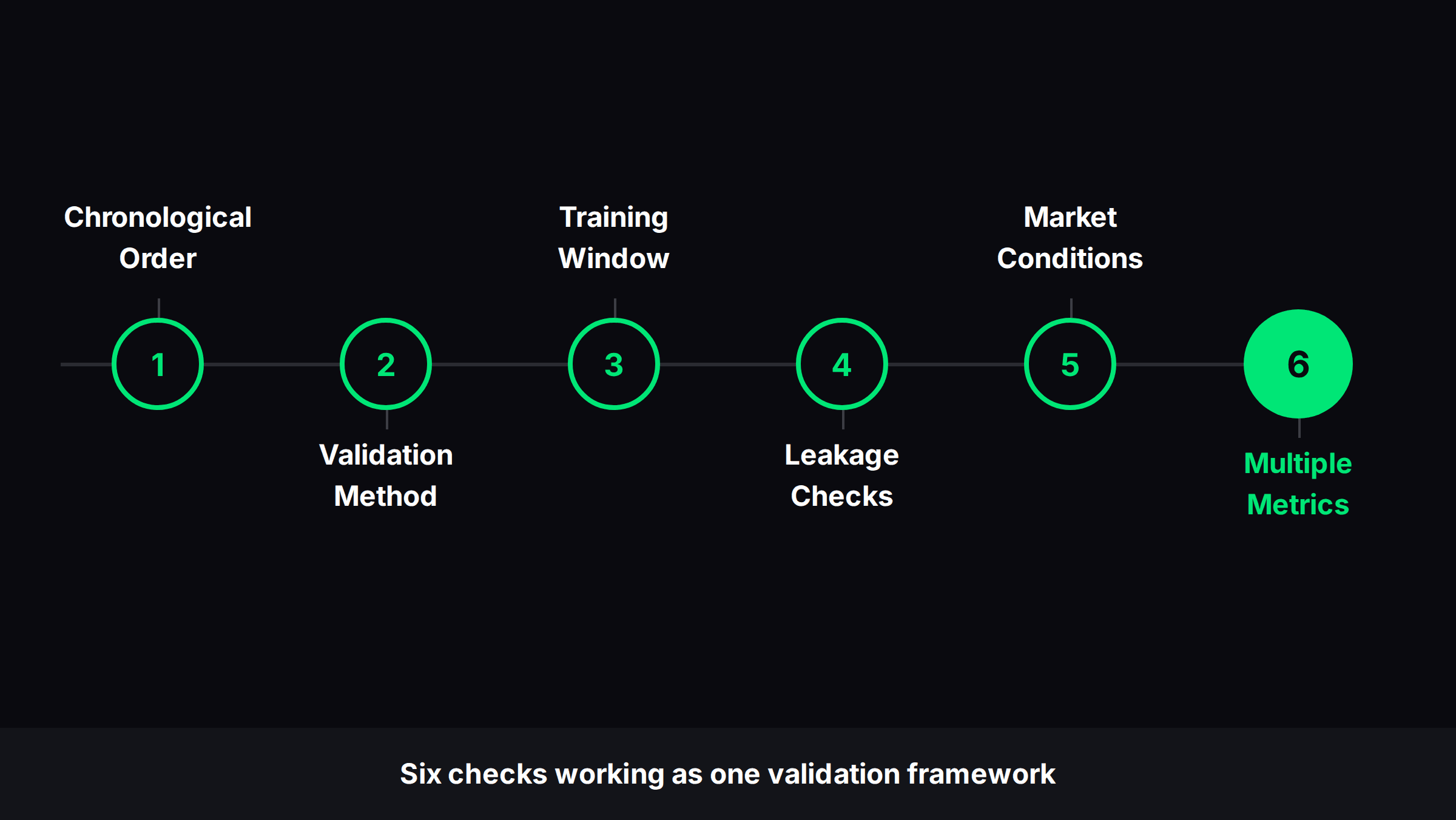
These elements work as parts of one validation framework rather than isolated checks. Chronological ordering establishes the correct direction of information flow, while the validation method determines how that process is repeated.
Training-window design controls which history the model can learn from, and leakage checks protect the boundary between available and unavailable information.
Testing across different conditions then reveals how performance changes over time and provides useful backtesting metrics for evaluating model reliability.
Finally, multiple evaluation metrics help distinguish a model that performs consistently from one that benefits from a small number of favorable observations.
Conclusion
Time Series Cross Validation is useful when model evaluation must respect the chronological structure of data. Its value comes from recreating the information conditions under which a model would actually make predictions, rather than simply producing a convenient train-test split.
A reliable process should maintain temporal order, use an appropriate validation design, prevent data leakage, carefully define the training window, test different market conditions, and evaluate several meaningful performance measures.
When these elements are considered together, validation results can provide a more realistic view of how a model may behave on unseen data and help traders understand how to analyze backtest results.