Machine learning can help traders analyze large amounts of market data, identify recurring patterns, and develop systematic approaches to decision-making. However, not every machine learning method learns from financial data in the same way.
Supervised vs Unsupervised Learning represents two fundamentally different approaches that can be applied to trading research and strategy development, including efforts to optimize trading strategies with AI. The main distinction is whether the model learns from labeled outcomes or searches for structure without predefined labels.
Understanding this difference is important when evaluating machine learning for trading, because the choice affects what the model can learn, how its results should be interpreted, and how it can be tested.
What Is Supervised Learning?
Supervised learning trains a model using historical examples where the desired outcome is already known. In a trading context, those outcomes might include whether a stock moved higher or lower after a specific period, whether a particular setup reached a target, or what return followed a given market condition.
For example, a dataset could contain technical indicators, price information, volume, and volatility measurements as inputs. Each historical observation could then be paired with an outcome such as a positive or negative future return.
The model uses these examples to learn relationships between the available features and the target variable. Once trained, it can produce predictions when it receives new observations.
Common supervised learning tasks include:
- Classification: Predicting categories such as up, down, or neutral.
- Regression: Estimating a continuous value such as a future return.
- Probability estimation: Estimating the likelihood of a particular market outcome.
- Signal classification: Categorizing historical setups based on their subsequent performance.
How Supervised Learning Can Be Applied to Trading
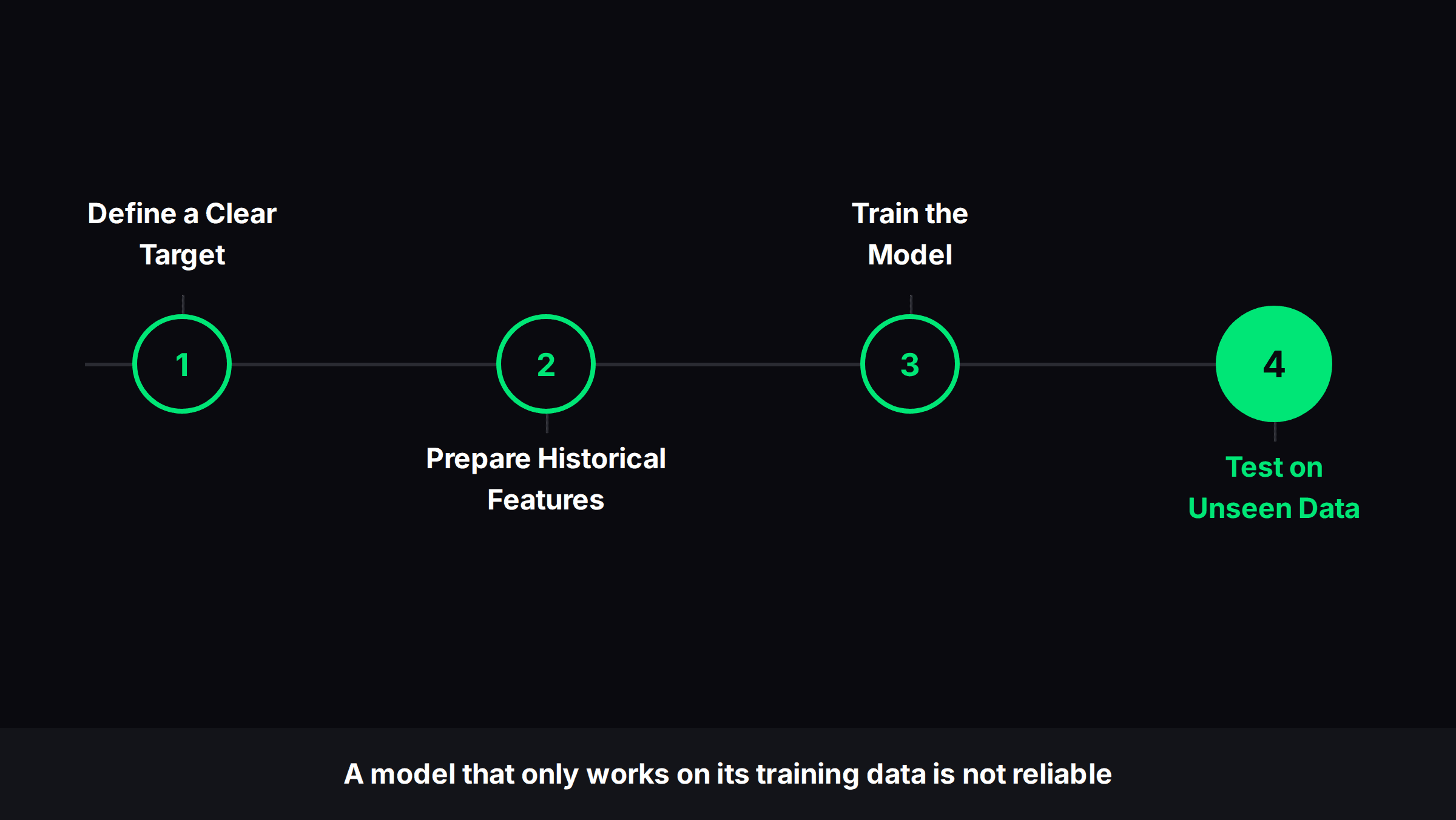
Supervised learning in trading can be useful when a clearly defined prediction target exists.
For example, a researcher might want to determine whether a particular combination of price and volume characteristics has historically been associated with positive returns over the next five trading sessions.
The model can then be evaluated using data that was not included during training. This separation is important because a model that performs well only on the observations it has already seen may not generalize effectively to new market conditions.
What Is Unsupervised Learning?
Unsupervised learning works without a predefined target label. Instead of being told what the correct outcome is, the model searches the available data for structure, similarities, or unusual observations.
In financial markets, this can be useful when the researcher does not want to start with a specific prediction question. A dataset might contain volatility, volume, returns, momentum, and other characteristics, with the model used to identify groups of observations that share similar properties.
For instance, clustering could reveal groups of trading days with comparable market characteristics. One group might contain relatively calm sessions, while another could contain periods characterized by elevated volatility and unusual volume.
Possible applications include:
- Market regime discovery
- Asset or stock clustering
- Pattern exploration
- Anomaly detection
- Feature analysis
- Grouping securities based on market characteristics
How Unsupervised Learning Can Be Applied to Trading
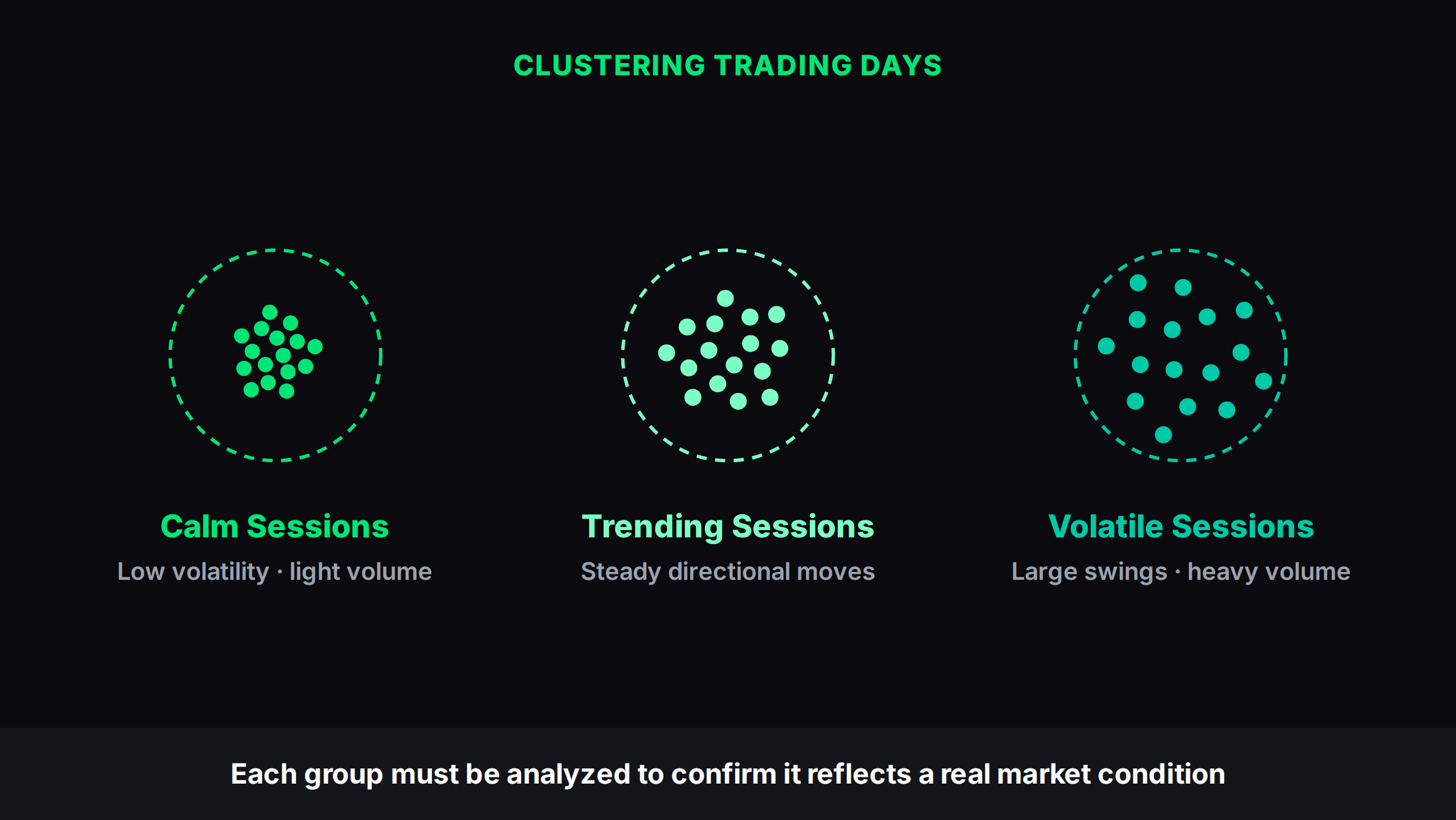
Unsupervised learning in trading can be useful when a researcher wants to identify patterns or groups within market data without defining a specific prediction target.
For example, a researcher might want to determine whether trading periods can be grouped based on similarities in volatility, volume, momentum, and price behavior.
The resulting groups can then be analyzed to determine whether they represent meaningful market conditions or recurring patterns. This approach can help with exploratory research, but the discovered structures still need to be tested carefully before being used as part of a trading strategy.
Main Difference Between Supervised vs Unsupervised Learning
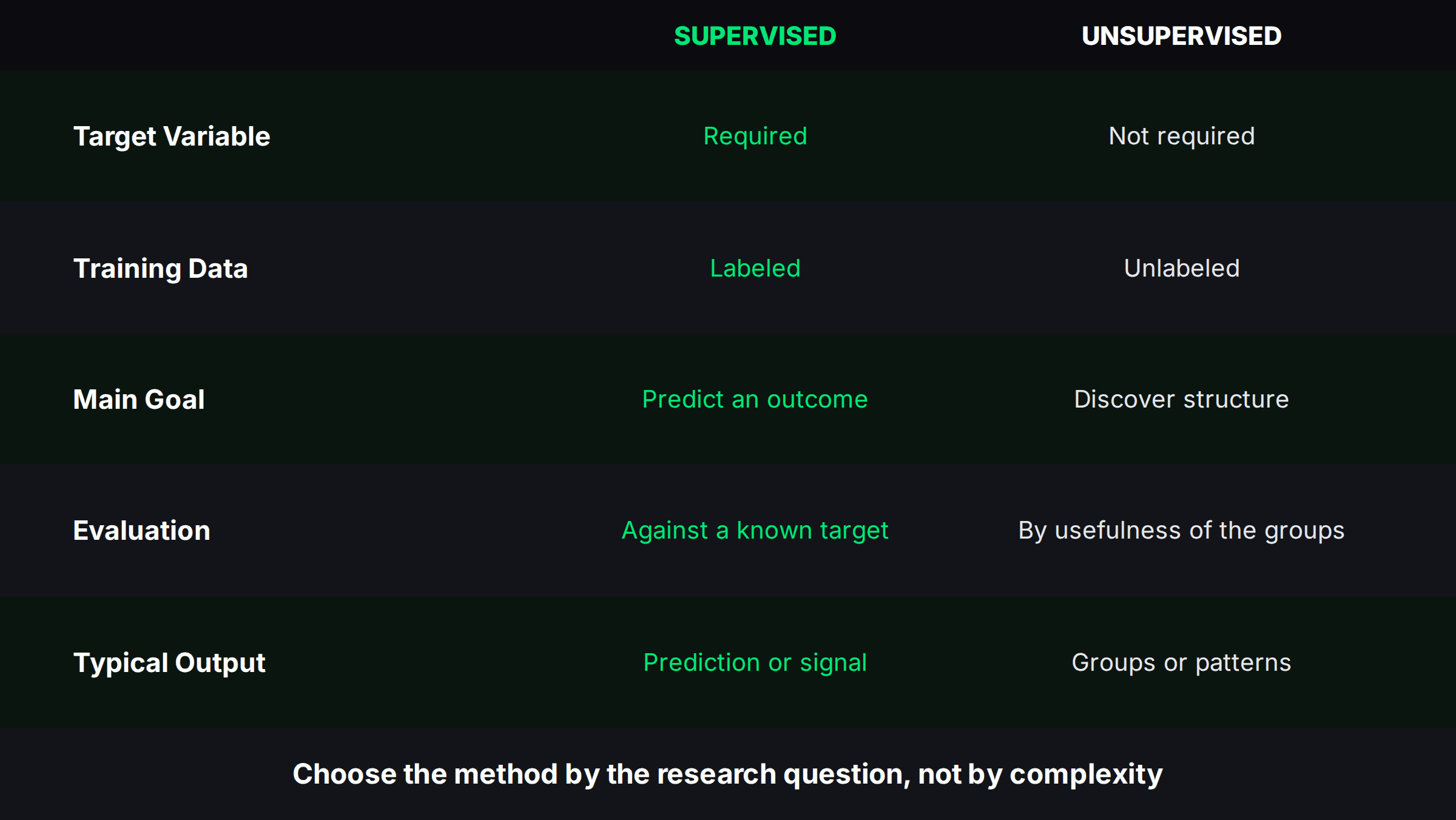
The central difference is the presence of a target variable. Supervised learning is designed around known outcomes, while unsupervised learning explores the underlying structure of data without those predefined outcomes.
This distinction creates practical differences in how each approach is developed and evaluated.
| Factor | Supervised Learning | Unsupervised Learning |
|---|---|---|
| Training data | Uses labeled data | Uses unlabeled data |
| Main objective | Predict a defined outcome | Discover patterns or structure |
| Target variable | Required | Not required |
| Common tasks | Classification and regression | Clustering & anomaly detection |
| Trading application | Predict returns, direction, or signal outcomes | Identify regimes, groups, or unusual behavior |
| Evaluation | Can compare predictions with known outcomes | Often requires indirect or domain-specific evaluation |
| Prediction | Predict whether a setup will produce a positive return | Group market periods by volatility and price behavior |
| Main challenge | Overfitting and unreliable predictions | Interpreting whether discovered patterns are meaningful |
Neither approach automatically produces a useful trading strategy. The quality of the data, feature selection, validation process, assumptions, and market conditions can have a substantial effect on the results.
For that reason, the machine learning technique should be selected according to the research question rather than simply choosing the more complex method.
How Their Trading Workflows Differ
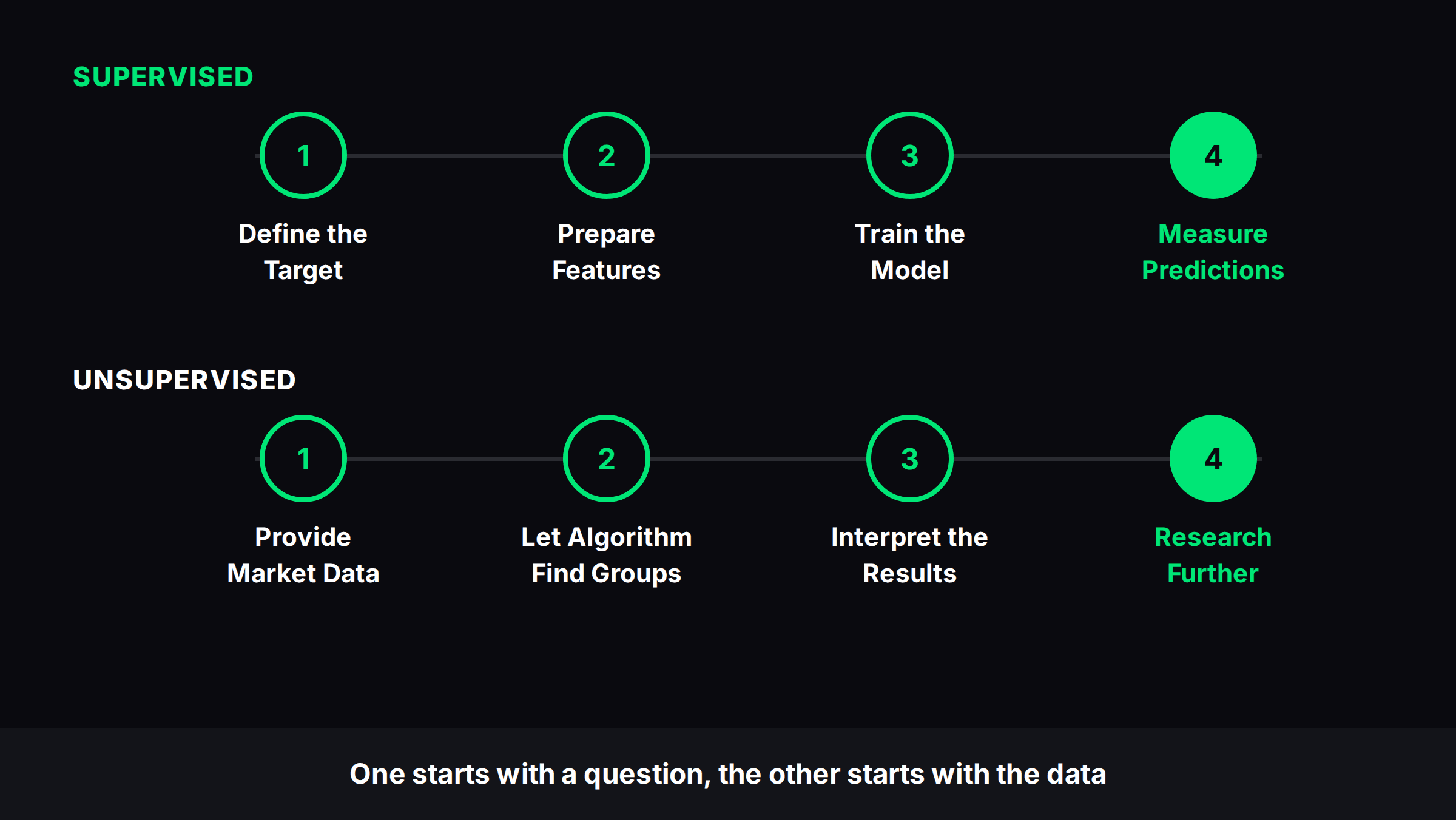
A supervised workflow usually starts with a specific prediction problem. The researcher defines the target, prepares historical features, trains the model, and measures how accurately it predicts previously unseen observations.
An unsupervised workflow begins differently. The researcher provides relevant data and allows the algorithm to identify relationships or groups. Those findings can then be investigated to determine whether they correspond to meaningful market conditions.
For example, supervised learning could investigate:
“Which market features are associated with positive returns over the next 10 sessions?”
Unsupervised learning could instead investigate:
“What distinct types of market conditions appear in this dataset?”
The first question has a predefined outcome. The second focuses on discovering structure.
What Is Better for You?
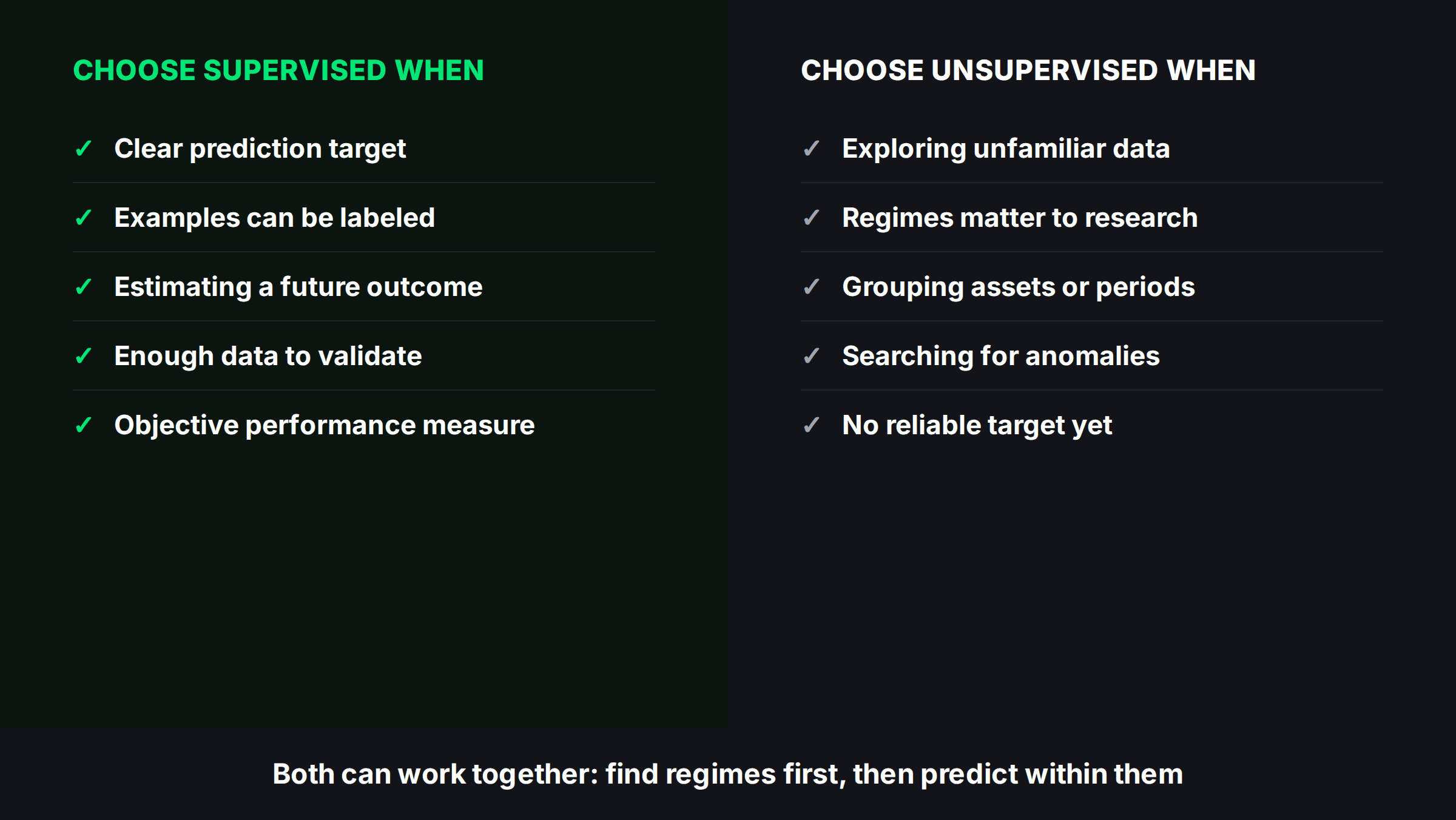
There is no universal choice between the two. The appropriate approach depends on what you are trying to accomplish with your trading research.
Supervised learning may be more appropriate when:
- You have a clearly defined prediction target.
- Historical examples can be labeled consistently.
- You want to estimate a future outcome.
- You have enough data to train and validate the model separately.
- Performance can be measured against an objective target.
Unsupervised learning may be useful when:
- You want to explore an unfamiliar dataset.
- Market regimes are an important part of your research.
- You want to group assets or market periods.
- You are searching for anomalies or unusual observations.
- A reliable target variable has not yet been established.
The two approaches can also be used together. For example, unsupervised learning might first identify different market regimes. A supervised model could then be developed to predict outcomes within or across those regimes. Combining methods does not eliminate the need for careful validation, however.
Avoiding Common Machine Learning Problems in Trading
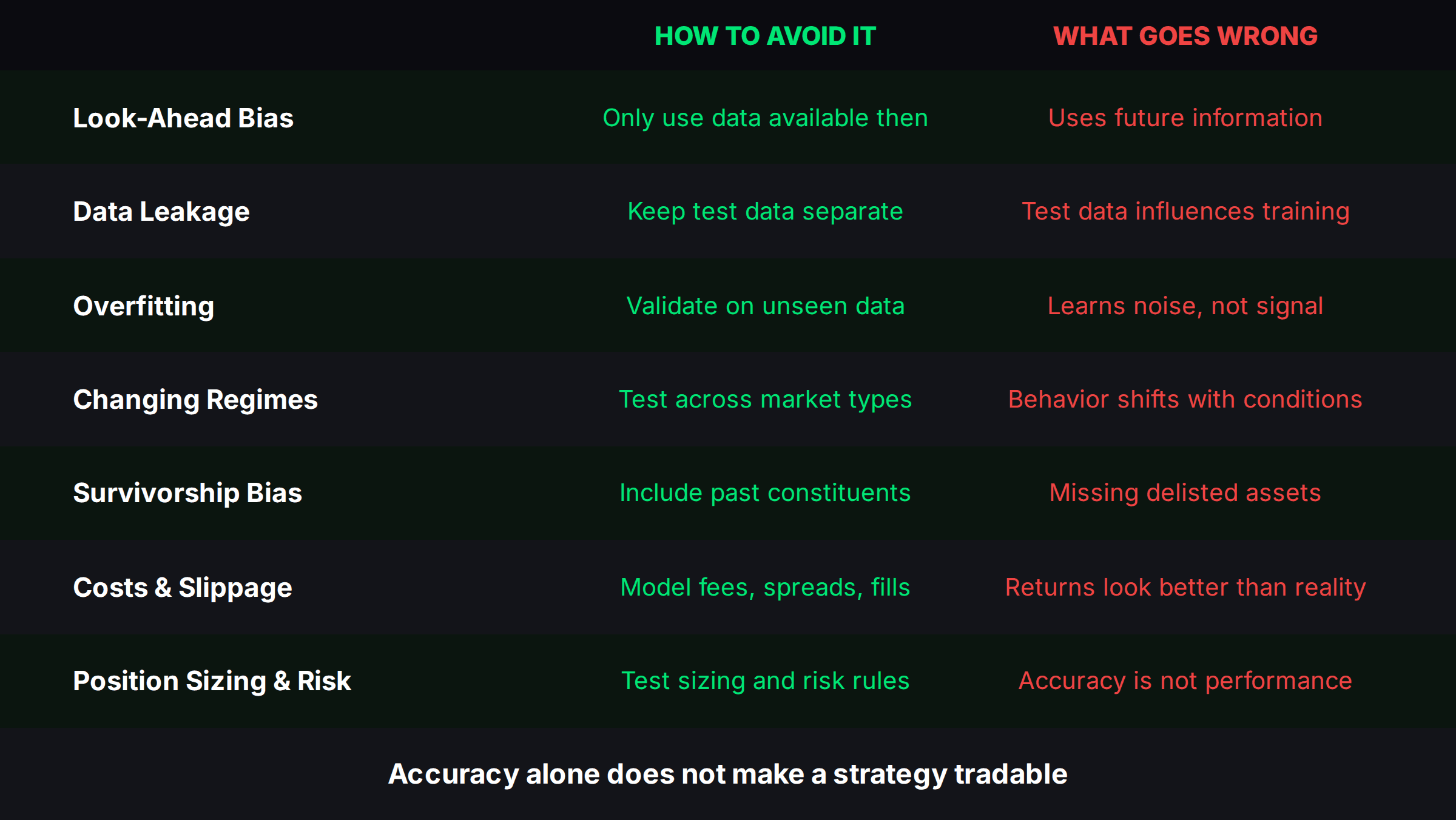
Financial datasets can create misleading results when models are developed without strict controls. Historical market data may contain time dependencies, changing market regimes, survivorship issues, or information that would not have been available at the time of a historical decision.
Key areas to consider include:
- Look-ahead bias: Avoid using information that would not have been available when the trading decision was made.
- Data leakage: Keep information from the future or test dataset from influencing model training.
- Changing market regimes: A model trained on one type of market environment may behave differently when conditions change.
- Survivorship bias: Consider whether the dataset excludes assets that previously existed but are no longer included.
- Overfitting: A model may learn historical noise rather than relationships that can generalize to new data.
- Trading costs: Evaluate transaction costs, spreads, and commissions instead of relying only on theoretical returns.
- Slippage: Account for the difference between an expected execution price and the actual price obtained.
- Position sizing and risk: Model accuracy alone does not determine how a strategy performs under different position sizes and risk levels.
Maintaining the chronological order of observations is particularly important when appropriate.
Researchers should also distinguish between model accuracy and actual trading performance, since a model can classify market direction reasonably well while still producing an unattractive strategy after costs and risk are considered.
Conclusion
Supervised vs Unsupervised Learning presents two different ways to apply machine learning to financial data. Supervised learning starts with known outcomes and attempts to predict them, while unsupervised learning searches for meaningful structures without predefined labels.
For traders and researchers, the choice should follow the question being investigated. Supervised learning in trading can support defined prediction tasks, whereas unsupervised learning in trading can help uncover market regimes, clusters, and unusual observations.
Both approaches require reliable data, appropriate validation, and careful interpretation before their findings can support a trading strategy or help traders validate trading strategies.