A trading strategy may work for months and even years, but gradually become ineffective. This phenomenon is referred to as strategy edge decay. This does not imply that the initial trading strategy was poorly chosen. The trading environment may change, the trader himself may change, and thus the environment may stop providing any opportunity for the trader to have any advantage.
Being aware of factors contributing to decay will help traders to avoid making rash decisions and changing their trading strategies immediately after they start showing some negative results. They will be able to observe the results of their trading and see if they need to change anything in their strategy.
This guide will explain what is strategy edge decay and how to detect it, and how to create the system of maintaining your trading strategy.
What Is Strategy Edge Decay?
Strategy edge decay in trading refers to a decline in the statistical or practical edge that a given trading strategy has over time.
An edge is defined as the outperformance of a trading strategy relative to what could be achieved by a random approach after considering risk, transaction costs, and other elements.
The edge may erode because of a change in the market conditions, a change in the reactions of the people in the market to certain signals, or because the market conditions required to make the strategy effective are changing.
Thus, edge decay is not necessarily a losing streak.
It is normal for a few losing trades to happen even when the strategy is still valid. However, edge decay should be taken seriously if the conditions making the strategy workable change at the same time that performance deteriorates.
Why Do Trading Strategies Lose Their Edge?
There are several reasons why the effectiveness of a strategy may worsen.
Market conditions change
The markets are not constant. The trends, volatility, liquidity, interest rates, economics, and behavior of the investors can all change.
A trend following strategy will work effectively under an extended trend but may not work well when there is a lack of trend in the market.
Similarly, the mean reversion strategy might work effectively in case of stable markets, while in the case of breakout, it will not work well.
Market participants adapt
Strategies used in trading have the potential to change the behavior of others if they are known about extensively.
If traders react in a similar manner, then there might be less opportunities around. It is not necessary for the market to be totally efficient for this to occur. Even small changes in the scale of opportunities can impact long term performance.
Strategy assumptions become outdated
All strategies make some underlying assumptions.
For example:
- The way price reacts to volatility
- How long trends usually persist
- How often reversal happens
- How much price movement occurs after that signal
- How liquidity impacts entry and exit
If assumptions alter, the strategy may not function as originally designed.To make accurate assessments, traders often rely on reliable technical tools like a non-repaint buy sell signals algorithm to verify that historical entry and exit signals remain true over time.
Costs reduce the remaining advantage
A system may seem profitable before expenses but not very attractive after expenses such as commissions, spreads, and slippages.
This is especially true for trading systems that produce a lot of trades. Any slight loss of quality of trades will be noticeable once all expenses are taken into consideration.
3 Signs of Strategy Edge Decay
Early detection of weakening performance may assist traders in researching the issue without implementing any unnecessary modifications.
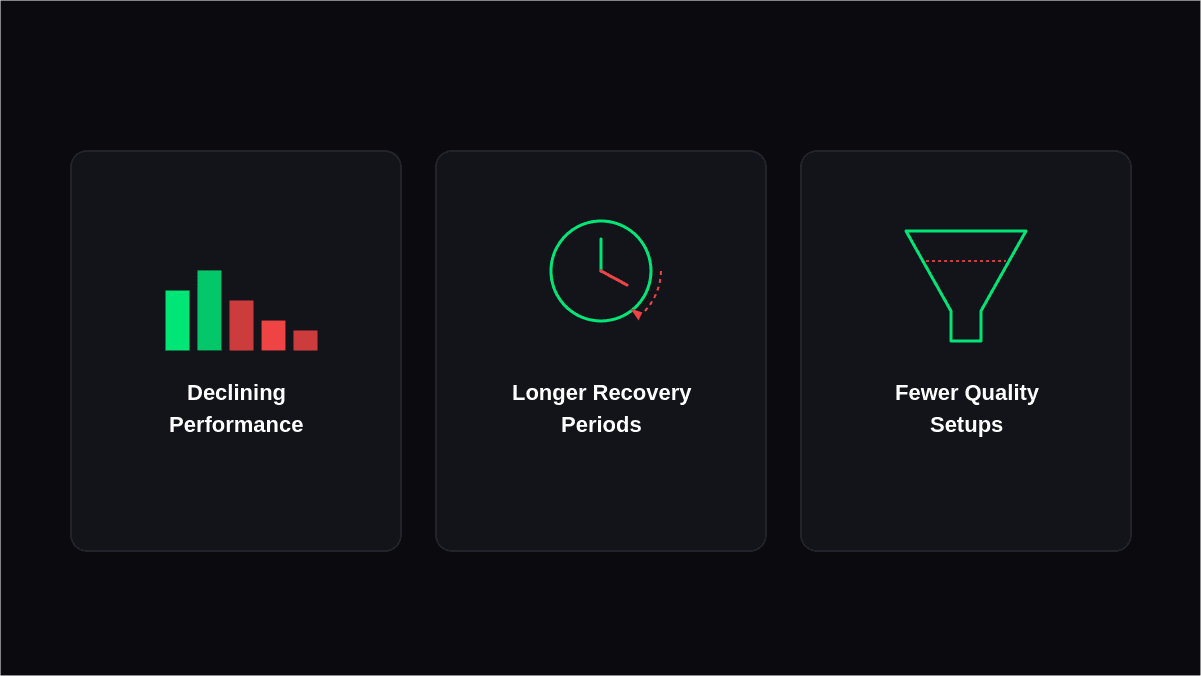
Declining performance across multiple trades
One of the most obvious red flags is a consistent decline in performance rather than just a loss.
Rather than considering one week or a few trades, consider the performance on a sufficiently large scale.
The following metrics are among the useful measures:
- Win rate
- Average winner
- Average loser
- Profit factor
- Maximum drawdown
- Expectancy
- Risk-adjusted performance
There is no such single metric which would prove that the edge is gone. Evaluating statistical models like the Sharpe Ratio on Corporate Finance Institute can help determine if your risk-adjusted performance is systematically declining.
Longer recovery periods
Although profits may be consistent for the trading strategy, recovery time from drawdown could become increasingly longer.
This shows that the distribution of returns has been altered. It could also show that the trading strategy is getting increasingly incompatible with prevailing market conditions.
Fewer high-quality setups
Yet another red flag is when there is a drop in the number of setups that conform to the requirements set by the strategy.
In cases where the strategy involves a certain price action, along with volatility and momentum, any changes in these factors may lead to fewer setups.
This does not necessarily imply that a trader should start lowering his entry requirements. This will lead to a whole new problem, namely overtrading.
Strategy Edge Decay vs. a Normal Losing Streak
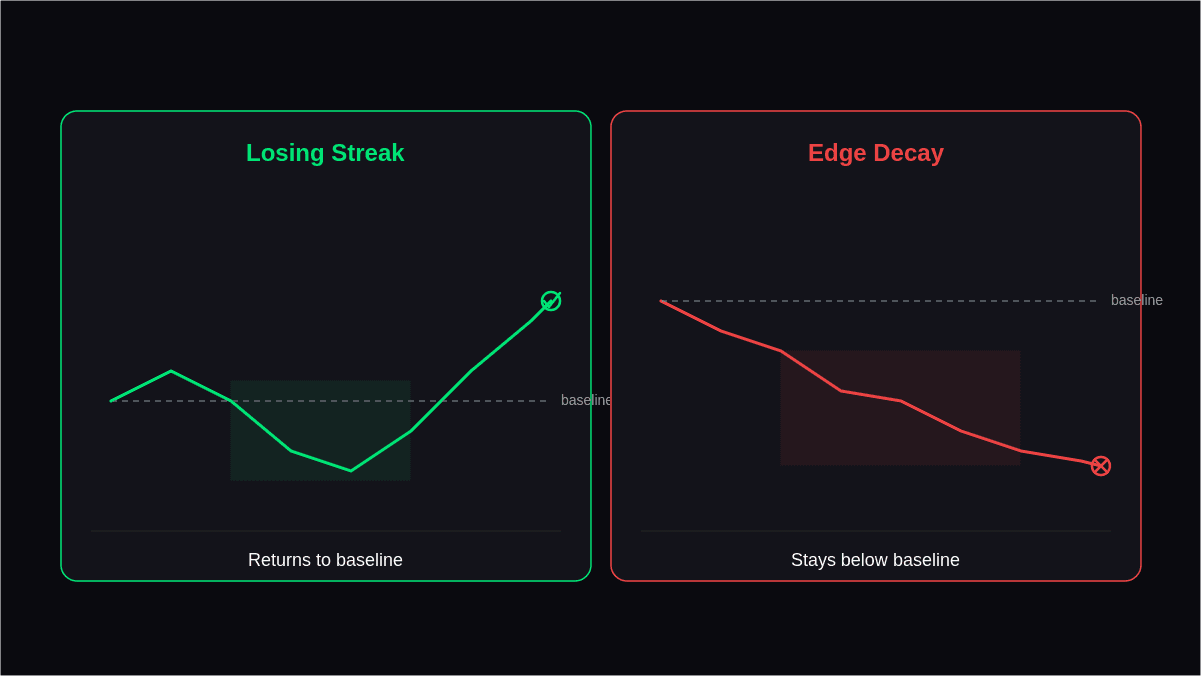
These two cases must not be confused. It is quite common to have losing streaks when trading. A system with a true positive expectancy may also encounter several consecutive losses.
You can better understand by following this table:
| Factor | Normal Losing Streak | Strategy Edge Decay |
|---|---|---|
| Duration | Usually temporary and can occur within normal strategy performance. | Persists across a larger and more meaningful sample of trades. |
| Performance | Results may return to historical expectations after the losing period. | Performance remains consistently below the strategy’s historical baseline. |
| Expectancy | May remain broadly consistent with the strategy’s long-term expectancy. | Expectancy may decline significantly over time. |
| Market Conditions | Market conditions may still support the strategy’s original logic. | Market conditions may have changed enough to reduce the strategy’s advantage. |
| Drawdown | Drawdown remains within a historically expected range. | Drawdowns may become deeper, longer, or more frequent than expected. |
| Trading Setups | Quality and frequency of setups may remain relatively normal. | High-quality setups may become less frequent or produce weaker outcomes. |
| Response | Continue following the strategy while monitoring performance. | Investigate the cause before testing adjustments or reducing exposure. |
| Risk of Overreaction | Changing the strategy too quickly can damage a valid system. | Ignoring persistent deterioration can expose the trader to continued underperformance. |
How to Monitor Strategy Performance
Edge monitoring is one of the most efficient ways of recognizing any loss of edge.
Establish a baseline
In order to evaluate the changes, first measure how the strategy was performing before.
Measurements include:
- Average return per trade
- Win rate
- Profit factor
- Maximum drawdown
- Average holding period
- Number of trades
- Performance by market condition
This baseline provides a reference point for future comparisons.
Use rolling performance
Instead of evaluating results after the conclusion of the year, consider using rolling periods.
Traders can compare the current group of transactions with past groups consisting of similar sizes.
By considering rolling periods, one can spot a gradual worsening situation that cannot be identified by an average period.
Separate market conditions
The performance of a strategy should also be analyzed in different environments.
Separation of the results into:
- High and low volatility
- Trending and ranging markets
- Bullish and bearish conditions
- Different timeframes
- Different trading sessions
This can show whether the strategy has actually lost its edge or simply performs poorly under a specific condition. Advanced tools like the GainzAlgo Indicator can assist in filtering market trends and adapting to these changing conditions.
How to Manage Strategy Edge Decay
If there are problems with performance, however, it would not be wise to try and remedy the situation by rebuilding the whole strategy.
Taking an approach that is more structured may prove to be helpful.
Review the original strategy logic
Go back to the root cause behind the construction of the strategy.
Find out:
- What kind of market behavior was the strategy supposed to catch?
- Is the behavior present?
- Have the entry signals lost their relevance?
- Has the price reaction changed?
- Are the exits happening in the same manner?
This helps determine whether the problem is with the strategy itself or with the environment in which it is being applied.
Test before changing rules
Do not make changes to several parameters simply because of recent losses.
Experiment with proposed changes using past data, as well as forward-testing where applicable.
It is not the goal to make past performance look perfect. The goal is to find out whether the change increases robustness without causing too much complexity.
Consider adapting to market regimes
There may be ways to make certain trading systems more effective by establishing conditions under which they have performed well in the past.
In such a case, for instance, the trend strategy will apply a filter that identifies conditions under which there is no trend at all.
This filter should have a sound logic and should be tested separately from the system itself.
Reduce exposure when uncertainty increases
Where it appears that the competitive advantage of the strategy is beginning to fade but there is still no basis to discard it because of the lack of sufficient information, it is logical to manage the risks by decreasing position sizes.
In such a way, it is possible to keep collecting information while being less exposed.
Risk management does not mean analysis substitution.
Building a Strategy Maintenance Process
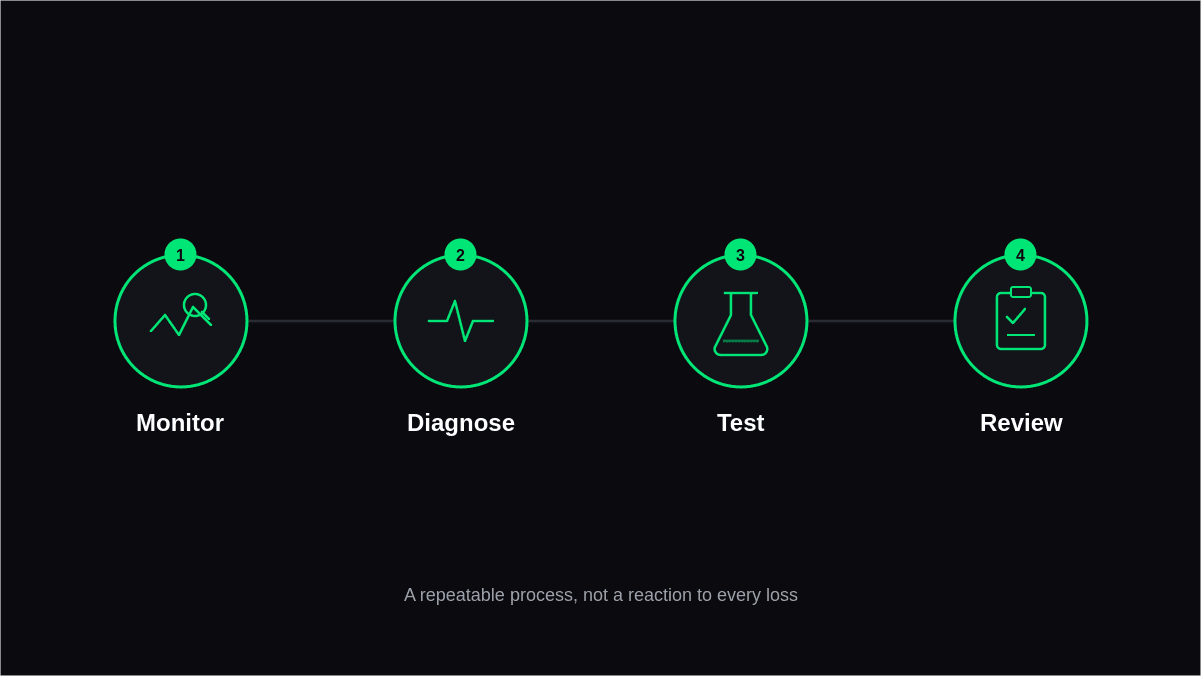
Maintenance of a successful strategy does not imply frequent modification of a trading system.
On the contrary, it implies creation of a repeatable procedure for checking if a strategy still operates as intended.
An effective procedure can be divided into four steps.
1. Monitor
Use the same performance indicators for tracking consistency.
2. Diagnose
See if the changes are caused by external factors like the market situation, execution, cost, or the strategy itself.
3. Test
Check possible changes using both historical and future data.
4. Review
Choose a set schedule for reviews instead of making them after each trade.
The result is that strategy management becomes a more organized process rather than an emotional one in response to losses.
Avoid Over-Optimization When Fixing a Weak Strategy
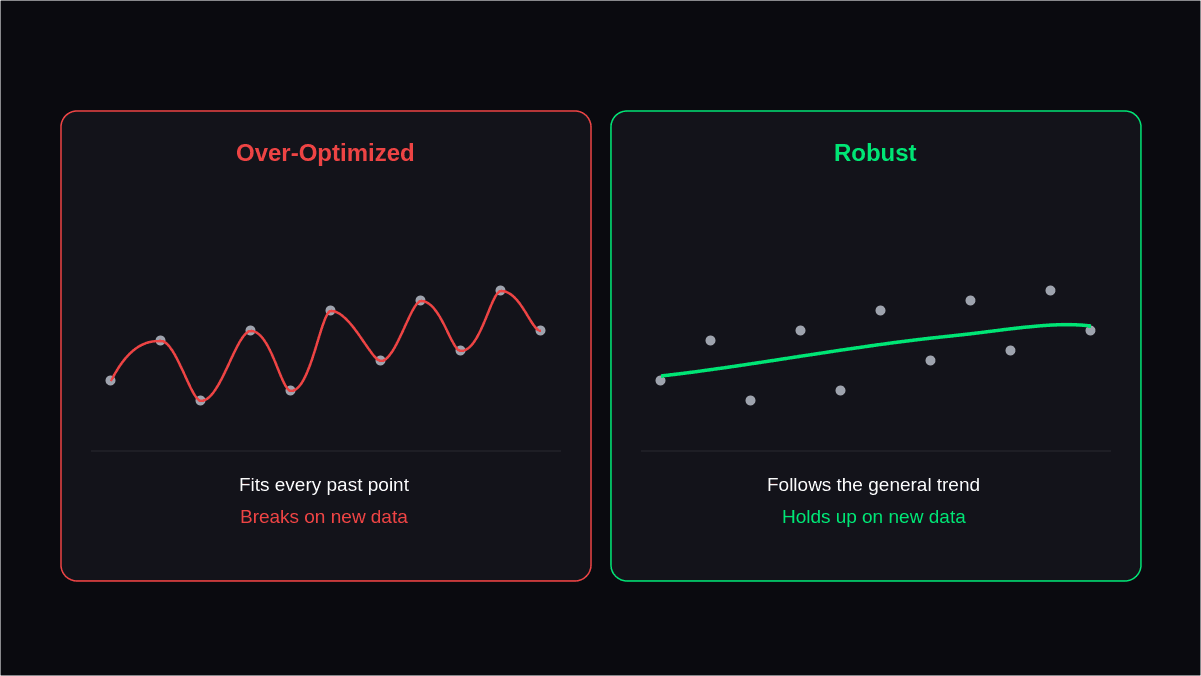
Another great risk associated with detecting trading strategy deterioration is over-optimization.
An investor can have bad performance over a certain period and fine-tune his or her system several times to improve the results in history.
However, it is possible that an investor has a system tailored to historical performance only.
Red flags in this regard might include the following:
- Too many adjustable parameters
- Rules created specifically around past losing trades
- Excellent backtest results with weak forward performance
- Very specific entry and exit conditions without a clear rationale
- Large performance differences from small parameter changes
A more robust strategy should not depend on finding one perfect combination of settings.
The goal is to identify changes that make sense across different samples and market conditions.
When Should a Strategy Be Replaced?
All weaknesses do not need fixing.
Rebuilding might be an option if there is no longer an edge in the market behavior, the weakness persists after appropriate testing, and the risk and reward profile of the strategy does not align with the trader’s goals anymore.
It is, nevertheless, important to check out enough data first to ensure the deterioration is indeed due to changing market conditions and not just variance.
A strategy going through hard times doesn’t mean it is damaged.
The main question is whether there is any indication of a change in the expected edge.
A Simple Strategy Edge Review Checklist
Use the following questions when conducting a periodic review:
- Did the strategy’s expectancy change?
- Did the drawdown structure change?
- Are the size and/or frequency of the losses increasing?
- Are high-quality trades less frequent?
- Did the market environment change?
- Have trading costs increased?
- Is execution impacting performance?
- Is the reasoning behind the strategy still valid?
- Have any possible modifications been tried?
- Is forward testing supporting these changes?
- Is the strategy still suited to its market environment?
The above list of questions can be useful in distinguishing between poor performance and a loss of edge.
Conclusion
Strategy edge decay is a natural risk that comes with implementing any particular trading strategy in an ever-changing market environment. The reason for edge degradation may be changes in market environment, adaptations made by other market participants, old assumptions used or cost reductions which lower the available edge. Understanding that this happens does not imply that traders have to constantly change their trading systems.
Rather, a better idea would be to compare performance of the system with the historical one, conduct analysis of results under various market conditions, find out the cause of the problem and conduct tests prior to making any changes. This will help traders retain good strategies and avoid unnecessary emotional actions and over-optimization.
In general, the main objective of such an approach is not to develop a strategy that never requires modifications.
FAQs
What is strategy edge decay?
Strategy edge decay is the loss of the advantage that a particular trading strategy has as a result of changes in the environment, participant behavior, or any other change. This can result in decreased performance.
How can traders identify strategy edge decay?
Traders can keep track of various measures such as expectancy, profit factor, drawdown, percentage wins, and quality of setups. Comparing past performance with recent trends will reveal if there has been any continuous decline in performance.
Does a losing streak mean a strategy has lost its edge?
No. The occurrence of a losing streak does not imply edge decay because the strategy may be profitable overall. Edge decay is more likely where there is continuous poor performance.
Can a trading strategy recover from edge decay?
Yes, in certain situations. If the market behavior is still there, making adjustments, adapting, or hedging may help. However, adjustments need to be tested, not made based on a losing period.