Slippage in trading occurs when an order is executed at a different price than the one a trader expected. It can happen when markets move quickly, available liquidity is limited, or there are not enough orders at the requested price.
Even a small difference between the expected and executed price can affect a trade's risk and return, especially for active traders placing frequent orders.
Understanding why slippage occurs, how much it costs, and what traders can do to limit it can help improve execution quality and provide more accurate backtesting metrics without assuming that every price difference is avoidable.
What Is Slippage in Trading?
Slippage is the difference between a trade's expected execution price and the actual price at which the order is filled.
For example, suppose a trader wants to buy a stock at $50.00. Before the order reaches the market, the available sellers at $50.00 may be filled by other participants. If the next available sellers are offering shares at $50.05, the order could execute at that higher price.
The $0.05 difference represents slippage.
Slippage is not automatically a sign that a broker or trading platform performed poorly. It is often a result of how orders interact with available liquidity and changing market conditions.
Why Does Slippage Happen?
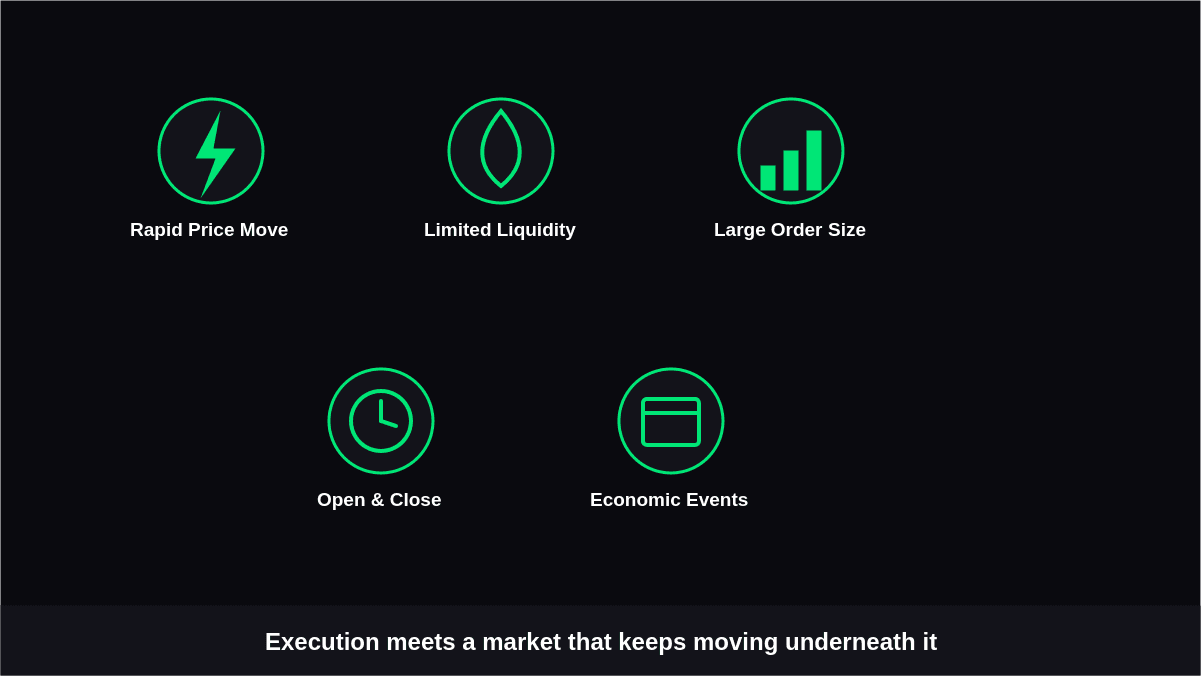
Several market and order-execution conditions can create a gap between the intended and actual execution price.
Rapid Price Movement
Prices can change within milliseconds when traders react to economic reports, earnings announcements, central bank decisions, or unexpected news. A market order submitted during such a movement may reach the order book after the quoted price has already changed.
This is particularly important for strategies that depend on entering or exiting positions quickly.
Limited Market Liquidity
Liquidity refers to how easily an asset can be bought or sold without causing a significant price change.
When an asset has fewer buyers and sellers at nearby prices, a large order may consume the available liquidity at the best quoted price. The remaining portion of the order may then be filled at progressively different prices.
Large Order Size
Order size can also influence execution. A small order may be completely filled at the best available price, while a larger order may require multiple price levels to complete.
This creates a greater possibility of receiving an average execution price that differs from the original quote.
Market Open and Close
Trading activity can change significantly around the market open and close. These periods can experience higher order volume, rapid price changes, and temporary imbalances between buyers and sellers.
Traders using market orders during these windows should account for potentially less predictable execution.
Economic and Market Events
Interest-rate decisions, inflation reports, employment data, company earnings, and major geopolitical developments can produce sudden price movements.
When prices move faster than orders can be matched, the execution price may differ considerably from the price visible when the order was submitted.
How Is Slippage Measured?
Slippage can be measured by comparing the expected price with the actual execution price.
A simple calculation is:
Slippage = Actual Execution Price − Expected Price
For a purchase, a positive difference generally means the trader paid more than expected. For a sale, the interpretation is reversed because receiving a lower price than expected can reduce the proceeds.
Example of Slippage Measurement
Suppose a trader expects to buy 100 shares at $40.00 but the order is filled at $40.08.
The per-share difference is:
$40.08 − $40.00 = $0.08
The total execution difference is:
$0.08 × 100 = $8
The trader therefore experienced $8 of price slippage on that order.
For traders analyzing many transactions, recording expected and actual execution prices makes it easier to identify whether execution costs are occasional or consistently affecting performance.
Negative Slippage vs. Positive Slippage
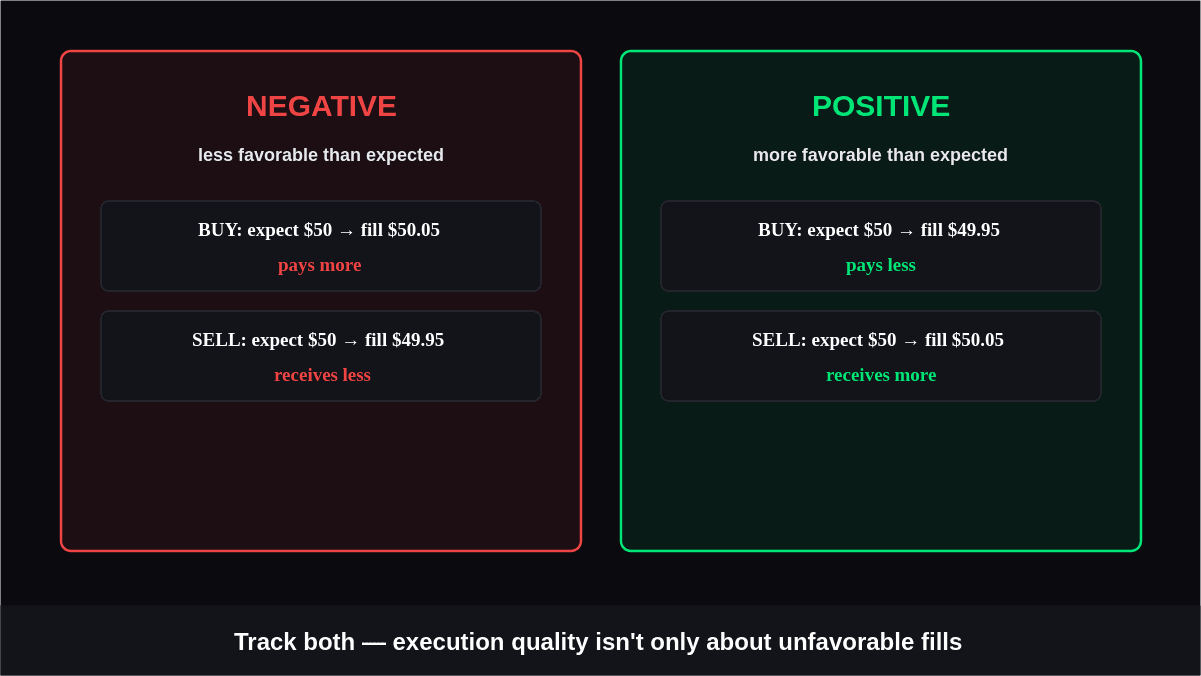
Slippage can either work against a trader or result in a better execution price than expected. The outcome depends on how the actual fill compares with the price the trader anticipated.
| Type of Slippage | What It Means | Buy Order Example | Sell Order Example |
|---|---|---|---|
| Negative Slippage | The trade executes at a less favorable price than expected. | Expected $50, executed at $50.05 | Expected $50, executed at $49.95 |
| Positive Slippage | The trade executes at a more favorable price than expected | Expected $50, executed at $49.95 | Expected $50, executed at $50.05 |
The key difference is the direction of the price movement relative to the trader's expected execution. Negative slippage can increase the cost of entering a position or reduce the proceeds from an exit, while positive slippage can improve the trade's outcome.
Tracking both types over multiple trades gives traders a more accurate view of their actual execution quality rather than focusing on unfavorable fills alone.
How Can Traders Calculate Slippage Across Multiple Trades?
Individual trade calculations are useful, but active traders should also evaluate slippage across a group of transactions.
A slippage calculator can help estimate the total difference between expected and executed prices. Traders can compare the results across different assets, trading sessions, order sizes, and order types.
For example, a trading journal could record:
| Trade | Expected Price | Actual Price | Difference | Order Size | Total Impact |
|---|---|---|---|---|---|
| A | $50.00 | $50.04 | $0.04 | 100 | $4 |
| B | $73.00 | $75.10 | $0.10 | 50 | $5 |
| C | $30.00 | $29.97 | -$0.03 | 200 | -$6 |
| D | $90.00 | $90.06 | $0.06 | 100 | $6 |
This type of record can reveal whether execution differences are concentrated around specific market conditions rather than occurring randomly.
How to Reduce Slippage in Trading
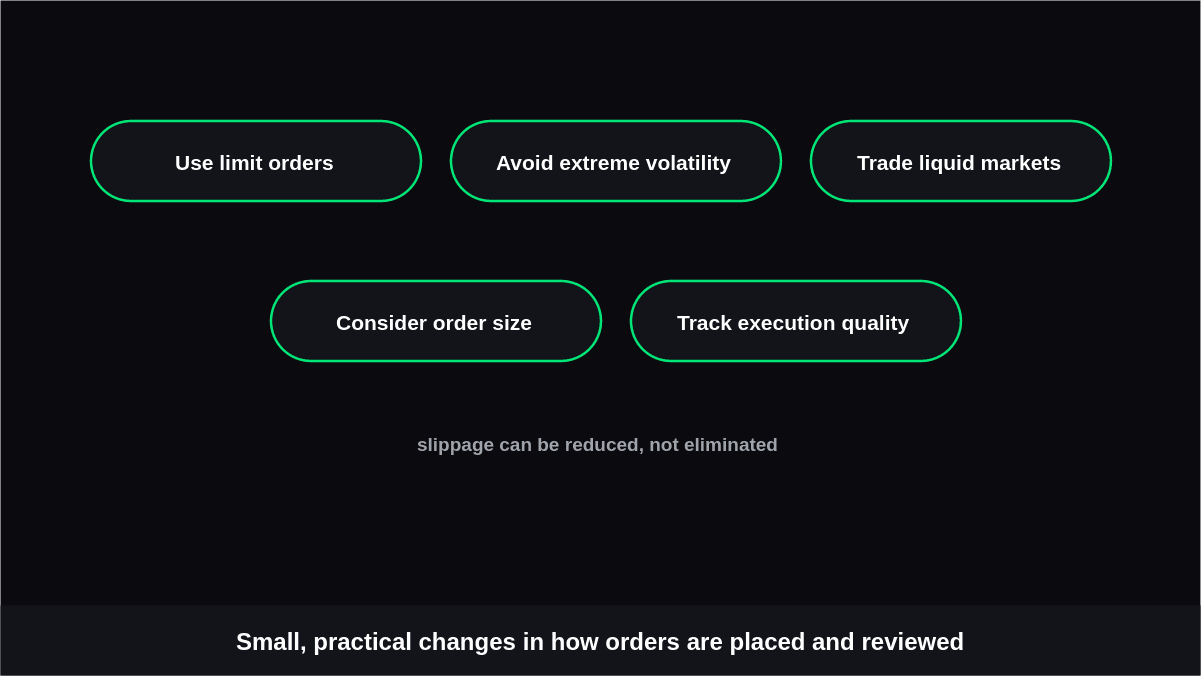
Slippage cannot be completely eliminated because market prices and available liquidity are constantly changing. However, traders can take practical steps to reduce its impact.
Use Limit Orders When Price Control Matters
A limit order allows traders to specify the maximum price they are willing to pay or the minimum price they are willing to accept.
This provides greater control over execution price than a market order, although there is a trade-off: the order may not be filled if the market does not reach the specified price.
Avoid Trading During Extreme Volatility
Entering positions immediately before or during major market announcements can expose traders to rapid price changes.
If a strategy does not specifically depend on news-driven volatility, waiting for conditions to stabilize may reduce execution uncertainty.
Trade More Liquid Markets
Highly liquid assets generally have more buyers and sellers competing around current prices.
Greater liquidity can make it easier for orders to execute near the quoted market price, although it does not guarantee zero slippage.
Consider Order Size
Breaking an unusually large order into smaller portions may reduce the chance of consuming multiple levels of available liquidity.
The appropriate approach depends on the market, strategy, fees, and execution system, so smaller orders are not automatically better in every situation.
Track Execution Quality
Keeping a detailed trading journal allows traders to identify recurring patterns.
If slippage is consistently higher during particular sessions, with specific assets, or after certain types of market events, those observations can inform future execution decisions.
Slippage and Different Order Types
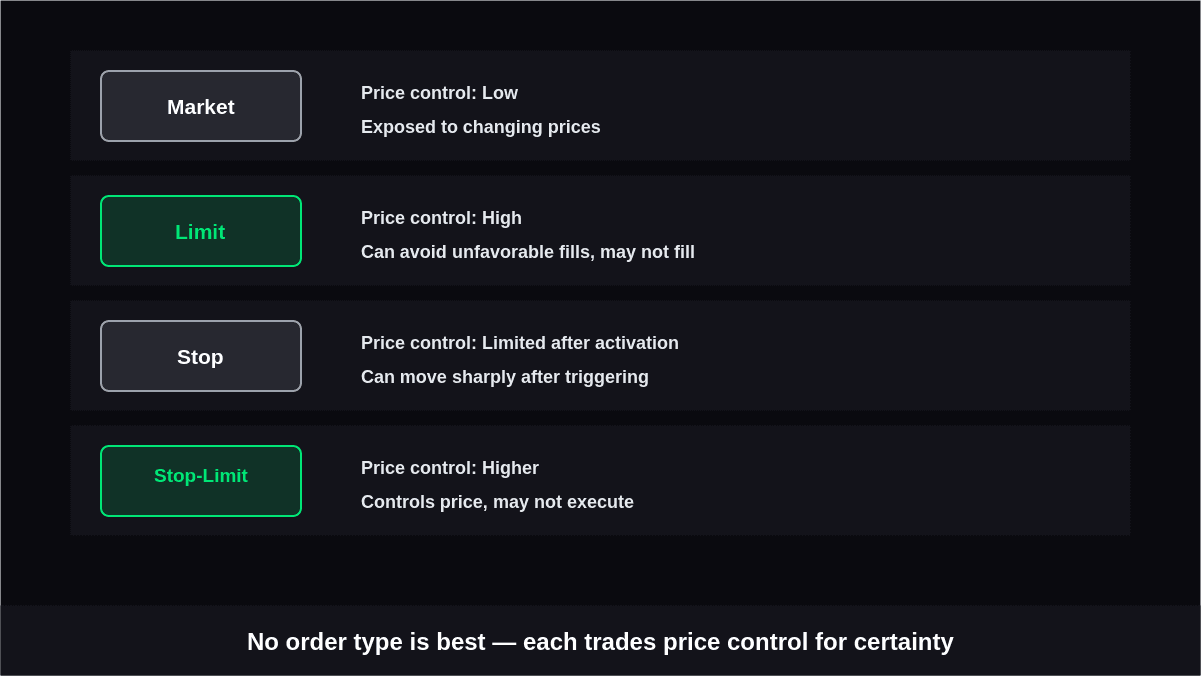
The order type a trader chooses can influence the balance between execution certainty and price control.
| Order Type | Price Control | Execution Certainty | Slippage Consideration |
|---|---|---|---|
| Market order | Low | Generally high | Exposed to changing prices |
| Limit order | High | Not guaranteed | Can avoid unfavorable fills but may remain unfilled |
| Stop order | Limited after activation | Depends on market | Can experience significant movement after triggering |
| Stop-limit order | Higher | Not guaranteed | Controls price but may not execute |
There is no universally best order type. The appropriate choice depends on whether the strategy prioritizes getting into or out of a position or controlling the exact execution price.
How Traders Can Monitor Slippage Over Time
Monitoring slippage becomes more useful when it is included in a regular performance review. Keeping consistent records allows traders to compare execution quality across different trades and market conditions.
A trader can track several factors, including:
- Expected price: The price at which the trader expected the order to execute.
- Actual fill price: The price at which the order was ultimately filled.
- Order type: Whether the trade used a market, limit, stop, or other order type.
- Position size: The number of shares or contracts involved in the trade.
- Asset and market session: The instrument traded and the time of day when the trade occurred.
- Market conditions: Factors such as volatility, liquidity, or major economic announcements.
After enough trades, these records can reveal useful patterns. For example, execution may be efficient during normal market hours but deteriorate around major economic releases. This information can help traders refine their execution process without unnecessarily changing the underlying strategy.
When Does Slippage Matter Most?
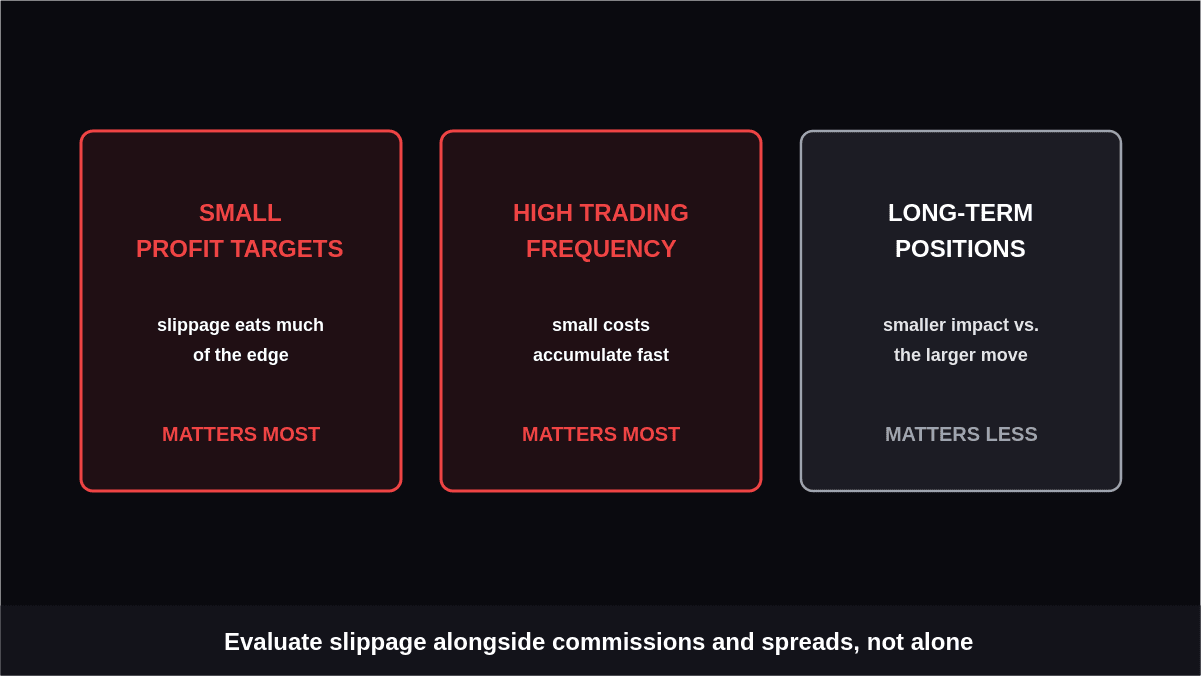
Slippage becomes particularly important when a strategy uses narrow profit targets or trades frequently. Even small execution differences can reduce a strategy’s expected returns when they occur across many trades.
The impact can be especially noticeable in these situations:
- Small profit targets: A strategy targeting minor price movements may lose much of its edge when slippage consistently reduces potential gains.
- High trading frequency: Frequent trades can cause small amounts of slippage to accumulate into a significant trading cost.
- Long-term positions: The same amount of slippage may have a smaller impact when a position targets a much larger price movement.
For this reason, traders should evaluate slippage alongside commissions, spreads, and other trading expenses. Looking only at the expected entry or exit price can give an incomplete picture of a strategy’s actual performance.
Final Thoughts
Slippage is a normal part of market execution, but its effect can vary significantly between assets, order types, market conditions, and trading strategies.
Fast-moving markets and low liquidity can increase execution differences, while limit orders and careful position management may help reduce unfavorable outcomes.
Rather than trying to eliminate slippage completely, traders should measure it consistently and understand when it affects their strategies most.
Slippage in trading becomes much easier to manage when execution data is treated as part of the process used to validate trading strategies, rather than as an isolated trading cost.