Entering a position with the full intended size is not the only way to participate in a market move. Scaling Into Trades allows traders to build a position through multiple entries instead of committing the entire amount at once.
This approach can provide more flexibility when price moves in stages, but it also introduces additional decisions around risk, timing, and exposure. Using a Position Sizing Calculator can help traders consider how each additional entry affects the overall position before incorporating the method into a trading plan.
In this blog you will explore the scaling into trades including the benefits, risks and the common mistakes.
What is Scaling?
Scaling is a trading approach where a trader builds or reduces a position through multiple transactions instead of handling the entire position in one order.
The process can involve scaling into a trade by adding smaller portions over time or scaling out by gradually closing part of an existing position.
The important part is having a clear plan for each transaction. Scaling should define when to add, how much to add, and when to stop, rather than becoming a reason to make repeated decisions based on short-term price movements.
What Does Scaling Into Trades Mean?
Scaling into a trade means opening a position gradually rather than entering the entire planned position at a single price.
For example, a trader may intend to buy 300 shares but divide the position into three 100-share entries.
The first order might be placed when a setup appears, while the remaining orders are triggered by predefined price levels or additional confirmation.
A scaling plan may involve:
- Starting with a partial position when the initial setup appears.
- Adding to the position when predefined conditions are met.
- Using price levels around support, resistance, or other technical areas to guide entries.
- Adding in the expected direction when price action provides further confirmation.
- Setting entry rules in advance so decisions are not driven by emotions during the trade.
The key distinction is that the entries should be planned before the trade develops. Adding randomly because a position feels uncomfortable is not the same as following a structured scaling approach.
How Scaling Into Trades Changes Position Building
A gradual entry process changes how capital is deployed during a trade.
Instead of putting the full amount at risk immediately, the trader initially commits only part of the planned exposure. If the setup develops according to the trading plan, additional portions can be added.
Consider a simple structure:
| Entry | Position Added | Example Price | Cumulative Position |
|---|---|---|---|
| Initial Entry | 100 | $50 | 100 |
| Second Entry | 100 | $51 | 200 |
| Third Entry | 100 | $52 | 300 |
| Position Complete | 0 | $52 | 300 |
This example illustrates how exposure can increase as the trade progresses. However, the increasing position size also means the consequences of a later exit can become larger.
Potential Benefits of a Gradual Entry
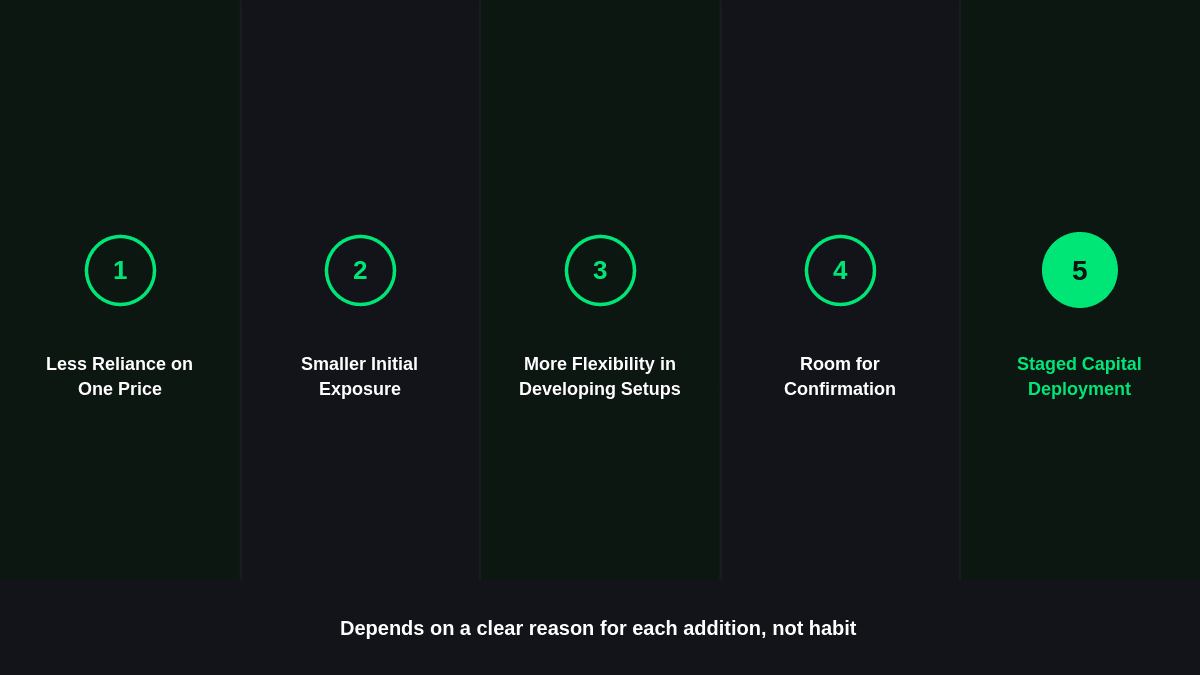
One advantage of scaling is that it can reduce the pressure associated with selecting a single entry price. A structured approach may offer several practical benefits:
- Less reliance on one entry price: The trader does not have to commit the entire position at a single price level.
- Initial exposure stays smaller: If the setup fails soon after the first order, only part of the planned position may be exposed.
- More flexibility in developing setups: A Trade Entry Strategy can define additional entries as new conditions appear rather than requiring every signal at once.
- Room for confirmation: Traders can begin with a smaller position and add only when price action provides further confirmation.
- Staged capital deployment: Capital can be committed progressively instead of being deployed all at once.
However, these advantages depend on having a clear reason for each addition. Splitting one position into several orders does not automatically reduce risk or make a trade safer.
The Risks Traders Need to Account For
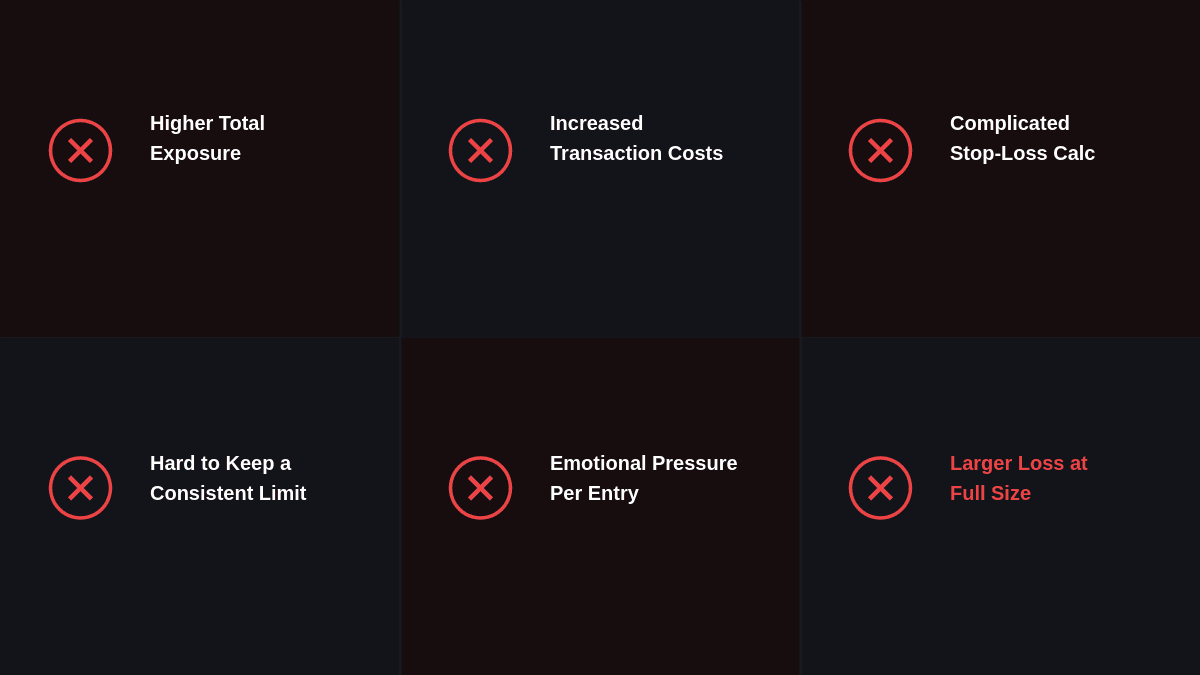
Scaling can increase complexity because every additional entry affects the overall position.
One important consideration is Risk Management. If a trader keeps adding to a losing position without reassessing the setup, the total exposure can become much larger than originally intended.
There is also the possibility of unfavorable price movement between entries. A trader might begin with a small position, add several times, and then experience a sharp reversal after reaching full size.
Other factors include:
- Higher total exposure after multiple additions
- Increased transaction costs in some markets
- More complicated stop-loss calculations
- Difficulty maintaining a consistent risk limit
- Emotional pressure after each new entry
- Potentially larger losses if the entire position reaches maximum size
A scaling plan therefore needs an explicit maximum position and maximum acceptable loss.
Scaling Into Trades vs. Averaging Down
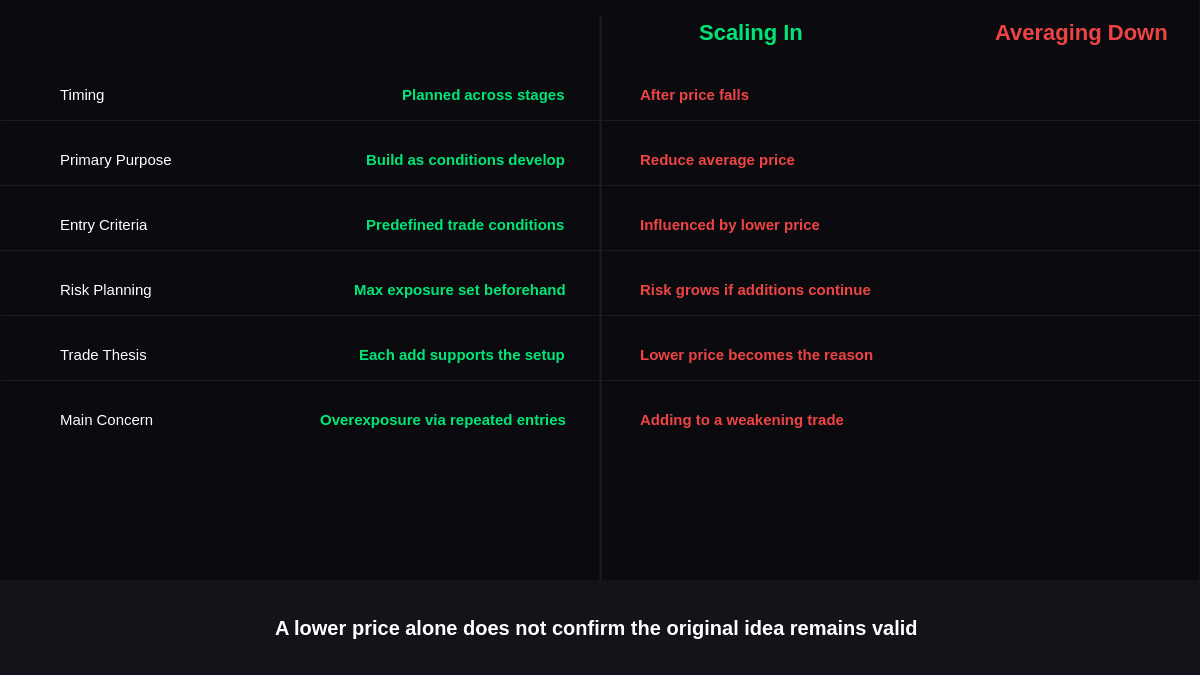
Scaling into a position and averaging down may look similar because both involve adding to an existing trade.
However, the reasoning behind each approach is different. Scaling is typically planned before the trade begins, while averaging down often occurs after price has moved against the position.
| Aspect | Scaling Into Trades | Averaging Down |
|---|---|---|
| Timing | Entries are planned across multiple stages | Additional entries occur after the price falls |
| Primary Purpose | Build a position as specific conditions develop | Reduce the average purchase price |
| Entry Criteria | Based on predefined trade conditions | Often influenced by the lower market price |
| Risk Planning | Maximum exposure can be established beforehand | Risk can increase if additions continue |
| Trade Thesis | Each addition should support the original setup | A lower price may become the main reason for adding |
| Main Concern | Overexposure through repeated entries | Increasing exposure to a trade that may be weakening |
The important distinction is why the trader is adding to the position. A lower price alone does not confirm that the original trade idea remains valid.
A structured scaling plan should specify the conditions that justify each additional entry and when no further additions are allowed.
How to Build a Controlled Scaling Plan
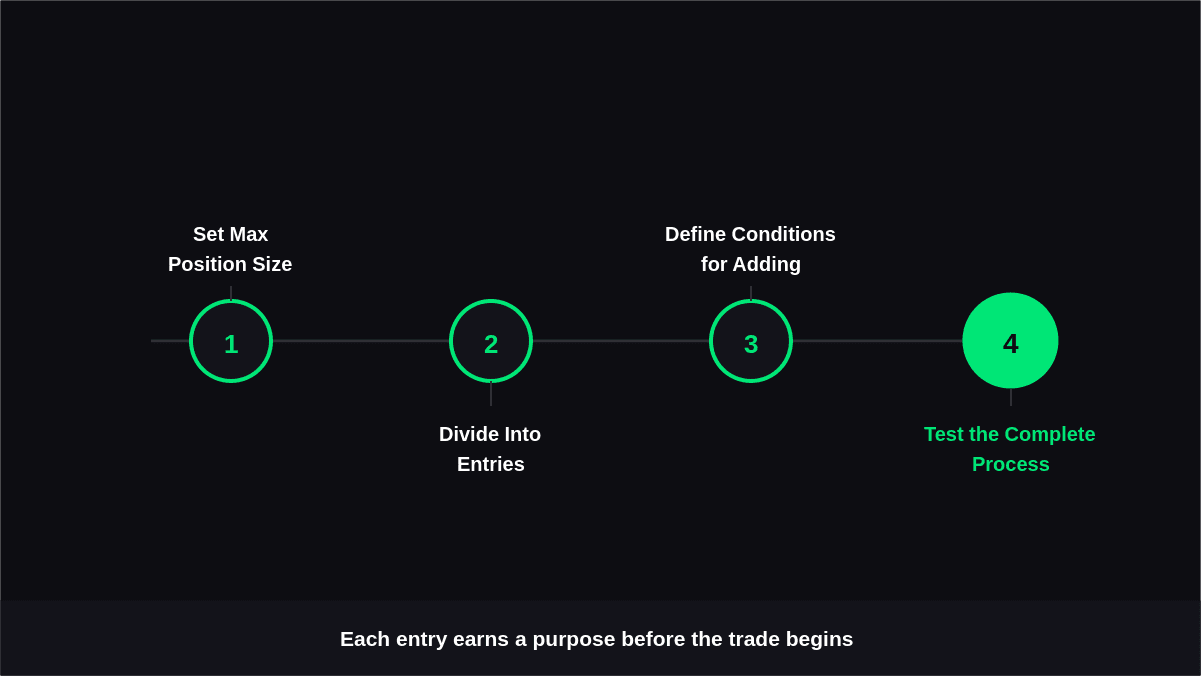
A controlled scaling plan gives each entry a defined purpose before the trade begins. Use these four steps to keep the process structured and prevent additional entries from becoming impulsive decisions.
1. Set the Maximum Position Size
Start with Position Sizing and determine the largest position you are willing to hold. Establishing this limit first prevents multiple entries from gradually creating more exposure than intended.
2. Divide the Position Into Entries
Decide how the total position will be distributed across each entry. You can use equal portions or assign different sizes depending on the strength of the conditions supporting each entry.
3. Define Conditions for Adding
Specify exactly what needs to happen before another portion is added. This could involve price behavior, confirmation from the setup, or another objective condition. Also define when no further additions are permitted.
4. Test the Complete Process
Review the scaling plan using historical data or simulated trades before applying it with real capital. Assess the entire position, including every entry and the resulting risk, rather than evaluating each transaction separately.
When Should Traders Avoid Scaling?
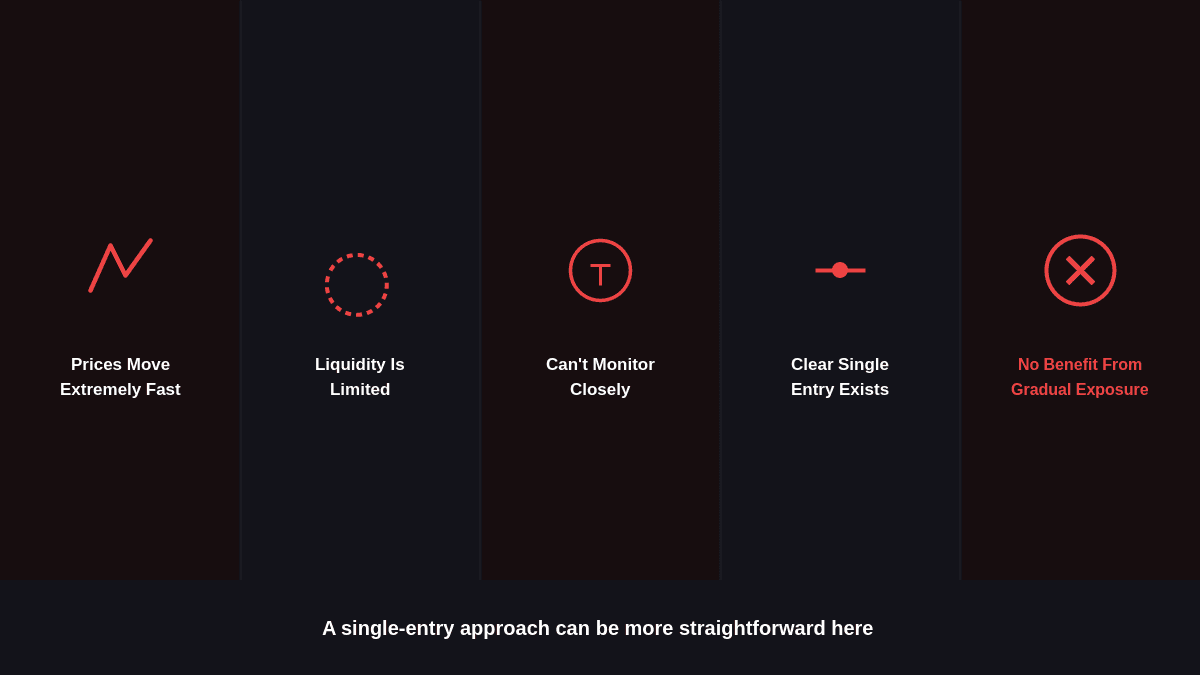
Scaling is not appropriate for every market situation or trading style. It can become harder to control when market conditions change rapidly or when execution does not match the assumptions behind the plan.
Traders may want to reconsider scaling when:
- Prices are moving extremely quickly, increasing the chance that orders are filled away from expected levels.
- Market liquidity is limited, making multiple entries more difficult to execute efficiently.
- The position cannot be monitored closely, which can make it harder to follow predetermined entry and risk rules.
- The setup has a clear single entry, where dividing the position may add unnecessary complexity.
- The strategy does not benefit from gradual exposure, making multiple entries difficult to justify.
A single-entry approach can be more straightforward when the trade already has a clearly defined entry, stop, and position size.
The goal is not to make every trade more complicated, but to use gradual entries only when they serve a specific purpose within the overall strategy.
Scaling Into Trades Requires More Than Multiple Entries
Scaling Into Trades can give traders a structured way to build exposure without committing the entire position immediately. Its usefulness depends on how clearly the trade is planned.
A controlled approach should include:
- Defined entry points for each portion of the position.
- A maximum position size to prevent exposure from growing beyond the original plan.
- Clear exit conditions that apply to the overall position.
- Specific reasons for each additional entry rather than adding simply because price moves.
- Consistent risk limits that remain relevant as the position grows.
Treating every addition as a planned decision helps keep position size, risk limits, and the original trade thesis connected throughout the trade.
Common Mistakes That Undermine the Strategy
One of the most common mistakes is adding without a predefined limit. A trader may begin with a modest position and repeatedly add because the market has not yet produced the expected move.
Another mistake is treating every entry as a separate trade while ignoring the combined exposure. Three small positions can collectively create a large position once they are viewed together.
Traders may also calculate risk using only the first entry. Once additional units are added, the original risk calculation may no longer represent the actual position.
Avoid these problems by establishing:
- The maximum position size before entering.
- The conditions required for each additional entry.
- The total loss that is acceptable if the complete position fails.
- The point where no further additions are allowed.
- The conditions that invalidate the original trade idea.
Conclusion
Scaling Into Trades can provide flexibility when a trading setup is expected to develop through multiple stages, but adding to a position also increases the need for disciplined risk control.
A well-defined plan should establish the entry conditions, maximum exposure, and exit rules before the trade begins. Traders can also validate trading strategies involving multiple entries to determine whether the approach supports the original trade plan rather than encouraging impulsive decisions that increase unnecessary exposure.