A premium indicator buy can be useful when a trading tool offers functionality that genuinely supports your analysis. However, paying for an indicator does not automatically make it more accurate or suitable for every trader.
The better approach is to evaluate what the tool does, how its signals behave, whether it fits your trading style, and whether its cost is justified by its practical value.
Before purchasing, traders should look beyond promotional claims and assess the indicator based on features, transparency, usability, and compatibility with their existing strategy.
This evaluation can also help traders validate trading strategies before relying on a paid tool as part of their workflow.
What Is a Premium Indicator?
A premium indicator is a paid trading tool designed to provide additional market analysis, signals, alerts, or charting features beyond what may be available through basic indicators. Traders may use these tools to organize market information and support their existing trading strategies.
Unlike standard technical indicators, premium tools may offer more customization or specialized functionality.
What Makes a Premium Trading Indicator Different?
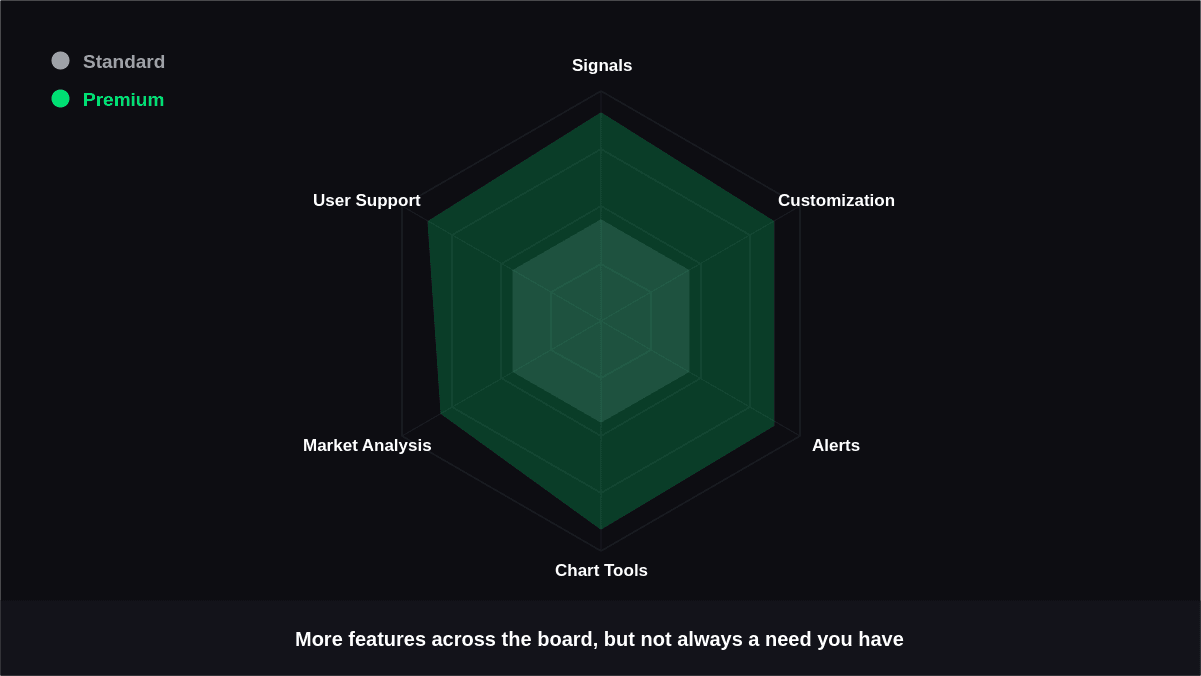
Premium trading indicators often provide more functionality than basic charting tools. Depending on the product, this may include configurable signals, alerts, multiple settings, additional market analysis, or a cleaner way to interpret price movements.
The important distinction is not simply whether an indicator is paid. It is whether the additional functionality solves a real problem for the trader.
For example, a trader who struggles to monitor several charts may benefit from customizable alerts. Another trader may value additional confirmation tools, such as signals and overlays, that help organize an existing technical analysis process.
Features Worth Paying Attention To
When comparing indicators, consider features that have practical relevance:
- Clear and understandable signals
- Customizable settings
- Trading alerts
- Support for relevant markets and timeframes
- Easy-to-read chart presentation
- Documentation explaining how the tool works
- Compatibility with the trader's existing workflow
A long feature list is not necessarily better. The most useful tool is usually the one that provides functions a trader can actually incorporate into a consistent process.
Premium vs Standard Indicators
Premium and standard indicators can both help traders interpret price movements, identify trends, and assess potential setups. The main difference is usually the level of functionality, customization, and additional features available.
To understand it better follow the given table:
| Feature | Standard Indicator | Premium Indicator |
|---|---|---|
| Core analysis | Provides basic market information | May combine multiple analytical features |
| Signals | Often offers simple signals or calculations | May provide more configurable or detailed signals |
| Customization | Usually has limited settings | Often provides broader customization options |
| Alerts | May include basic alerts | Can offer more flexible alert conditions |
| Chart tools | Basic visual presentation | May include additional chart-based features |
| Market analysis | Focuses on standard calculations | May provide additional confirmation or analysis |
| User support | Often limited or community-based | May include dedicated documentation or support |
| Cost | Usually free or low-cost | Typically requires a purchase or subscription |
A premium indicator can be useful when its additional features address a specific need in your trading workflow. However, traders should evaluate the actual functionality rather than assuming a paid tool will automatically produce better results.
How to Evaluate an Indicator Before You Buy
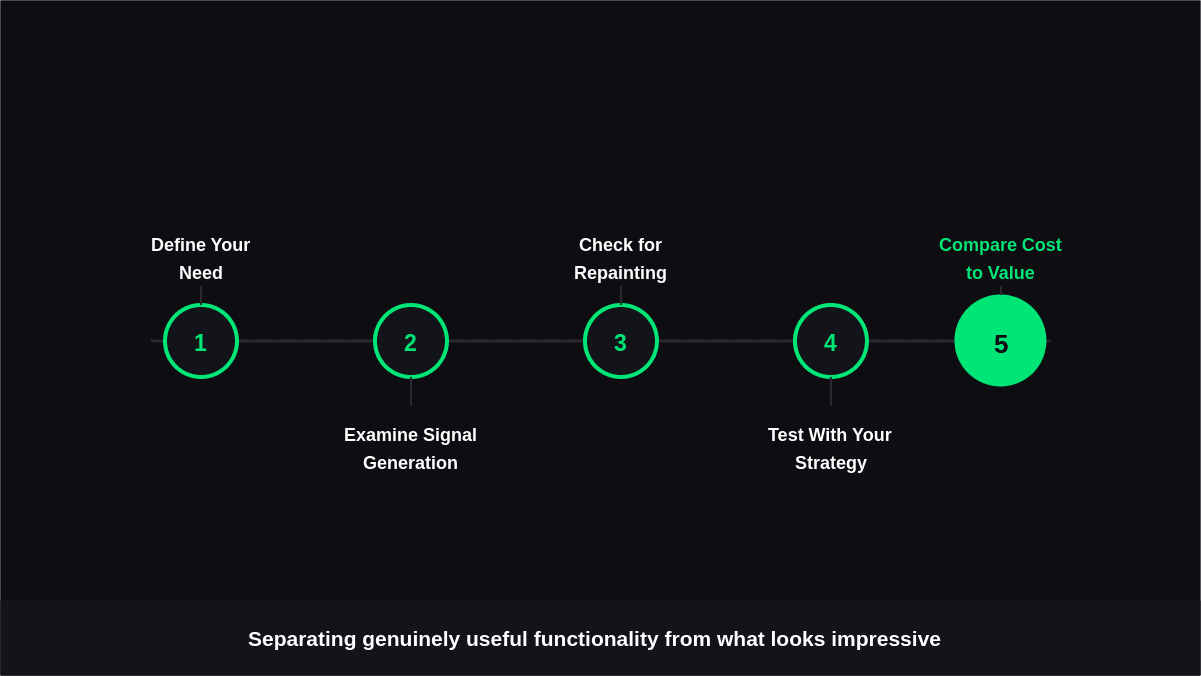
A structured evaluation can help separate useful functionality from features that simply look impressive. Before making a purchase, consider how the indicator works, what it offers, and whether those features match your trading needs.
1. Define What You Need From the Indicator
Start with the problem you want the indicator to solve. Are you looking for clearer entry signals, trend confirmation, alerts, or a way to organize existing analysis?
Defining the purpose first makes it easier to compare products objectively. Without a specific need, it is easy to purchase an indicator simply because it has more features than another option.
2. Examine How Signals Are Generated
Understanding what produces a signal is more valuable than simply counting how many signals appear on a chart.
Look for information about the conditions behind the indicator's signals and whether the developer explains its intended use.
You should also understand whether signals are designed for confirmation, entries, trend identification, or another purpose.
This helps prevent unrealistic expectations about what the tool can accomplish.
3. Check for Repainting and Signal Behavior
Historical charts can sometimes make an indicator look more reliable than it may be during live trading. If previous signals can change as new price data arrives, the historical appearance may not accurately represent what a trader would have seen in real time.
Understanding whether an indicator repaints, how its signals are displayed, and when alerts are triggered can therefore be an important part of the evaluation process.
4. Test It With Your Existing Strategy
An indicator should fit into your trading process rather than force you to abandon a strategy that already makes sense for you.
Consider how its signals interact with your entry rules, confirmation methods, stop placement, profit targets, and risk management. Testing this relationship can reveal whether the tool adds useful information or simply creates more chart noise.
5. Compare the Cost With Practical Value
Price should be considered alongside functionality.
A low-cost tool may offer everything a trader needs, while a more expensive product may include features that the trader never uses. Consider the purchase or subscription cost, available functionality, updates, support, and the amount of value the tool could realistically add to your workflow.
Premium Indicator Buy: Questions to Ask Before Purchasing
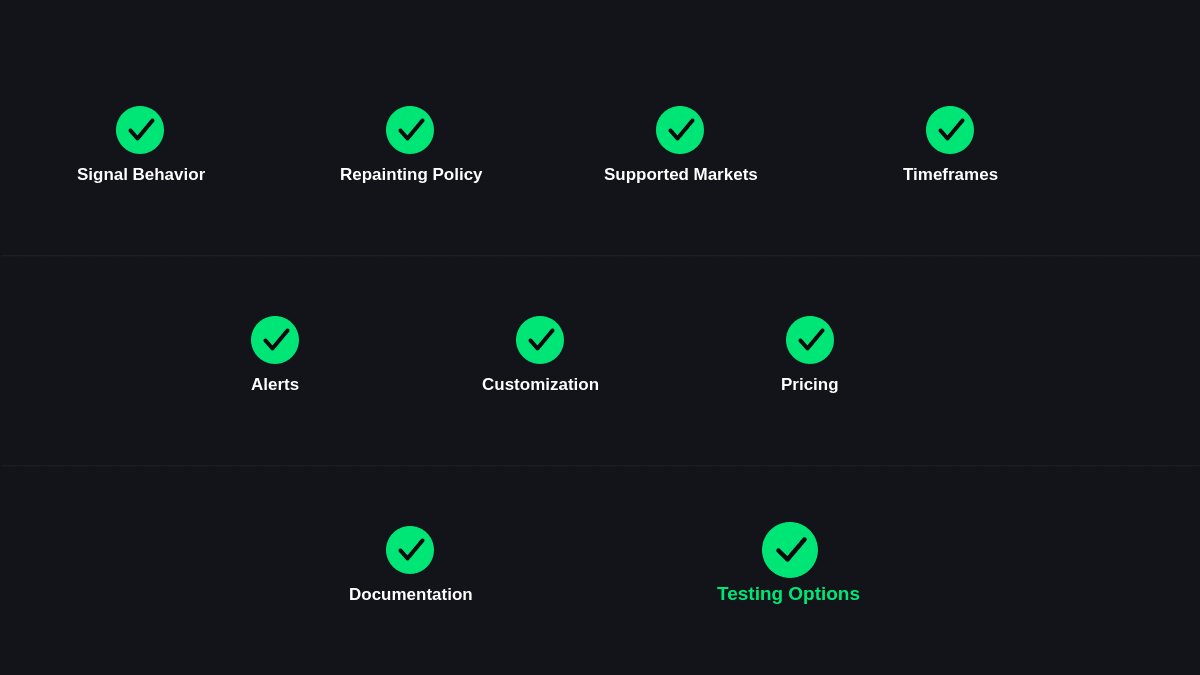
Before completing a premium indicator buy, use a simple checklist to assess whether the tool fits your trading needs.
| What to Check | Why It Matters |
|---|---|
| Signal behavior | Shows how the tool responds to changing market conditions |
| Repainting policy | Helps determine whether historical signals can change |
| Supported markets | Confirms compatibility with the assets you trade |
| Timeframes | Determines whether the tool fits your trading approach |
| Alerts | Makes it easier to monitor potential setups |
| Customization | Lets traders adjust the tool to their workflow |
| Pricing | Shows the actual financial commitment |
| Documentation | Helps explain features, settings, and intended use |
| Testing options | Provides an opportunity to evaluate functionality |
This type of comparison is more useful than choosing an indicator based solely on its price or appearance.
How to Test a Premium Indicator After Purchase
After purchasing a paid trading indicator, avoid immediately changing your entire trading process around it. Instead, take time to understand how it works and evaluate its usefulness through a structured process:
- Understand what each option does and what different signals represent.
- Monitor the indicator during strong trends, consolidation, and periods of changing volatility.
- Keep track of a broader sample instead of focusing only on successful setups. This can help reduce hindsight bias.
- See whether the indicator supports your existing strategy or simply adds more chart noise.
- If it consistently provides useful information without making your process unnecessarily complicated, it may have a meaningful role in your workflow.
When a Premium Indicator May Not Be the Right Choice
A paid indicator may not be worthwhile for every trader. If you are still developing a basic trading strategy, purchasing additional tools may add complexity before you have a clear process to use them.
It may also be unnecessary when an existing free or built-in indicator already provides the information you need.
Most importantly, an indicator should not be purchased with the expectation of guaranteed profits. Market conditions change, signals can fail, and no analytical tool removes trading risk.
Matching a Paid Indicator to Your Trading Approach
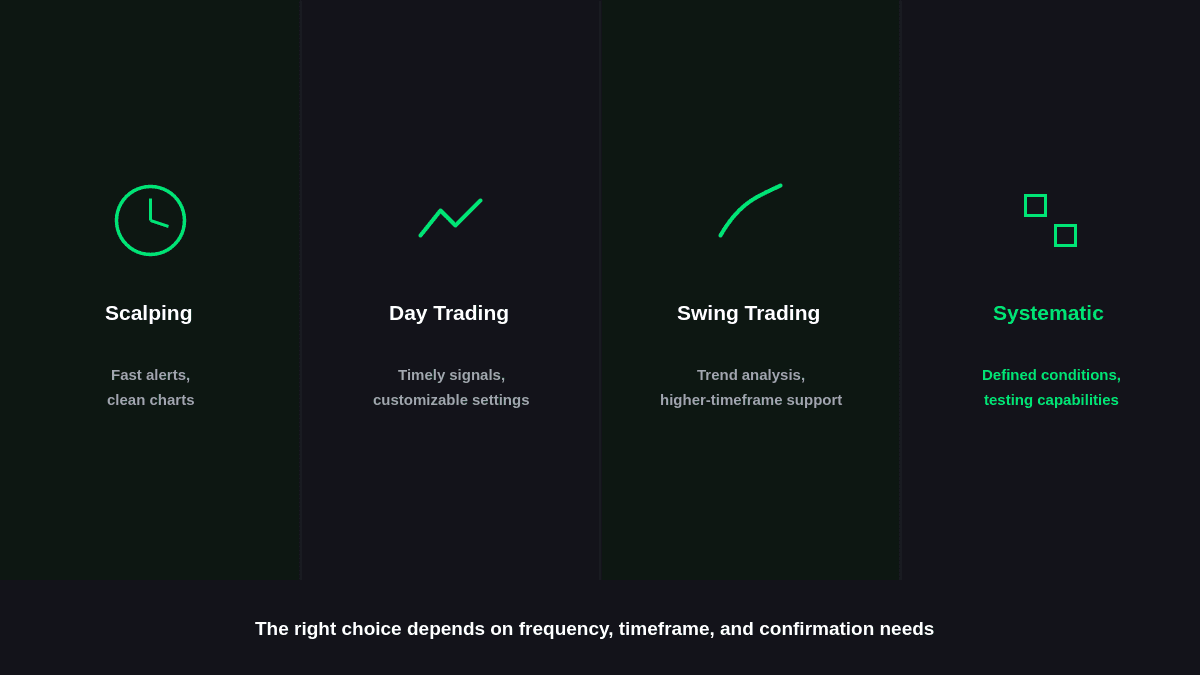
Different trading styles require different types of analytical support, so an indicator that works well for one trader may not suit another. The right choice depends on factors such as trading frequency, timeframe, and how much confirmation the trader needs.
| Trading Style | What to Look For | Why It Matters |
|---|---|---|
| Scalping | Fast alerts, clean charts, lower-timeframe support | Helps traders monitor short-term opportunities efficiently |
| Day Trading | Timely signals, customizable settings, clear market context | Supports decision-making during active trading sessions |
| Swing Trading | Trend analysis, higher-timeframe support, confirmation tools | Helps assess setups that may remain open for several days |
| Systematic Trading | Defined conditions, consistent signals, testing capabilities | Makes it easier to evaluate the tool within a structured process |
Choosing an indicator based on your trading style can prevent unnecessary features from complicating your charts.
The goal is to find a tool that complements your existing approach and provides information you can use consistently.
Common Mistakes When Buying Trading Indicators
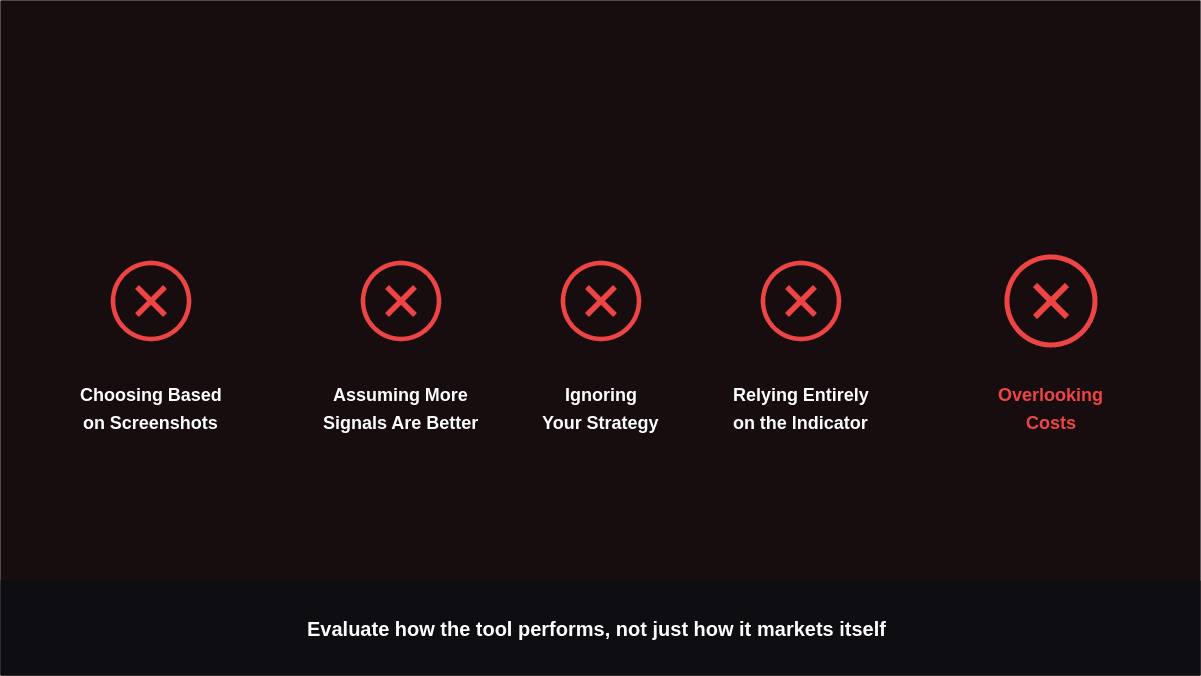
Buying a trading indicator without evaluating how it fits your strategy can lead to unnecessary costs and more complicated decision-making. Traders should look beyond promotional claims and consider how the tool performs, what its signals mean, and whether it genuinely adds value to their workflow.
Common mistakes include:
- Choosing based on screenshots
- Assuming more signals are better
- Ignoring your own strategy
- Relying entirely on the indicator
- Overlooking costs
Final Takeaway
A premium indicator buy should be based on functionality and fit rather than price, popularity, or attractive historical charts. Evaluate how the tool generates signals, whether its behavior is transparent, what markets and timeframes it supports, and how naturally it fits into your existing strategy.
Traders should also consider to verify a tradingview indicator doesn't repaint before relying on its historical signals. A useful indicator should make analysis more structured or efficient without replacing sound decision-making and risk management.
Taking time to evaluate these factors before relying on a tool can lead to a more informed purchasing decision.