Overnight Gaps vs Intraday Gaps is an important distinction for traders who use price action concepts to understand what is happening in the market. While both involve a sharp difference between traded prices, they do not form under the same conditions. An overnight gap appears between one trading session and the next, often after news or other developments occur while the market is closed. An intraday gap, on the other hand, develops while the market is open and can be triggered by sudden news, order imbalances, or changes in liquidity.
The difference matters because the information available to traders is not the same in each situation. Looking at the timing, catalyst, volume, and price action around a gap can provide a clearer picture of what the move may actually mean.
What Are Overnight Gaps and Intraday Gaps?
Overnight gaps are those gaps that occur when the stock opens at a price quite different from where it had ended in the last trading period. This usually happens because of significant moves in the market even when the market is closed.
Intraday gaps are those that occur in a period of active trading where prices experience a sharp move from one traded level to another, mostly due to newsworthy events, imbalances in orders, trading suspension, or liquidity changes.
Overnight Gaps vs Intraday Gaps Formation
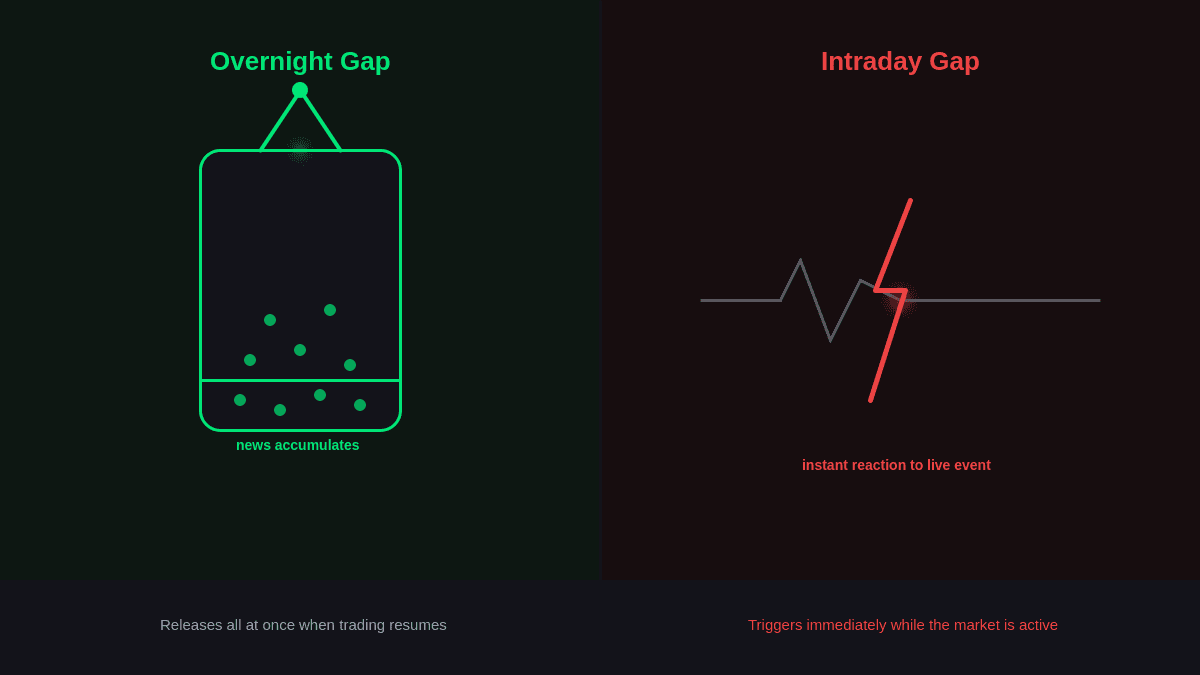
The main difference in formation of these is when the gap occurs and what triggers the price move. Overnight gaps form between trading sessions, while intraday gaps develop during active market hours.
To understand the formation better here we have given a proper detail:
How Overnight Gaps Form
An overnight gap appears when a security opens at a substantially different price from its previous session's close. The market may continue to receive information after regular trading ends, but that information cannot always be reflected in the stock's regular-session price until trading resumes.
Common catalysts include:
- Earnings releases
- Economic indicators
- Company news
- Investment advice
- Global political events
- Significant moves in correlated markets
For instance, a firm that experiences better-than-expected profits after the market closes will receive buying pressure before the next day's trading session begins. When the market reopens, the share price may begin much higher than where it last closed.
How Intraday Gaps Form
An intraday gap occurs during an active trading session when price moves rapidly between areas where little or no trading takes place. These situations can develop because of:
- Unexpected announcements in the market
- Suspension of trading and later price changes
- Large order imbalances
- Sudden change in market liquidity
- Changes in market pressure to buy or sell
Unlike an overnight gap, an intraday gap develops while the market is open. Traders can observe the surrounding price action as the event unfolds, although rapid movements can make execution more difficult.
What Causes Each Type of Gap?
The underlying catalyst matters because the same-sized gap can have very different implications depending on why it occurred.
| Factor | Overnight Gap | Intraday Gap |
|---|---|---|
| Timing | Between trading sessions | During an active session |
| Common catalyst | News released outside regular hours | Live news or order imbalance |
| Price discovery | Concentrated around the next open | Develops during ongoing trading |
| Liquidity | Can change significantly at the open | Varies throughout the session |
| Initial reaction | Often concentrated in opening activity | Can develop around the catalyst |
An overnight gap may represent the market incorporating several hours of new information at once. An intraday gap, by contrast, can reflect a sudden change in expectations while participants are already trading.
The distinction is useful because the circumstances surrounding the price move can provide more information than the size of the gap itself.
Gap Up and Gap Down: Does Direction Change the Analysis?
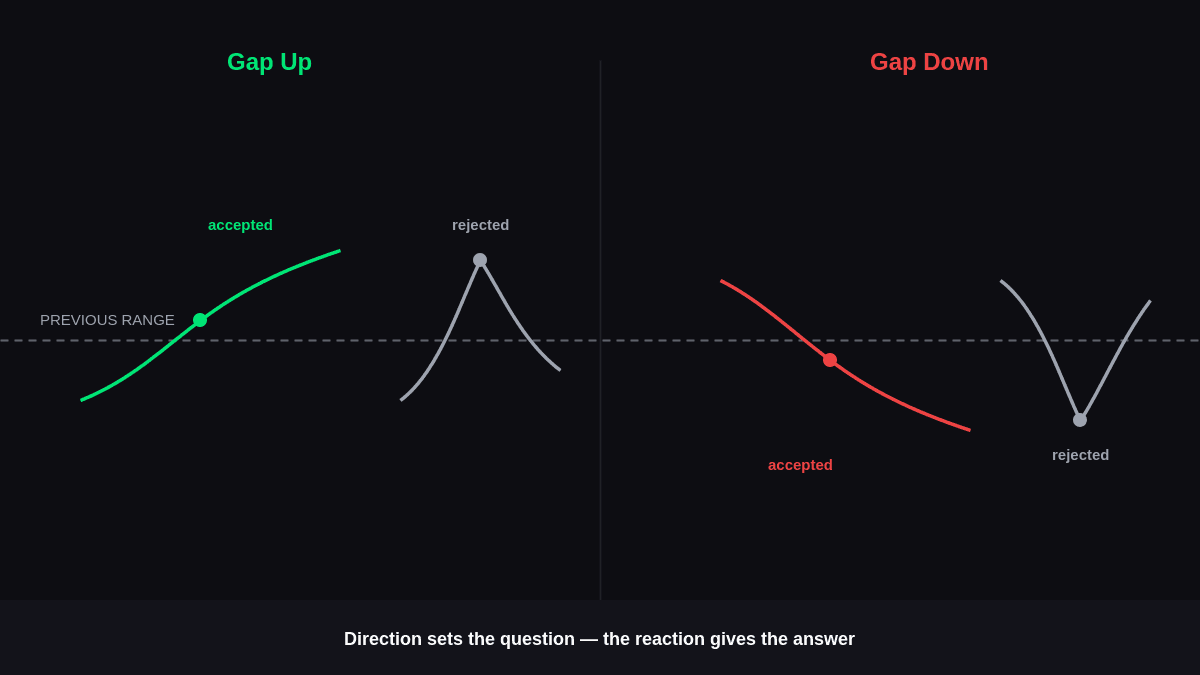
The direction of a gap provides useful context, but it should not be treated as a standalone trading signal.
When Price Opens Above the Previous Range
A gap higher indicates that the market is accepting a price above the previous reference point. Traders may then watch whether buyers sustain that level, whether volume supports the move, and whether the price encounters significant support resistance.
A strong opening followed by continued buying can indicate sustained demand. A rapid rejection, however, may show that sellers are willing to enter at the higher level.
When Price Opens Below the Previous Range
A downward gap places price below the previous reference area. Traders may examine nearby support, selling volume, and whether the lower price is accepted or rejected.
A stock that gaps lower but quickly recovers may be behaving differently from one that continues declining with strong participation.
The important point is that a gap up and gap down describe direction, not the eventual outcome. Neither guarantees continuation or reversal.
Comparing the Trading Risks of Overnight and Intraday Gaps
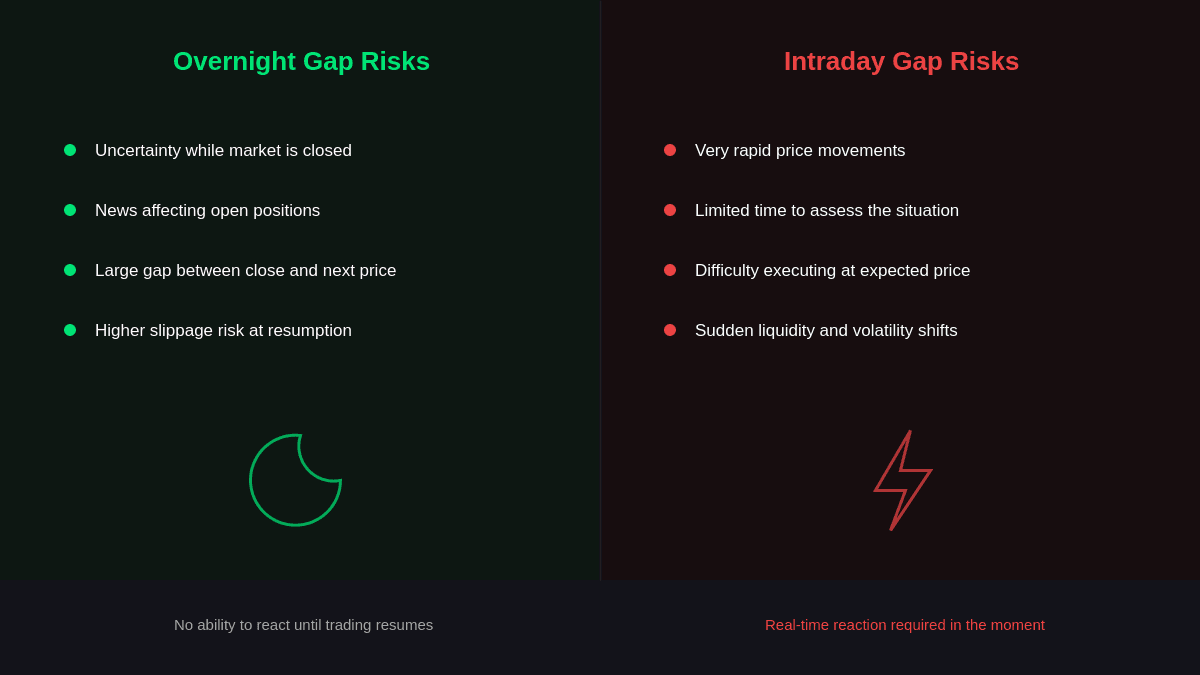
The two gap types create different risk considerations because traders have different amounts of information and control over execution.
Overnight gap risks include:
- Uncertainty while the regular market is closed
- Earnings, economic data, or unexpected news affecting open positions
- Large differences between the previous close and next available price
- Higher risk of slippage when trading resumes
Intraday gap risks include:
- Very rapid price movements
- Limited time to assess the situation
- Difficulty executing orders at the expected price
- Sudden changes in liquidity and volatility
Both situations can involve slippage and elevated volatility. A predefined risk level can help structure a trade, but it does not guarantee execution at an exact price during unusually fast markets.
Key Differences Between Overnight and Intraday Gaps
Overnight and intraday gaps differ mainly in their timing, catalysts, and trading conditions. Overnight gaps form between sessions, while intraday gaps develop during active market hours.
The table below highlights the key differences traders should consider when evaluating each type.
| Feature | Overnight Gaps | Intraday Gaps |
|---|---|---|
| Formation | Between trading sessions | During an active session |
| Primary information | Developments outside regular hours | Real-time catalysts and order flow |
| Trader reaction | Often begins around the open | Can occur immediately |
| Main consideration | Opening volatility | Rapid price behavior |
| Key risk | Overnight uncertainty | Fast execution and volatility |
| Useful confirmation | Opening volume and follow-through | Volume and price structure |
The comparison shows why these gaps should not automatically be interpreted using the same framework. Their timing, catalysts, and surrounding market conditions can all differ.
A Practical Framework for Comparing a New Gap
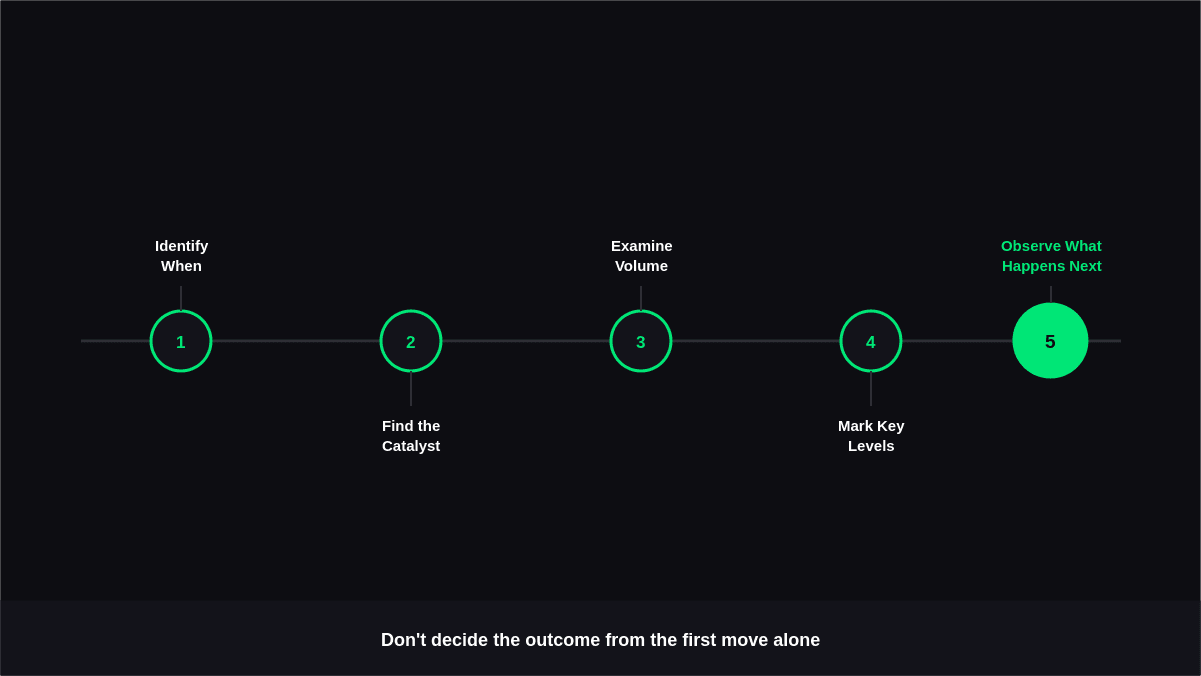
When a new gap appears, traders can use a structured process to determine what they are actually observing.
1. Identify When It Occurred
First determine whether the move developed between sessions or during active trading. This establishes the basic context for the gap.
2. Find the Catalyst
Look for earnings, economic releases, company news, market-wide developments, or changes in liquidity that could explain the move.
3. Examine Volume
Compare the activity surrounding the gap with normal trading volume. Participation can help distinguish a heavily supported move from one occurring in thinner conditions.
4. Mark Important Price Levels
Note the previous close, recent highs and lows, support, resistance, and the opening price. These levels can help show whether the market is accepting or rejecting the new area.
5. Observe What Happens Next
Avoid deciding the outcome based solely on the initial gap. Follow-through, rejection, consolidation, or retracement can provide additional evidence about market behavior.
Which Gap Type Should Traders Pay More Attention To?
Neither type is universally more important. Its relevance depends largely on the trader’s timeframe and exposure.
Traders should consider:
- Holding positions overnight: Pay closer attention to developments that may affect the next session’s opening price.
- Short-term intraday trading: Focus more on live price behavior, volume, and catalysts developing during the session.
- Trading timeframe: Evaluate each gap according to how long the position is expected to remain open.
- Market monitoring: Consider how closely the trader can follow price movements and respond to sudden changes.
- Risk tolerance: Account for the level of volatility and execution risk the trader is prepared to handle.
- Strategy validation: Use approaches that have been tested under market conditions similar to those being traded.
A gap should therefore be evaluated within its specific market context rather than treated as an isolated pattern.
Conclusion
Overnight Gaps vs Intraday Gaps differ mainly in when they occur, what triggers them, and how traders can respond to the resulting price movement. Overnight gaps reflect information that reaches the market between trading sessions, while intraday gaps develop as new events and order imbalances emerge during active trading. Neither type guarantees continuation, reversal, or a gap fill. Traders should consider the catalyst, volume, liquidity, key levels, and subsequent price action before drawing conclusions from a gap. Understanding these differences allows traders to evaluate each situation within its proper market context rather than applying the same assumptions to every gap.