Options trading involves more than predicting whether an asset will move up or down. Options Greeks help traders understand how an option's price may respond to changes in the underlying asset, time, volatility, and interest rates.
They provide a framework for examining different sources of option risk before entering or managing a position.
Each Greek measures a different sensitivity. Delta relates to the underlying asset's price, Gamma shows how Delta can change, Theta focuses on time decay, while Vega measures sensitivity to implied volatility.
Rho addresses interest-rate changes. Understanding how these measurements interact can help traders evaluate positions more systematically, alongside factors such as Unusual Options Activity, instead of relying only on the option's current premium.
In this blog, we will discuss:
- What are Options Greeks?
- 7 things every trader should know about Options Greeks
- How the Greeks can affect option positions
- How traders can use them when evaluating risk
- Frequently asked questions about Options Greeks
What Are Options Greeks?
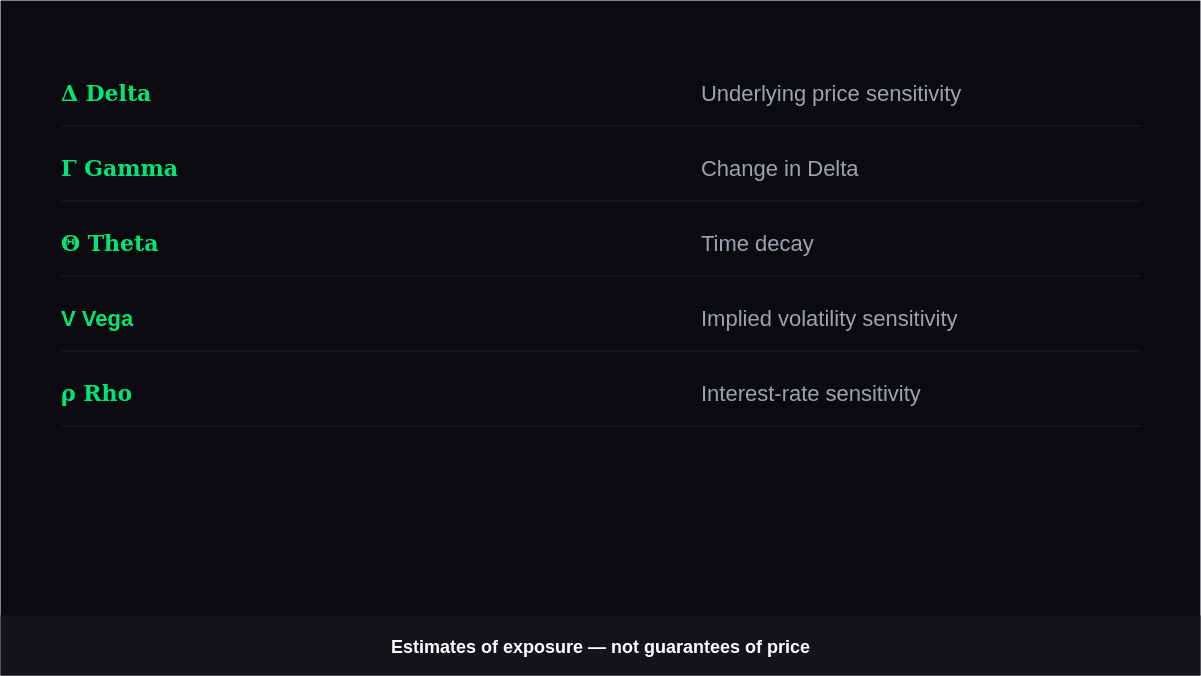
Options Greeks are measurements used to estimate how an option's theoretical price may respond to specific changes in market conditions. They are commonly used to analyze an option's exposure before and after a trade is placed.
The main Greeks include:
| Greek | What It Measures | Why It Matters |
|---|---|---|
| Delta | Sensitivity to the underlying asset's price | Helps assess directional exposure |
| Gamma | Change in Delta | Shows how quickly directional exposure can shift |
| Theta | Sensitivity to the passage of time | Highlights the effect of time decay |
| Vega | Sensitivity to implied volatility | Helps evaluate volatility exposure |
| Rho | Sensitivity to interest rates | Shows potential rate-related effects |
These measurements are estimates rather than guarantees. Actual option prices can be influenced by several variables simultaneously.
7 Things Every Trader Should Know About Options Greeks
The Greeks become more useful when they are viewed as a connected risk framework rather than isolated numbers. The following seven concepts cover the main considerations traders should understand when analyzing an options position.
1. Delta Shows How Directional Exposure Can Change
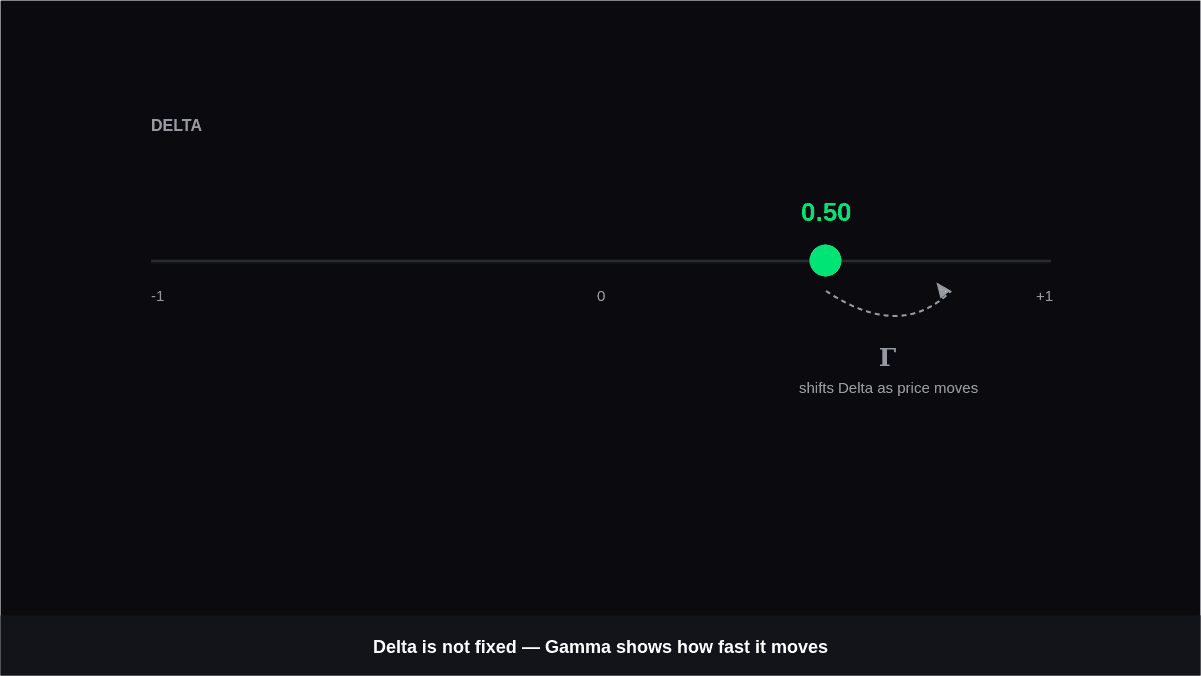
Delta estimates how much an option's price may change for a one-unit move in the underlying asset, all else being equal.
For example, a call with a Delta of 0.50 has an estimated price sensitivity of approximately $0.50 for a $1 increase in the underlying asset. Put options generally have negative Delta because their value tends to move in the opposite direction.
Important points include:
- Call Delta generally ranges from 0 to 1.
- Put Delta generally ranges from -1 to 0.
- Delta can change as the underlying price moves.
- Delta is also sometimes used as a rough probability-related measure, but it should not be treated as an exact probability of profit.
Delta is therefore useful for understanding the directional character of an option rather than simply determining whether it is bullish or bearish.
2. Gamma Explains Why Delta Is Not Fixed
Delta does not remain constant throughout an option's life. Gamma measures the rate at which Delta changes when the underlying asset moves.
Consider an option with a Delta of 0.50 and positive Gamma. If the underlying rises, Delta may increase. If the underlying falls, Delta may decrease. The exact change depends on the option's characteristics and market conditions.
Gamma becomes particularly relevant when:
- An option is close to the strike price.
- Expiration is approaching.
- The underlying experiences a sharp price movement.
- A trader is managing a position with substantial directional exposure.
Understanding Gamma helps explain why a position that initially appears moderately directional can become much more sensitive after a significant market move.
3. Theta Measures the Cost of Waiting
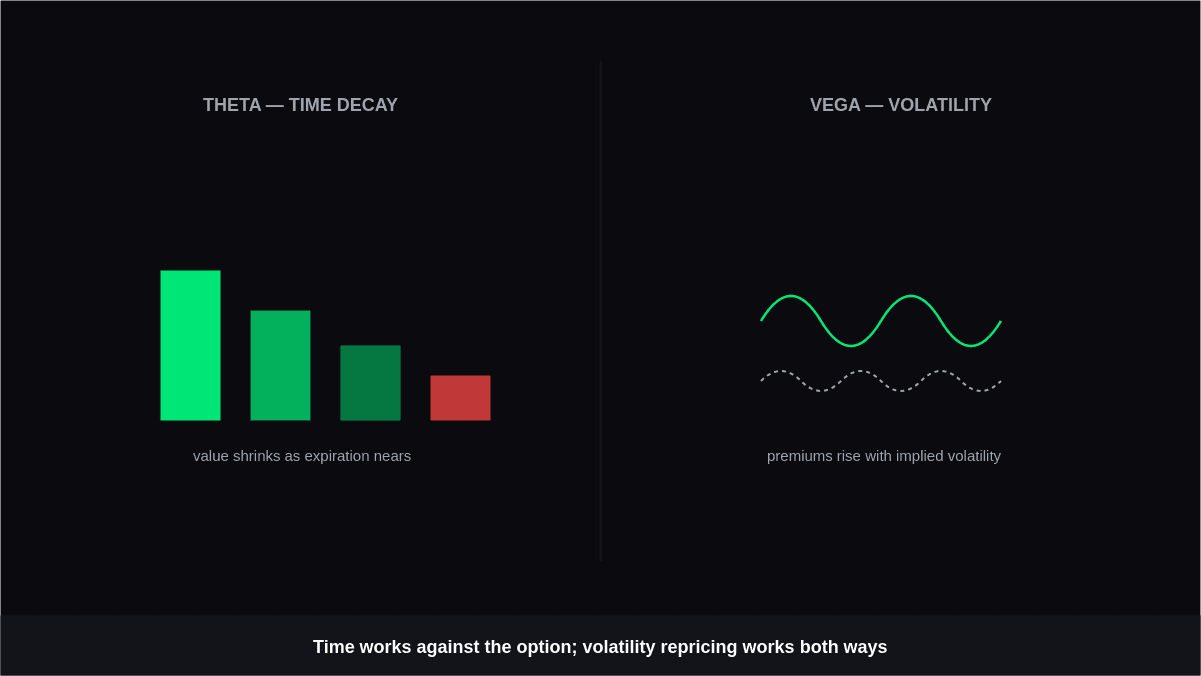
Theta Decay describes the effect of passing time on an option's theoretical value. Because an option has a limited lifespan, the amount of time available for the expected move gradually decreases.
Time decay is not necessarily uniform. It can become more significant as expiration approaches, particularly for options near the strike price.
Traders should consider:
- How many days remain before expiration
- Whether the option is in, at, or out of the money
- How quickly time decay may accelerate
- Whether the position benefits from or is hurt by declining time value
For an option buyer, negative Theta can work against the position when the underlying does not move sufficiently. For some option sellers, time decay can work in their favor, although selling options introduces other forms of risk.
4. Vega Connects Option Prices With Volatility Expectations
Vega measures an option's sensitivity to changes in implied volatility. When implied volatility rises, option premiums will generally increase, all else being equal. When implied volatility falls, premiums generally decrease.
This makes Vega particularly important around events that can change volatility expectations.
For example:
- Earnings announcements can alter implied volatility.
- Major economic releases may affect volatility expectations.
- Unexpected news can produce rapid volatility changes.
- Longer-dated options can have meaningful volatility exposure.
Implied Volatility represents the market's expectations about future price movement as reflected in option prices. It does not tell traders the direction of that movement.
5. Rho Shows the Effect of Interest Rates
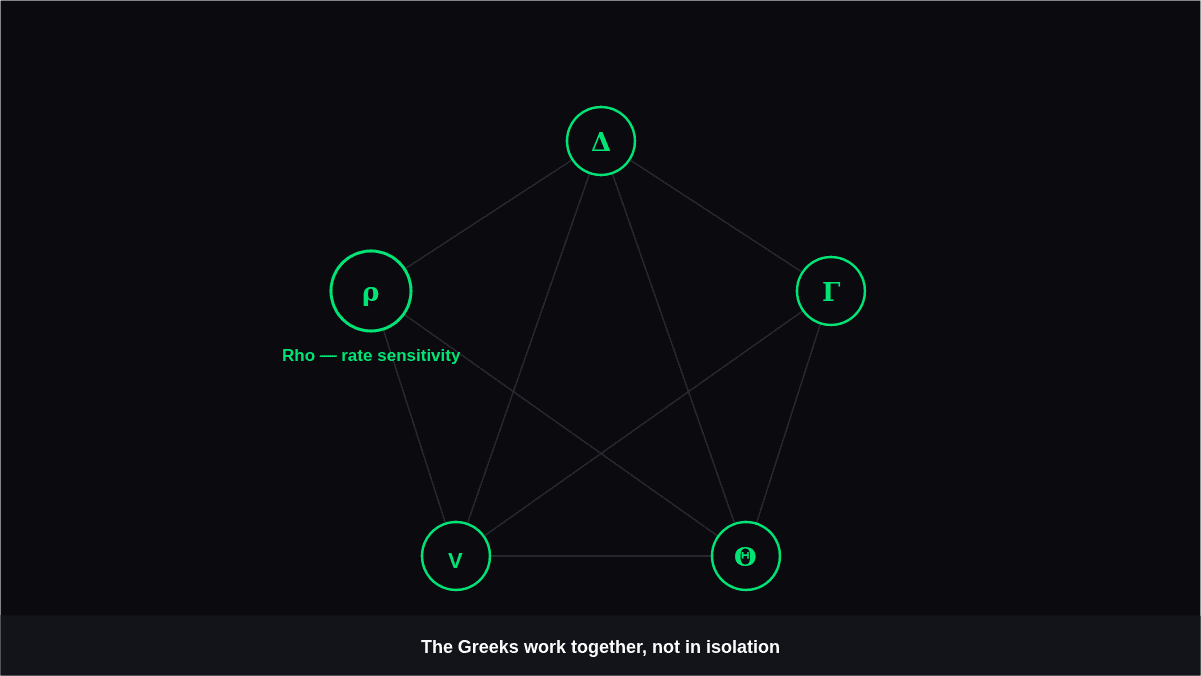
Rho measures an option's sensitivity to changes in interest rates. It is often less prominent in short-term trading discussions than Delta, Gamma, Theta, and Vega, but it can become more relevant when interest rates change significantly or when traders analyze longer-dated options.
Rho is affected by factors such as:
- Time remaining until expiration
- The type of option
- Prevailing interest rates
- The option's strike and underlying price
For longer-duration contracts, even relatively small changes in rates can have a more noticeable theoretical effect on option value.
6. The Greeks Work Together Rather Than Independently
Looking at one Greek in isolation can provide an incomplete picture of an options position. A trader may have favorable exposure according to one measurement while facing substantial sensitivity elsewhere.
For example, a position may have:
- Positive Delta but significant negative Theta
- Low initial Delta but rapidly changing Gamma
- Limited directional exposure but substantial Vega
- Small short-term sensitivity but greater interest-rate exposure over a longer period
A practical review should therefore consider the combined profile.
| Situation | Greek to Examine | Key Question |
|---|---|---|
| Underlying price changes | Delta | How directional is the position? |
| Large underlying movement | Gamma | How quickly could Delta change? |
| Time passes | Theta | How does expiration affect value? |
| Volatility changes | Vega | How sensitive is the premium to volatility? |
| Interest rates move | Rho | Could rate changes affect the position materially? |
The objective is not to find one "best" Greek but to understand which risks matter most for a particular position.
7. Greeks Can Help With Position and Risk Management
Options Greeks can be incorporated into the process of evaluating an existing trade rather than being used only when selecting an entry.
A trader can monitor changes in the Greeks to identify how the risk profile is evolving as market conditions change.
Useful considerations include:
- Reviewing Delta after substantial underlying price movements
- Watching Gamma as expiration approaches
- Monitoring Theta when holding short-dated options
- Checking Vega before major volatility events
- Considering Rho for longer-duration positions
- Comparing the current Greek profile with the original trade thesis
This approach can help traders recognize when an options position has developed a different risk profile from the one they initially intended.
How to Read Options Greeks Before Entering a Trade

Before opening an options position, traders can review the Greeks alongside the strike price, expiration, premium, implied volatility, and underlying price.
A simple checklist can include:
- Directional exposure: Review Delta.
- Potential Delta changes: Examine Gamma.
- Time sensitivity: Check Theta.
- Volatility exposure: Review Vega.
- Interest-rate sensitivity: Consider Rho.
- Overall position: Look at the Greeks together rather than separately.
This creates a more complete picture of what could influence the option's value after the trade is opened.
Conclusion
Options Greeks give traders a structured way to examine the different forces that can influence an option's value. Delta, Gamma, Theta, Vega, and Rho each describe a different type of sensitivity, but their usefulness increases when they are considered together.
Understanding these measurements can help traders identify directional exposure, recognize the impact of time decay, evaluate volatility risk, and monitor how a position changes as market conditions evolve.
The Greeks are analytical tools rather than predictions, so they should be considered alongside the underlying asset, expiration, strike, volatility, and broader trading plan, including the Put call ratio trading strategy when evaluating options market conditions.