Non repainting signals can provide information about confirmed trading setups, but the signal alone is insufficient to establish an entire trade setup. The signal may confirm that certain conditions are met, but it will not define by default the point of entry, position sizing, stop loss and profit target.
The conversion of a confirmed signal into an actual trading setup demands further analysis.
Traders must be able to determine where the signal occurs, whether the signal confirms the general market trend, at which point the trade concept breaks down, and whether the reward outweighs the risks.
This 7-step guide will show you how to go from a confirmed signal to a trade setup, leaving the signal in its rightful place as part of the entire decision process.
What Makes a Confirmed Signal Different From a Trade Setup?
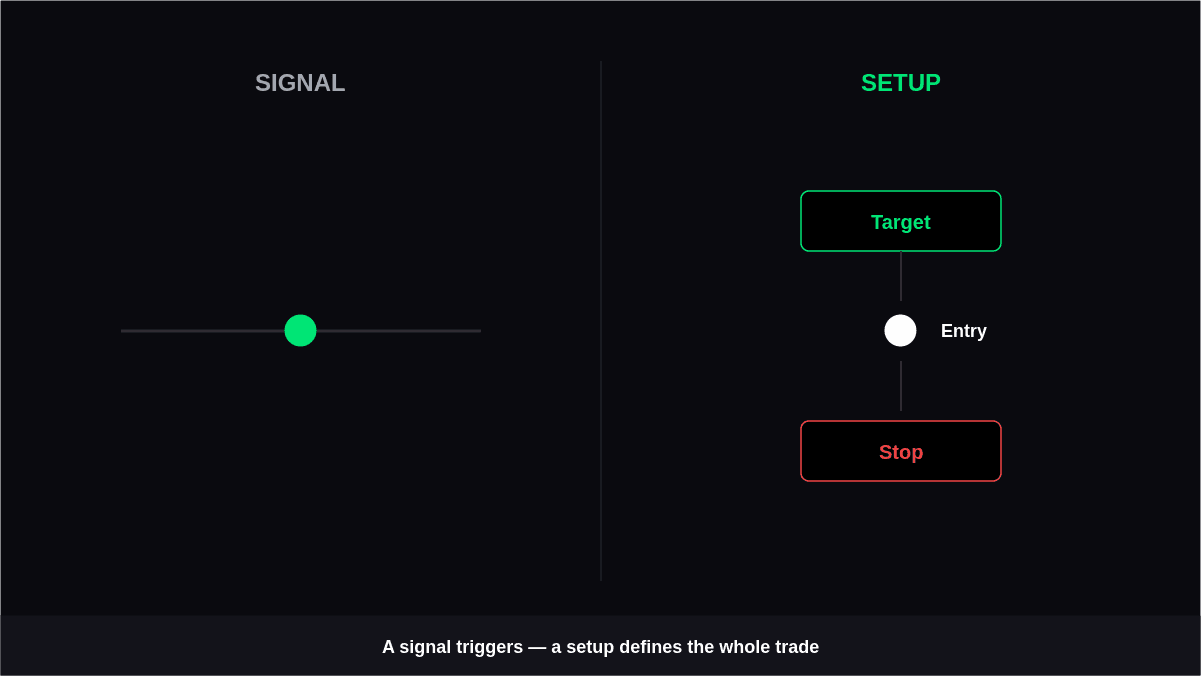
A confirmed signal means that certain criteria established by an indicator or system have been satisfied. On the other hand, a trade setup refers to the manner in which that signal is put to use.
Here you will find a proper comparison table to better understand it:
| Confirmed Signal | Complete Trade Setup |
|---|---|
| Shows a potential direction | Defines the direction and trade conditions |
| Appears at a specific chart location | Determines whether that location is suitable |
| May indicate bullish or bearish conditions | Defines entry and invalidation |
| Provides an analytical trigger | Includes stop-loss and target |
| Does not define risk by itself | Establishes acceptable risk |
This is crucial since even though the signal itself is valid technically, it may be found in an inappropriate place. In this case, it is not about trading every single signal identified, but rather determining if the signal can make a valid system.
7 Steps to Turn Confirmed Signals Into Trade Setups
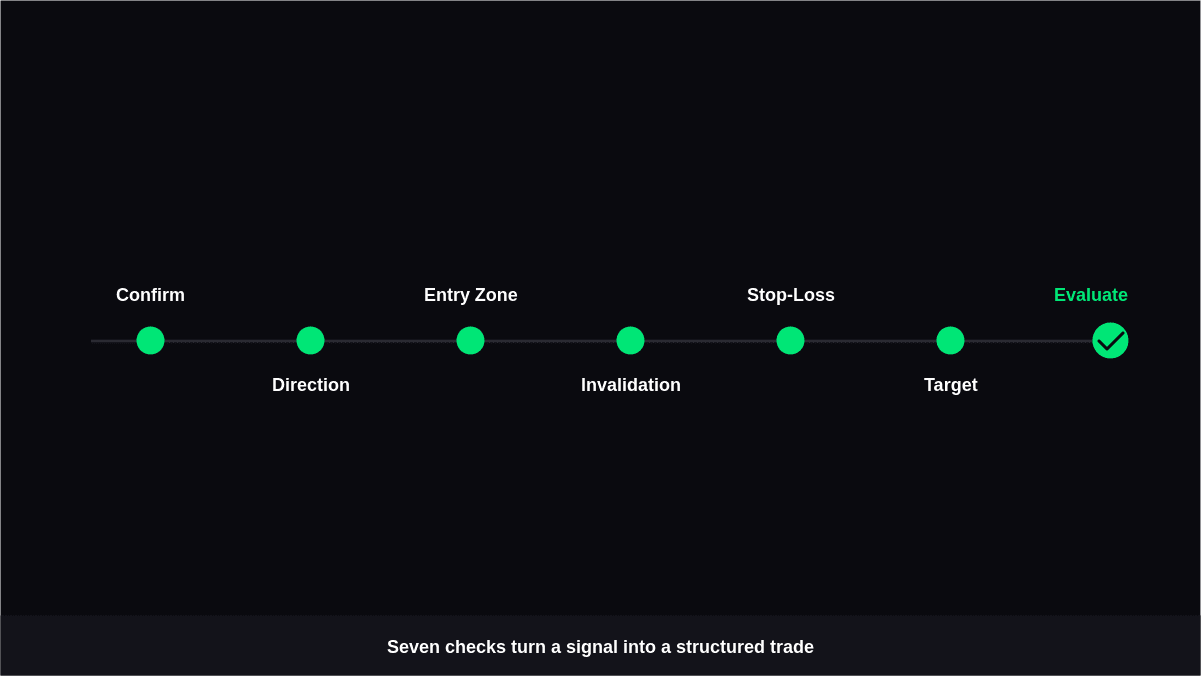
Here you will find a proper step by step guide that can help you explore how to turn confirmed signals into the trade setups:
Step 1: Confirm the Signal
First of all, it is necessary to make sure that the signal was really formed according to the indicator's settings. The formation of a signal during an open candle will act in a different way compared to the one that forms when the conditions for it are fulfilled.
In case of using a non-repainting indicator, know the moments when its signals are locked. This could depend on the closure of a candle or other conditions of confirmation.
Before considering an entry, check:
- Has the relevant candle closed?
- Has the indicator's confirmation condition been met?
- Is the signal still present after confirmation?
- Do you know the exact candle on which the signal became available?
This prevents a trader from building a setup around a signal that was only temporarily visible during an unfinished candle.
Step 2: Identify the Market Direction
Once you are sure about the signal, look at the overall structure of the market. The signal needs to be understood in context and not as an isolated order.
Look for characteristics such as:
- Higher highs and higher lows
- Lower highs and lower lows
- Consolidation or range-bound movement
- Recent breakouts or breakdowns
- Changes in momentum
As another example, a confirmed buy signal will definitely carry more weight if the price has already formed a bullish structure. A sell signal occurring within a bearish structure will likely be congruent with the prevailing trend direction.
The point here is not that countertrend signals need to be disregarded. Rather, knowing the trend direction assists in deciding which kind of setup the signal is forming.
Step 3: Find the Entry Zone
The signal will not always offer the best entry level for the price. After having found the general trend, figure out where you can have an entry point.
Entry points can be based on different strategies:
- A pullback during a trend
- A retest after a breakout
- A support or resistance area
- A recent swing point
- A consolidation breakout
- A confirmed price-action pattern
This prevents the trader from chasing the signal after the prices have been changed.
For example, when a buy signal comes after many big bullish candles, entering straight away will give you a worse risk to reward ratio than waiting for the pull back, if that’s part of your system.
Step 4: Define the Invalidation Level
In order to find out the price action that makes the original trade set up no longer valid, you need to figure out what will make your position incorrect before entering into the trade.
If we are talking about a long set up, then the invalidation point will be lower than the important swing low or support level. If we consider a short set up, then the invalidation point will be higher than the swing high or resistance level.
- Long setup: Invalidation may occur below a meaningful swing low or support zone.
- Short setup: Invalidation may occur above a significant swing high or resistance zone.
- Market structure: The level should reflect the structure supporting the original trade idea.
It is important that the method depends on the particular trading approach and on the market situation. What is important is that the level of invalidation should be set up before the trade rather than adjusted later in order to accept the loss.
Having such a level will help to set the stop-loss.
Step 5: Set the Stop-Loss
After identifying the point of invalidation, determine the location of the stop-loss in line with the trading strategy. The stop-loss should allow some buffer zone for natural price movements while keeping the level of losses within the specified risk level.
A stop set too close to the entry may be activated by natural movements in prices. An excessively large stop may expose the trader to too much risk except when the position size is changed accordingly.
The position size and the stop distance should therefore be viewed together. Large stops do not have to imply that the trader will have to take on larger risks; he may reduce his position size to retain the required level of risk.
Step 6: Choose the Profit Target
The next step is to identify where the trade could reasonably reach if the setup develops as expected. The target should be based on the market rather than selected simply because a certain profit percentage looks attractive.
Potential target areas can include:
- Previous swing highs or lows
- Major support or resistance zones
- Range boundaries
- Measured moves defined by the strategy
- Predefined risk-to-reward levels
The target should also be logical in terms of time frame. An entry in short time frames can have a smaller price target than an entry that occurs at a higher time frame.
When there is little distance between the suggested entry and the next significant opposing level, then the setup might not have enough profit potential to cover the risk taken.
Step 7: Evaluate Risk Before Entering
The last thing to do is to analyze the full setup before trading.
Here, the trader knows what the signal direction is, where the entry zone is, where the invalidation level is, the stop loss point, and how much profit the trade might yield.
Now we can consider the possible loss versus the possible reward. For instance, when the trade has a risk of $50 while the planned target might yield $100, the reward is two times higher than the loss, which gives us the 1:2 risk-to-reward ratio.
The risk/reward ratio does not ensure success of the trade. It is merely an instrument to make the comparison more consistent and objective.
When Not to Turn a Signal Into a Trade
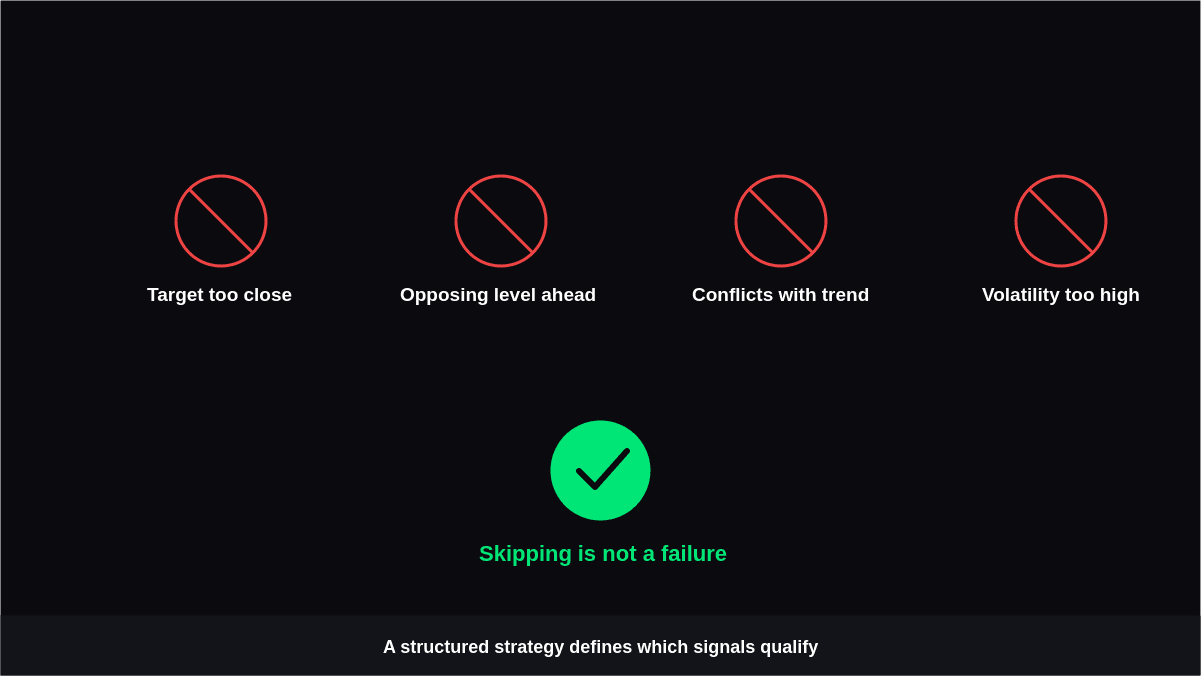
A confirmed signal does not have to result in a position. Sometimes the surrounding conditions make the setup unattractive even though the signal itself is valid.
Consider staying out when:
- The entry is too far from a logical invalidation point.
- The potential target is too close to justify the risk.
- Price is approaching a strong opposing market level.
- The setup conflicts with the broader structure without a defined countertrend strategy.
- Volatility makes the planned risk difficult to control.
- The signal has already been followed by an unusually large move.
- The trade does not meet the predefined rules of the strategy.
Skipping a signal is not necessarily a failure. A structured strategy should define which signals qualify and which ones do not.
Example of a Complete Signal-Based Setup
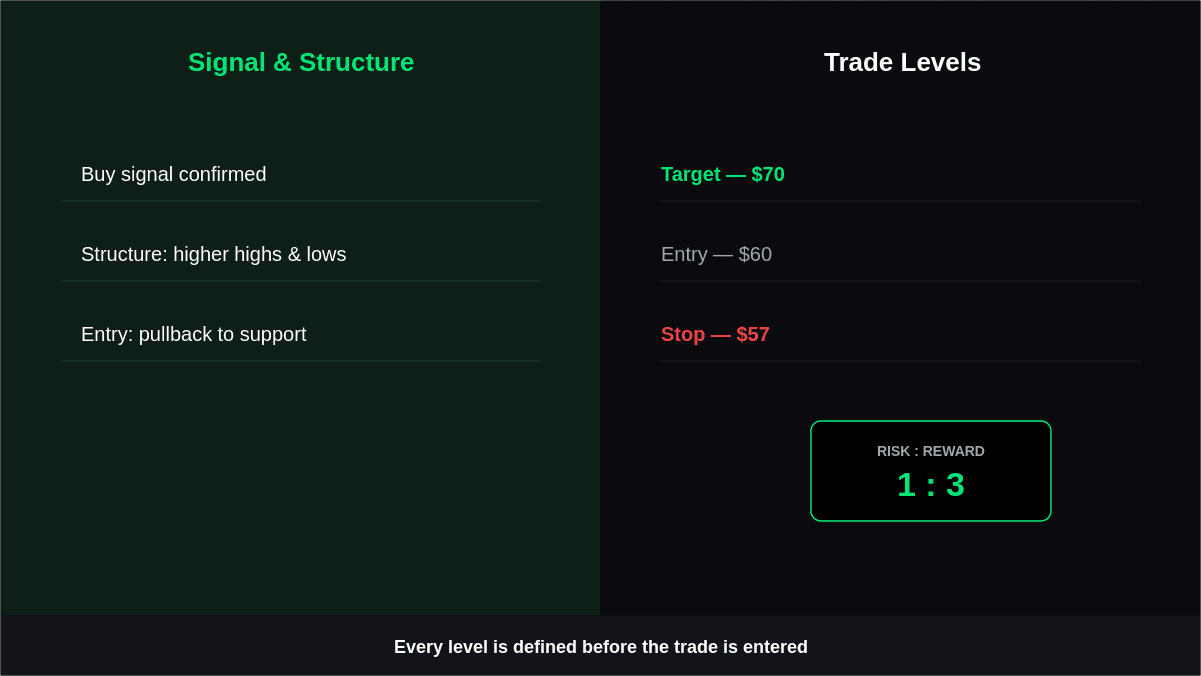
Suppose a confirmed buy signal appears while the broader market is making higher highs and higher lows. Price then pulls back toward a previously respected support area rather than continuing sharply upward.
The trader could evaluate the setup by:
- Confirming that the buy signal is valid.
- Checking that the broader structure remains bullish.
- Identifying the support area as a potential entry zone.
- Defining a level below the relevant swing low where the idea would be invalidated.
- Setting the stop-loss according to the planned risk.
- Identifying a previous high or other logical area as a potential target.
- Checking whether the potential reward justifies the amount being risked.
If the setup does not meet the predefined criteria at any stage, the trader can simply wait for another opportunity.
Common Mistakes When Building Trades From Signals

The biggest mistake is treating the signal as the entire strategy. Other common errors include:
- Entering before the signal is confirmed
- Chasing price after a large move
- Ignoring the broader market structure
- Choosing a stop-loss without considering invalidation
- Setting unrealistic profit targets
- Increasing position size because a signal appears highly convincing
- Changing trade rules after entering
- Taking every signal instead of filtering setups
A repeatable process can help reduce these mistakes by requiring the same questions to be answered before each trade.
Final Thoughts
Non-repaint signals can be used as a good foundation for creating trade setups in an organized manner, but signals alone do not constitute the whole process. The seven steps, confirmation, direction, entry level, invalidation, stop loss, target, and risk analysis, play an important role in turning an indicator signal into a trade setup.
Whether you have a non repainting buy sell indicator or any other tool that generates signals for trading, the aim should not be to trade all confirmed signals but to create setups.