No-code trading strategies allow traders to transform the market rules into either an automated or semi-automated trading system without having to write any programming code. Instead of starting the process by creating a new script, the user is able to create a condition using the visual interface or other trading rule builders.
This approach can simplify systematic trading, however, taking away coding does not mean that strategy development will be taken away. An efficient trading system still needs the trader to have the entry and exit rules, risk management, and testing and evaluation.
In this practical guide you will learn everything related to No Code Trading Strategies.
What Are No-Code Trading Strategies?
No-code trading strategies are rule-based trading systems that do not involve traditional programming languages but use visual applications for their creation.
The strategy could be specified by the trader through some specific rules, for example:
- Buy if the price crosses a certain moving average upwards.
- Check for additional confirmation via volume condition.
- Sell when a profit target is achieved.
- Exit the trade at a stop-loss level.
- Set up the limit on the amount of trades per session.
The application will then execute these rules within the trading environment.
The key aspect of this is that no-code does not mean no logic. The trader must define precisely what should happen and under what conditions.
How No-Code Strategy Builders Work
Most visual strategy builders follow a similar process, although their interfaces and capabilities differ.
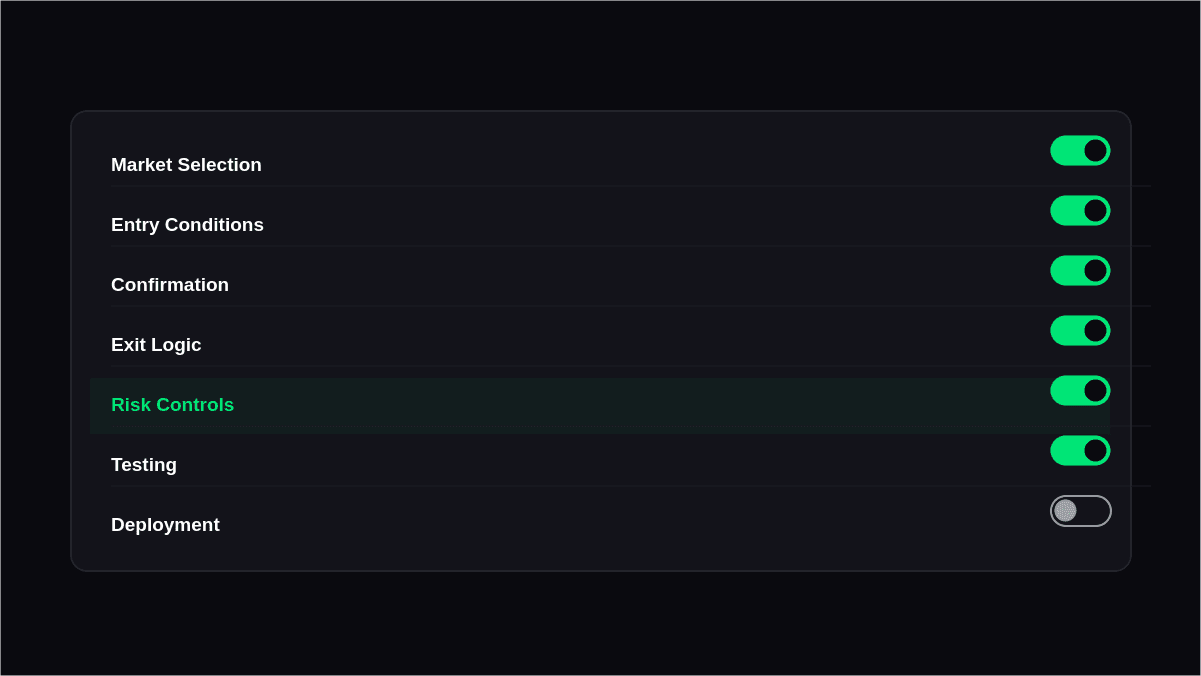
| Stage | What the Trader Defines | Why It Matters |
|---|---|---|
| Market selection | Asset, exchange, or market | Determines where the strategy operates |
| Entry conditions | Signals that trigger a trade | Establishes the setup |
| Confirmation | Additional filters | Helps control weak signals |
| Exit logic | Profit target, stop, or reversal | Defines how positions are closed |
| Risk controls | Position size and trade limits | Restricts potential losses |
| Testing | Historical or simulated performance | Reveals how the rules behaved |
| Deployment | Alerts, paper trading, or live execution | Moves the system into practice |
The quality of the resulting strategy will depend on how accurately these rules are formulated. While a graphical user interface can make this easier, it cannot determine if the trading idea is good.
Building a Strategy Without Writing Code
A no-code algo trading approach based on practice begins with forming a hypothesis instead of using indicators.
For instance, a trader might have an idea that a breakout along with strong volume will have better follow-through than a breakout in conditions of low volume.
These thoughts can be easily translated into actionable rules:
- Form a breakout definition.
- Set the required level of volume compared to its usual values.
- Make an entry rule.
- State how to determine a stop-loss point.
- Create a rule for profit taking or exiting the trade.
- Set maximum risk per trade.
- Check all the rules together.
In this way, the trading system won't be a set of uncorrelated signals.
Indicators Should Support the Trading Idea
Increased indicators do not necessarily mean an improvement in the trading strategy.
The system which uses moving averages, RSI, MACD, volume, volatility bands, trend filters, and a number of other components will seem quite complicated while it can become hard to understand and manage.
Instead, it would be reasonable to define certain responsibilities for each indicator.
For instance:
- Price pattern – defines the setup.
- Volume – analyzes participation.
- Volatility – decides whether the trading environment is favorable.
- Risk management rules – regulate the size of possible loss.
In case when two indicators give very similar information, both can be superfluous.
Testing Before Using Real Money
Backtesting is an extremely critical stage in the development of automated trading strategies.
The profitability of a strategy cannot be evaluated by the overall return on history alone. There are a number of metrics to consider:
- winning percentage
- average win/loss
- maximum drawdown
- profit factor
- number of trades
- losing streaks
- strategy performance under various market conditions
There also needs to be testing considering trading expenses wherever possible. Fees, spreads, slippage, and latency can really make a difference in how theoretical and actual results vary.
A strategy that works well during only one favorable market period requires further consideration.
Avoiding Overfitting in Visual Strategy Builders
No-code systems can enable experimentation in a way that is very convenient. This poses a risk, as traders might continuously tweak the parameters until the historical performance becomes good enough.
This is known as overfitting.
For instance, tweaking the period of a moving average, the stop distance, or the profit target according to the past can result in an overfitted system that works great in the historical data but not in the unseen one.
The correct approach would be to:
- Stick to the initial trading hypothesis.
- Set realistic parameter values.
- Divide the development and validation datasets.
- Test the strategy in multiple market conditions.
- Choose simple rules where performance is equal.
- Do not change the system just to fix all losing periods.
It is not about making the historical curve look beautiful. It is about determining the viability of the idea itself.
Risk Management Still Requires Human Judgment
While automation can apply the rules reliably, it cannot convert an inappropriate risk model into a proper one.
Before implementing your model, you should determine what maximum amount of money can be at risk for one position and how the system should function after several losing trades.
It can be helpful to set the following controls:
- Risk level for each individual trade
- Daily loss limit
- Number of open positions simultaneously
- Limits for position sizes
- Controls on the duration of trades
When transitioning from paper trading to real trades, these controls become vital.
No-Code vs. Traditional Algorithmic Trading
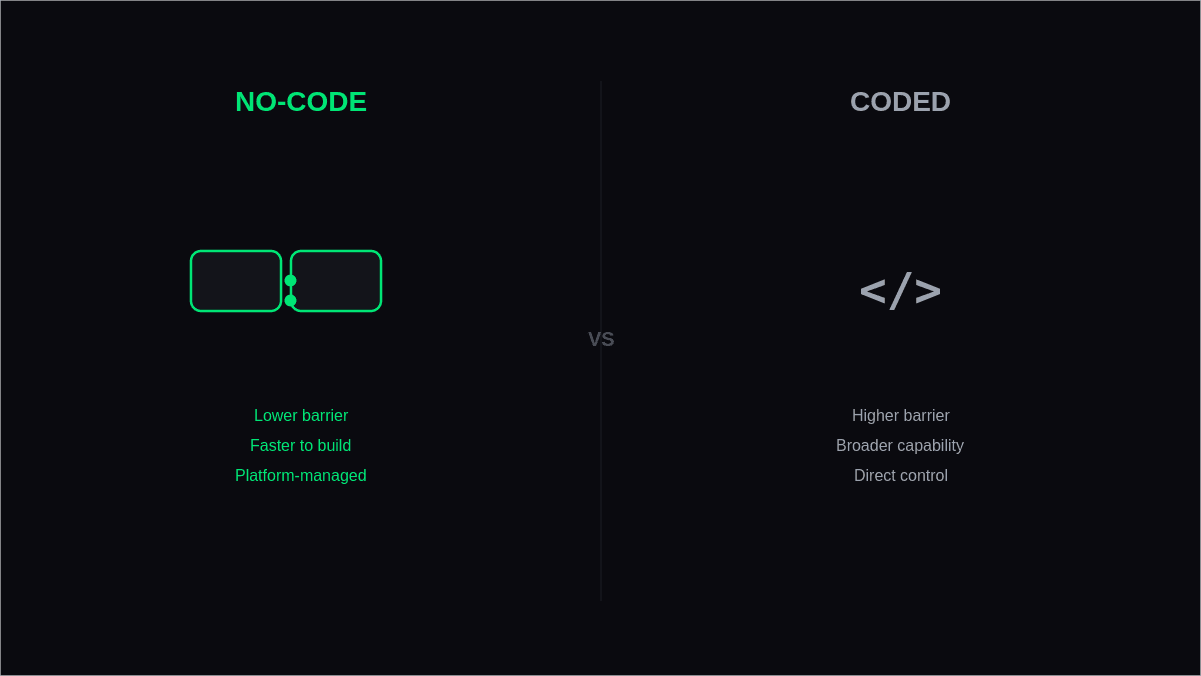
For algorithmic trading for beginners, no-code platforms can provide a simpler entry point because users can focus on strategy logic without first learning a programming language.
| Factor | No-Code Approach | Coded Approach |
|---|---|---|
| Technical barrier | Lower | Higher |
| Strategy customization | Depends on platform | Usually extensive |
| Development speed | Often faster | Can require more development |
| Debugging | Platform-dependent | More direct control |
| Advanced functionality | May be limited | Usually broader |
| Learning focus | Trading logic | Trading logic + programming |
| Maintenance | Often platform-managed | User/developer managed |
When No-Code Trading Makes Sense
A no-code system may prove to be extremely handy if a trader already has a well-thought-out strategy but lacks knowledge about programming.
The no-code framework may assist experienced traders in developing an idea fast without spending too much time on coding.
In contrast, a no-code system may prove to be constraining if the strategy relies on complex calculations, portfolio logic, custom data handling, or execution specifics.
Common Mistakes to Avoid
Here you can find some common mistakes to avoid:
- Building rules around vague concepts that cannot be measured.
- Assuming more indicators will create stronger signals.
- Optimizing repeatedly until the backtest looks perfect.
- Ignoring transaction costs and slippage.
- Testing only one market regime.
- Moving directly from backtesting to live execution.
- Using position sizes that are too large for the strategy's drawdown profile.
- Assuming automation guarantees profitability.
Final Takeaway
A no-code trading strategy is a way to transform a well-defined trading concept into a system workflow without having to write the code. The biggest advantage of no-code trading strategies is that it will allow the trader to focus on creating and testing rules, without the need to build the supporting software infrastructure.
The best way to approach the matter is to begin with just one market concept, formulate it into measurable criteria, validate it, and add some risk management before even thinking of live application. The simpler the strategy, yet still reasonable in its logic, the better.
FAQs
1. What are no-code trading strategies?
These are rule-based trading systems that have been made using the graphical interface rather than coding them. Users are able to set the rules and conditions inside the platform.
2. Can no-code trading strategies be profitable?
Yes, they can be. However, the use of no-code trading platforms does not give one an advantage. This will depend on the strategy that is employed.
3. Are no-code trading strategies suitable for beginners?
They may serve as an initial guide, since beginners can study strategies designed systematically without prior programming knowledge. However, beginners still need to be aware of the necessity for testing, probability, drawdowns, and risk management.