When Multiple Orders reach an exchange at nearly the same time, the system must determine which orders can interact, which should wait, and which cannot be filled.
This process is handled through established matching rules rather than simply processing every order in the order it appears on a trader's screen. Price, time, Market Orders vs Limit Orders, and available liquidity can all influence what happens next.
Understanding this process helps traders see why two orders submitted within moments of each other may receive different results.
One may execute immediately, another may receive a partial fill, while a third may remain pending because there are not enough matching orders available.
What Is Meant by Multiple Orders Reaching an Exchange?
Multiple Orders reaching an exchange means that several buy and sell instructions are being submitted to the trading venue around the same time.
These orders may come from individual traders, institutions, market-making systems, or automated trading programs.
The exchange does not treat every incoming instruction as an automatic trade. Instead, each order is processed according to its characteristics and the exchange's matching rules.
Key factors include:
- Price: Better-priced orders generally receive priority over less competitive prices.
- Time: When orders have the same price, earlier eligible orders can receive priority.
- Order type: Market, limit, stop, and other instructions may be handled differently.
- Available liquidity: An order can only execute if suitable opposing interest is available.
- Quantity: A large order may be filled in several portions instead of all at once.
This creates an organized process for deciding which orders interact and at what price.
How an Exchange Receives Multiple Incoming Orders
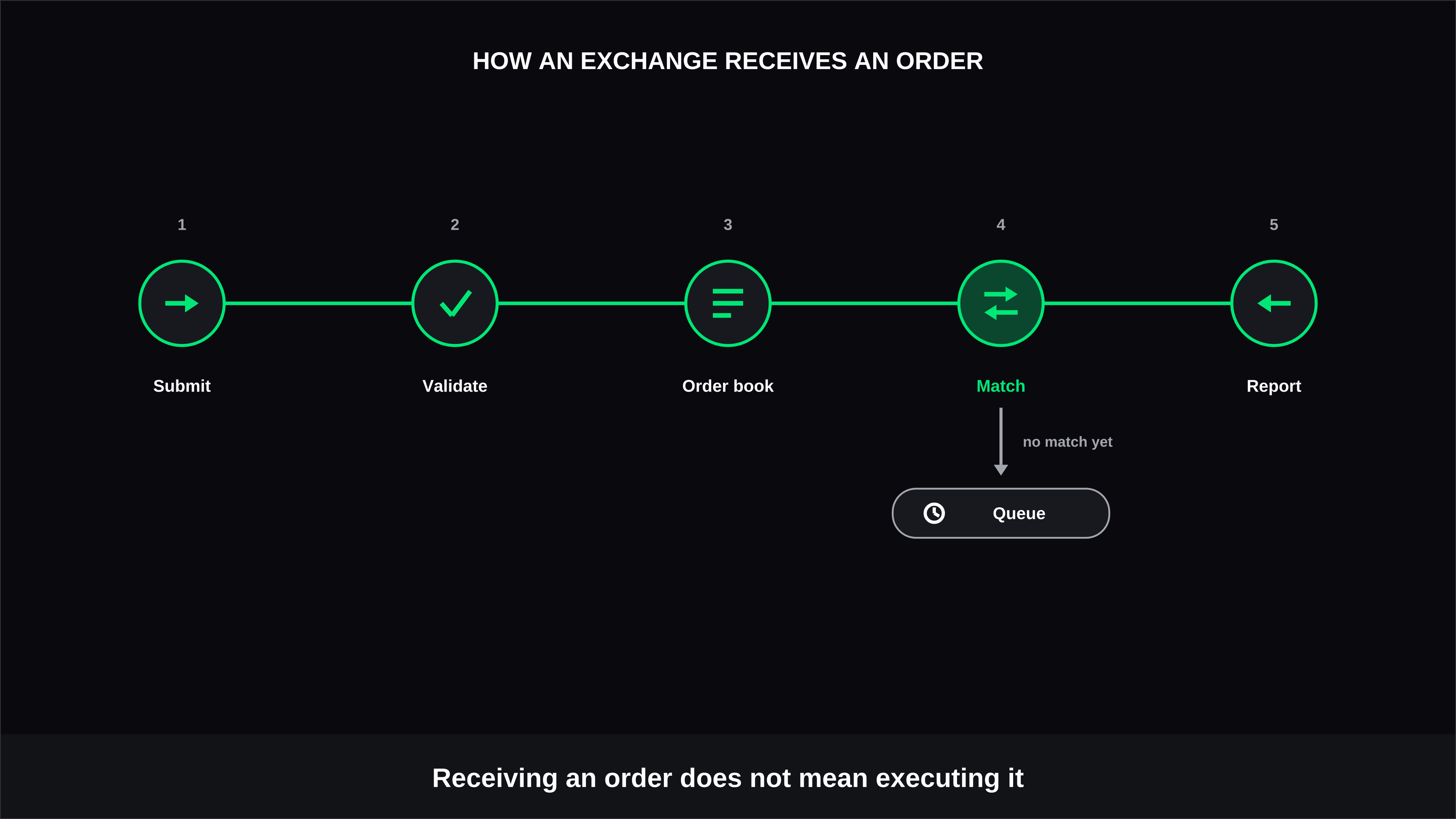
An exchange receives orders through connected trading systems and routes them into its market infrastructure for validation and processing. Before an order can participate in Order Matching, it generally needs to satisfy the venue's technical and trading requirements.
The incoming process can involve:
- Order submission: A broker or trading participant sends the instruction to the exchange.
- Validation: The system checks required information, order parameters, and applicable controls.
- Entry into the market: An eligible order is placed into the appropriate Order Book or handled according to its type.
- Matching: The system checks whether an opposing order is available.
- Execution reporting: If a match occurs, the resulting trade is reported back through the relevant trading infrastructure.
- Queue management: Orders that cannot be immediately executed may remain available according to their conditions.
The important point is that receiving an order does not necessarily mean executing it. The exchange must first determine whether the order can interact with existing market interest.
5 Things That Happen When Multiple Orders Reach an Exchange
When several orders arrive around the same time, the exchange's matching engine applies predefined rules to determine how they interact. The outcome depends on the orders' prices, timing, quantities, and instructions.
1. Orders Are Prioritized
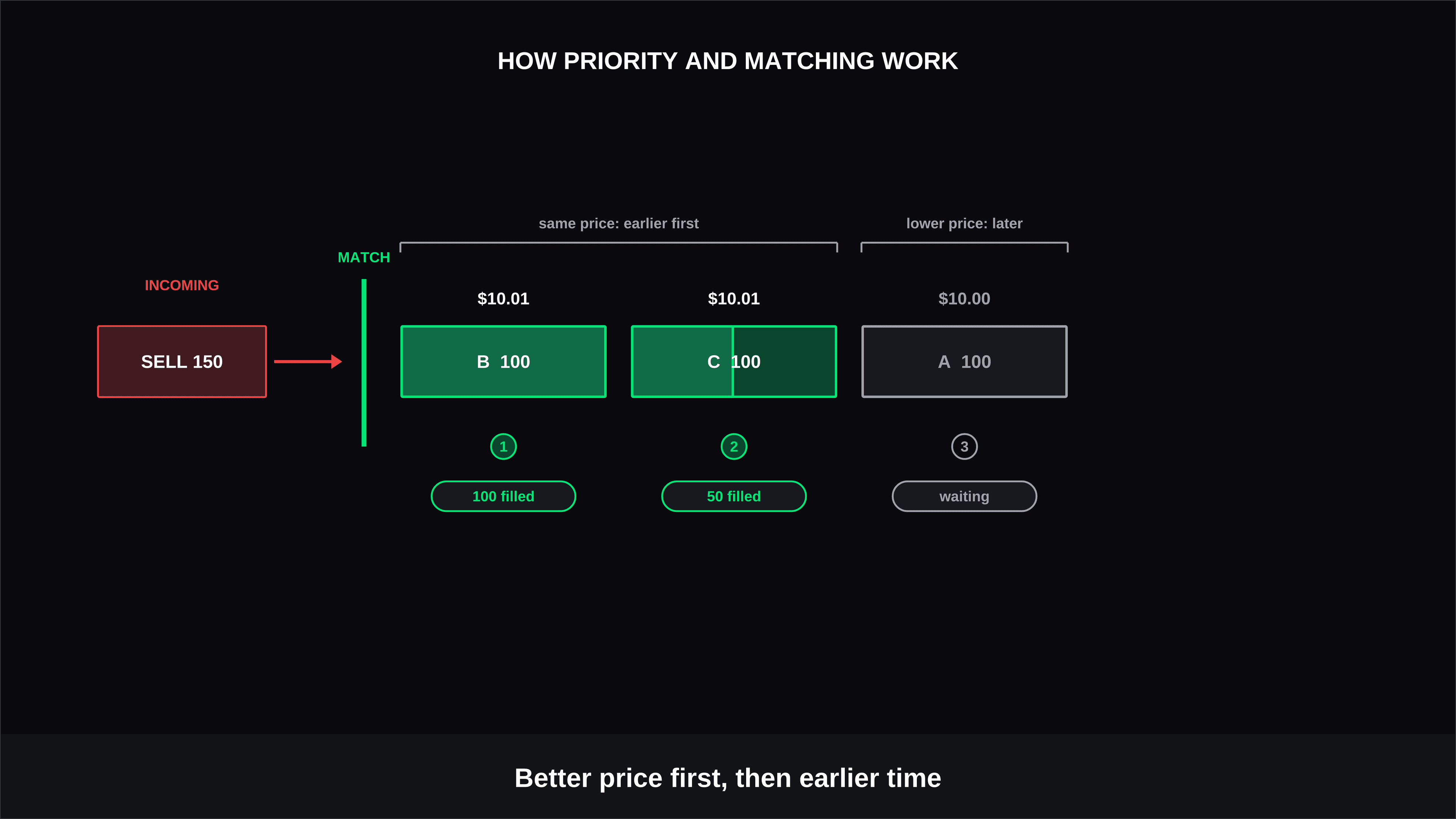
The exchange first needs to establish which eligible orders should receive attention when several orders compete for available liquidity.
For orders at the same price, time-based priority can become important.
- A better-priced order can have priority over a worse-priced order.
- Orders at the same price may be arranged by their arrival time.
- An order that arrives later may have to wait behind earlier eligible orders.
- Different order types can follow specific handling rules.
This prevents the matching process from becoming arbitrary when demand exceeds available liquidity.
2. Compatible Buy and Sell Orders Are Matched
Once orders are organized, the matching engine looks for compatible buy and sell interest.
For example, if a buyer is willing to pay $100 and a seller is willing to accept $100, their instructions may be eligible to interact, subject to the exchange's rules.
During this stage:
- Buy and sell instructions are compared.
- Compatible prices can result in an execution.
- The executed quantity is determined by available opposing volume.
- Multiple orders may interact with one incoming order.
This is where Trade Execution actually takes place rather than merely being requested.
3. Available Liquidity Determines How Much Gets Filled
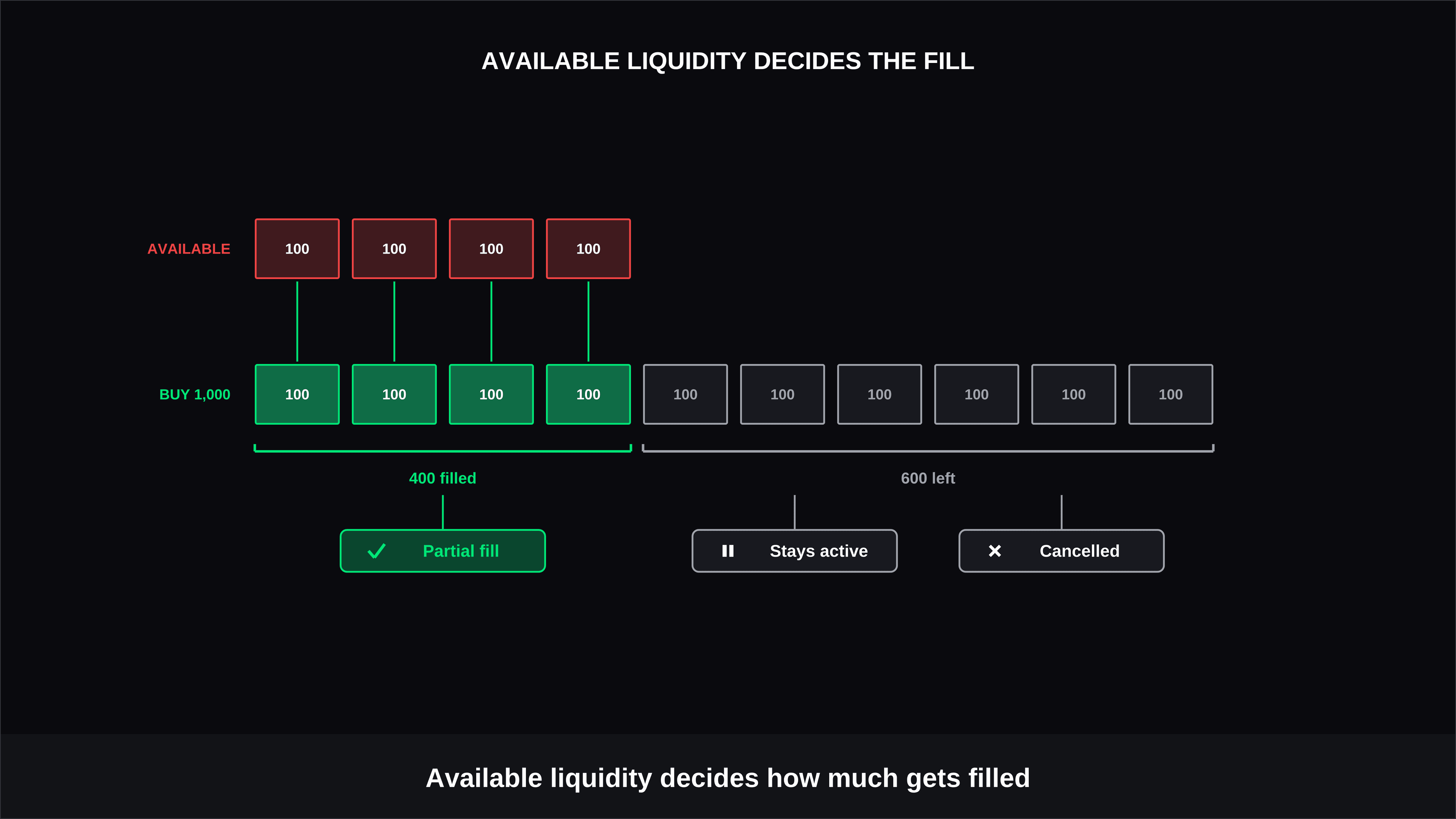
Even when an order can interact with another order, there may not be enough quantity available to complete it.
Suppose a trader submits a buy order for 1,000 shares, but only 400 shares are available at the relevant price. The trader may receive a 400-share fill while the remaining quantity is handled according to the order's instructions.
Possible outcomes include:
- Full fill: The entire requested quantity executes.
- Partial fill: Only part of the order executes.
- Remaining quantity: The unfilled portion stays active if permitted.
- Cancellation: The remaining amount may be removed when the order's conditions require it.
Liquidity therefore has a direct effect on the final execution result.
4. Orders That Cannot Match Remain Pending or Are Removed
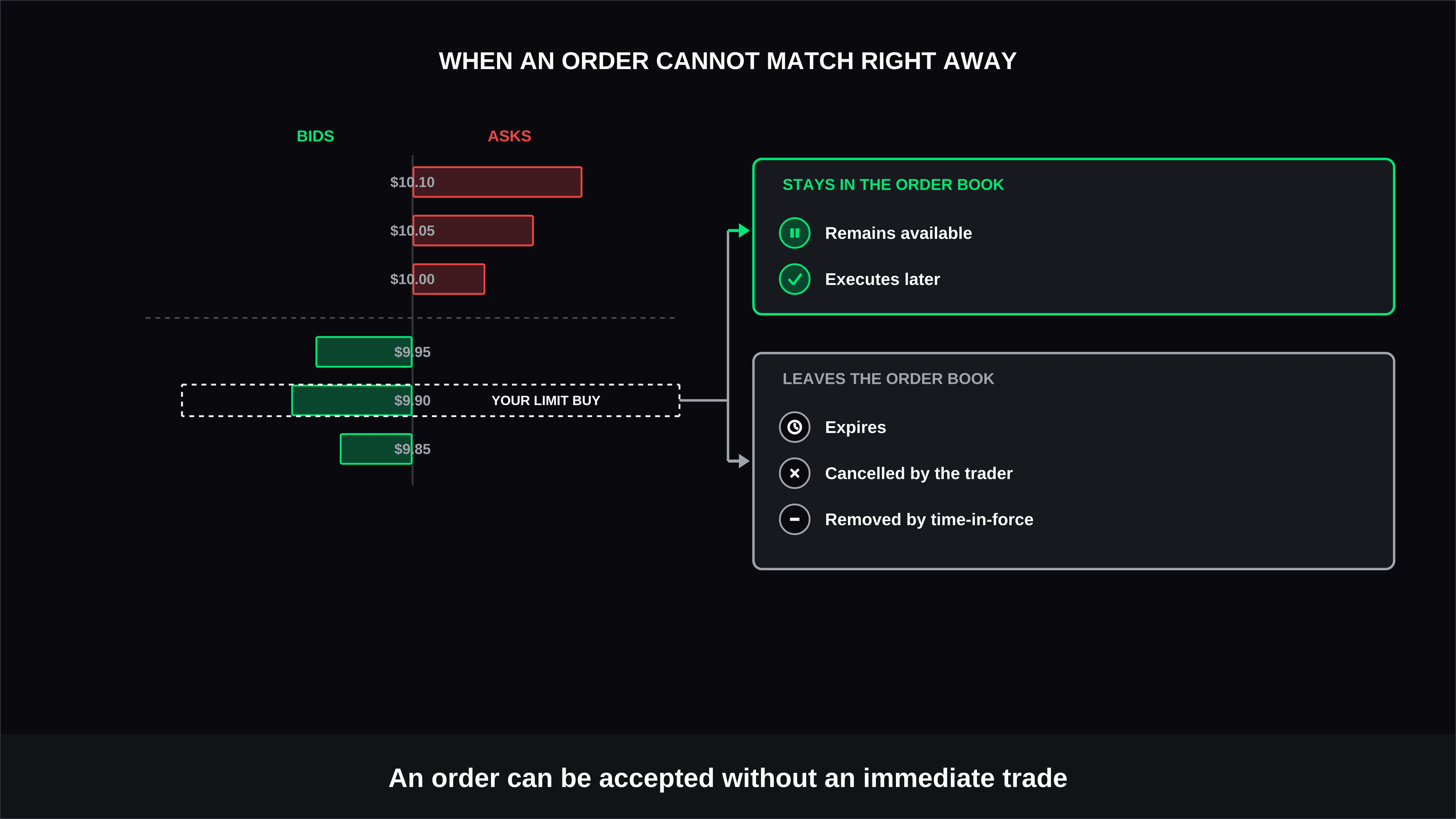
Not every incoming instruction finds an immediate counterpart. A limit order, for example, may remain in the order book when its specified price is not currently available.
Depending on the order's conditions, it may:
- Remain available for future matching.
- Execute later when another suitable order arrives.
- Expire after a specified period.
- Be cancelled by the trader.
- Be removed automatically under its time-in-force instructions.
This explains why an order can be successfully accepted by an exchange without producing an immediate trade.
5. Executions and Remaining Orders Are Updated
After matching occurs, the exchange updates the relevant market records. Filled quantities are reduced or removed, while unfilled quantities may continue through the appropriate process.
The resulting information can affect what other participants see in the market.
| Stage | What Happens | Possible Result |
|---|---|---|
| Submission | Order enters the exchange system | Order received |
| Validation | Trading and technical conditions are checked | Accepted or rejected |
| Prioritization | Eligible orders are organized | Queue position established |
| Matching | Compatible orders interact | Full or partial execution |
| Remaining quantity | Unfilled portion is handled | Stays active, expires, or cancels |
| Reporting | Completed trades are recorded | Execution information returned |
This continuous cycle allows the exchange to process changing buying and selling interest without treating every incoming order identically.
Conclusion
When Multiple Orders reach an exchange, the outcome depends on more than simply which order arrived first. Price, time priority, order conditions, available liquidity, and the presence of matching interest all influence what happens.
Some orders can execute immediately, while others may receive partial fills or remain in the market, affecting entry exit signals.
Understanding Order Matching, the Order Book, and Trade Execution gives traders a clearer view of why orders can produce different results even when submitted close together.
It also helps explain why execution is a structured process rather than a simple first-come, first-served system.