Markets do not behave the same way all the time. Prices may trend strongly for weeks, move sideways within a defined range, or become unusually volatile around major events.
Understanding how traders adapt strategies to different market regimes can help traders avoid applying the same approach to every market condition.
Instead of expecting one strategy to perform equally well everywhere, traders can identify the current environment by evaluating support resistance, then adjust their setups, risk controls, and trade management accordingly.
In this blog we will cover what market regimes are and how traders adapt strategies to different market regimes.
What Are Market Regimes in Trading?
Market regimes in trading describe the broader conditions influencing how prices behave during a particular period. A regime is not simply whether the market is rising or falling. It can also describe the strength of the move, volatility, and whether price is following a sustained direction or remaining within a range.
Common regimes include:
- Trending markets: Price generally moves in one direction with recognizable higher highs and higher lows, or lower highs and lower lows.
- Range-bound markets: Price moves between relatively established support and resistance levels without developing a sustained trend.
- High-volatility markets: Large price swings create wider trading ranges and faster changes in market conditions.
- Low-volatility markets: Price movement becomes compressed, often producing smaller ranges and weaker short-term opportunities.
Recognizing these conditions gives traders a starting point for deciding whether their existing strategy fits the environment.
How Traders Adapt Strategies to Different Market Regimes
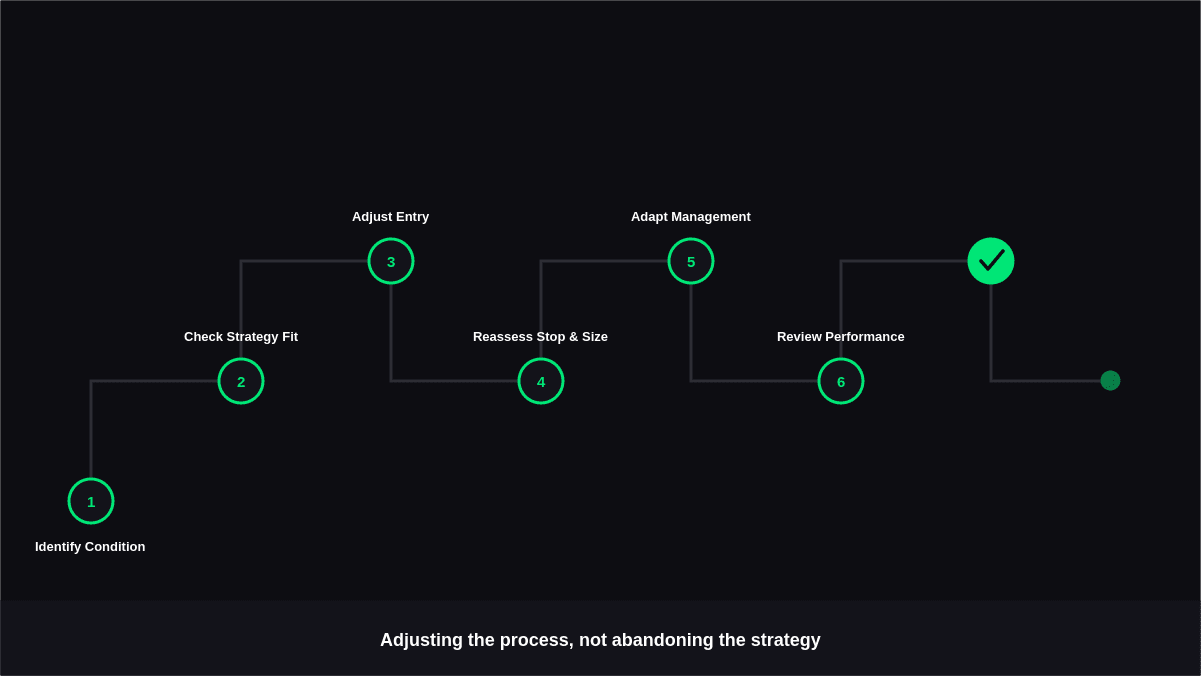
Adapting a trading strategy starts with understanding what the market is doing before deciding how to trade it. Traders do not necessarily need to abandon their existing strategy when conditions change. Instead, they can follow a structured process to determine whether their entries, exits, and risk controls still fit the current environment.
Step 1: Identify the Current Market Condition
Start by determining whether the market is trending, ranging, or experiencing an unusual change in volatility. Look at price structure, recent movements, and the consistency of directional momentum.
Ask:
- Is price making higher highs or lower lows?
- Is price repeatedly moving between support and resistance?
- Has volatility recently increased or decreased?
- Are large price movements becoming more frequent?
This first step establishes the environment in which the strategy will be applied.
Step 2: Check Whether the Strategy Fits the Environment
Once the market condition is identified, compare it with the type of setup being considered. A breakout strategy may be better suited to expanding momentum, while a range-based approach may make more sense when price repeatedly respects established boundaries.
Consider:
- What conditions has the strategy been designed to handle?
- Has it historically performed well in the current type of environment?
- Are the signals appearing with enough confirmation?
- Is the strategy producing more false signals than usual?
This prevents traders from using a strategy simply because it worked in a different market phase.
Step 3: Adjust Entry Conditions
The next step is to determine whether the entry rules need more confirmation. In a volatile market, traders may require stronger evidence before entering. In a range, they may pay greater attention to how price behaves around established support or resistance.
Possible considerations include:
- Waiting for confirmation after a breakout
- Looking for a pullback instead of entering after an extended move
- Requiring stronger momentum before taking a position
- Avoiding entries in the middle of an established range
The objective is to make entries more compatible with the behavior currently visible on the chart.
Step 4: Reassess Stop-Loss and Position Size
Market conditions can change how much room a trade needs to develop. A stop that works during a low-volatility period may be too close when price swings become larger.
Traders can review:
- Stop-loss distance
- Position size
- Expected price movement
- Maximum acceptable loss
- Distance to important technical levels
If wider price fluctuations require a larger stop, reducing position size can help keep the overall risk within predetermined limits.
Step 5: Adapt Trade Management
After entering a position, traders can continue monitoring whether the market remains compatible with the original setup. A strong trend may allow a position to remain open longer, while a weakening move may call for more defensive management.
Depending on the strategy, traders may:
- Move a stop after price reaches a predefined level
- Use a trailing stop during sustained trends
- Take partial profits at planned targets
- Exit when the original market condition is no longer present
Trade management should follow predefined rules rather than reacting emotionally to every price movement.
Step 6: Review Performance Across Different Regimes
Finally, evaluate how the strategy performs under different market conditions. A strategy may work well during strong trends but struggle during prolonged consolidation.
Track factors such as:
- Win rate
- Average gain and loss
- Maximum drawdown
- Profit factor
- Number of trades
- Performance by market regime
This review helps traders determine whether an adjustment genuinely improves the strategy or only worked because of a particular period of market behavior.
Adjusting Trend Strategies When Momentum Is Strong
Strong directional markets can create opportunities for traders using trend following strategies. These approaches generally attempt to participate in an established move rather than repeatedly predicting short-term reversals.
Traders may look for:
- Higher highs and higher lows during an uptrend
- Lower highs and lower lows during a downtrend
- Breakouts supported by increasing market activity
- Pullbacks toward established technical levels
- Continued momentum following an entry
Trade management can also change during a strong trend. Instead of automatically using the same fixed target for every position, traders may use trailing stops or adjust exits as the trend develops.
However, strong momentum does not eliminate risk. Entering after an extended move can expose a trader to a sharp pullback, while a sudden change in market structure can invalidate a previously favorable setup.
Using Different Tactics in Range-Bound Conditions
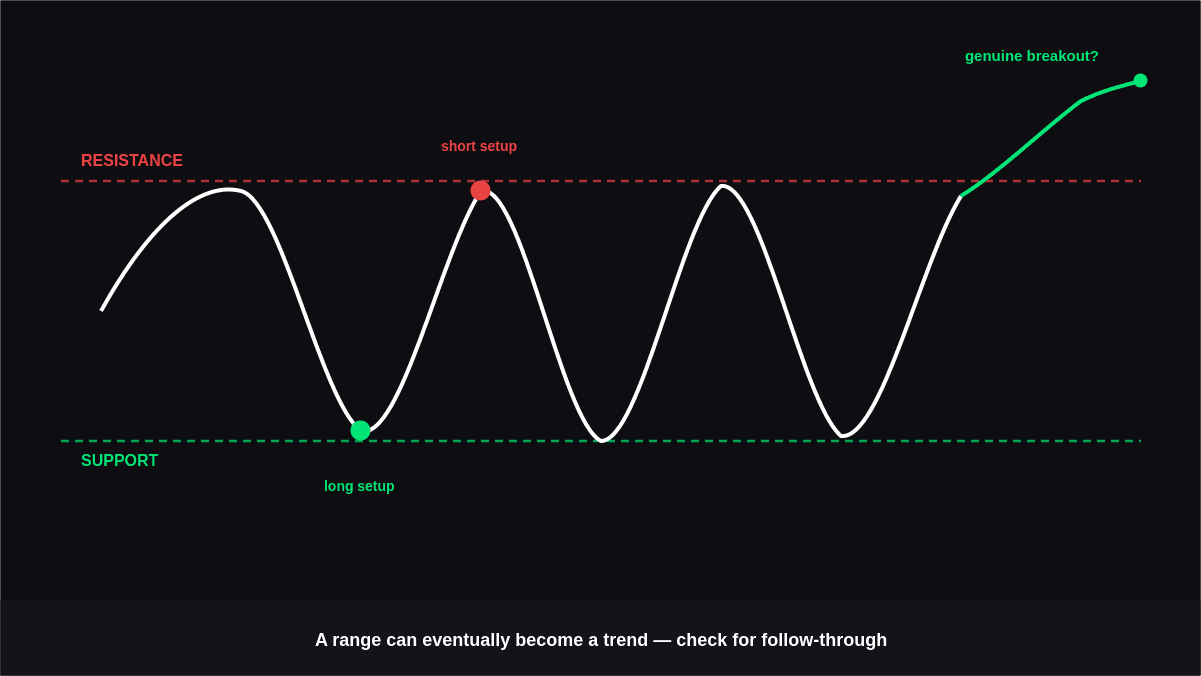
Sideways markets require a different approach because price may repeatedly move between recognizable boundaries.
Traders using range-bound market strategies may consider:
- Looking for potential long setups near established support
- Watching for potential short setups near resistance
- Waiting for confirmation before entering
- Treating brief moves beyond the range cautiously
- Checking whether price follows through after a breakout
A range can eventually develop into a trend, so traders should avoid assuming that support and resistance will hold indefinitely. A genuine breakout accompanied by stronger momentum may signal that the market environment is changing.
This distinction matters because a strategy designed to trade reversals inside a range can become vulnerable when price begins establishing a sustained directional move.
Managing Risk When Volatility Changes
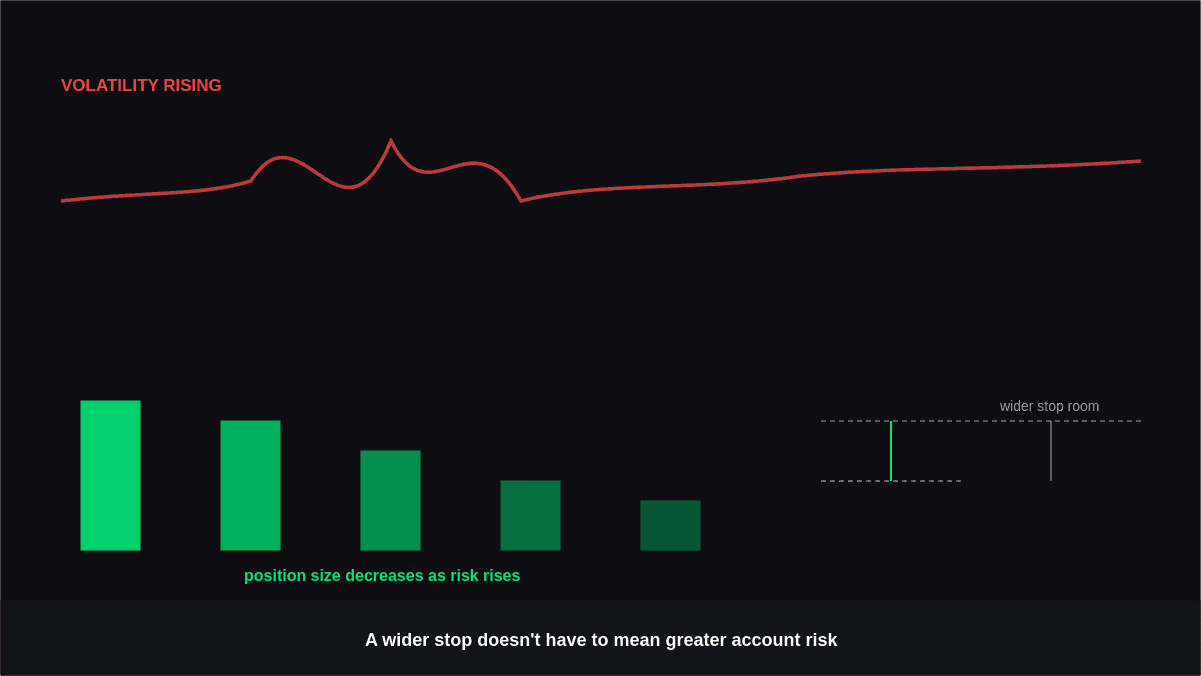
Volatility affects more than the size of a price move. It can influence stop placement, position sizing, expected trade duration, and the probability of sudden losses.
When volatility increases, traders may:
- Reduce position size
- Allow more room for normal price fluctuations
- Avoid entering immediately after unusually large price moves
- Reassess whether existing stop-loss levels remain appropriate
- Reduce the number of simultaneous positions
A wider stop does not automatically have to mean greater account risk. Traders can adjust position size alongside stop distance so that the amount at risk remains within their predefined limits.
During unusually volatile periods, some traders may also wait for conditions to stabilize rather than increasing activity simply because more price movement is available.
Choosing a Strategy Based on Market Conditions
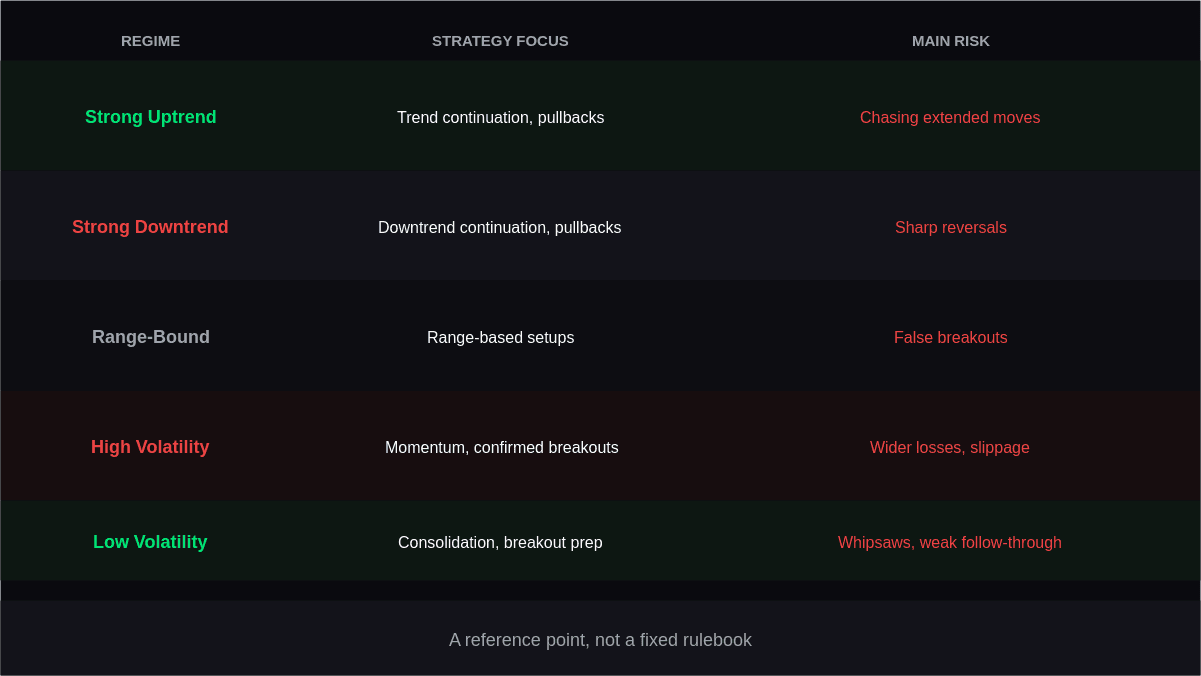
A structured comparison can help traders determine which characteristics deserve attention before selecting a setup.
| Market Regime | Typical Price Behavior | Potential Strategy Focus | Main Risk |
|---|---|---|---|
| Strong uptrend | Higher highs and higher lows | Trend continuation and pullbacks | Chasing extended moves |
| Strong downtrend | Lower highs and lower lows | Downtrend continuation and pullbacks | Sharp reversals |
| Range-bound | Price moves between support and resistance | Range-based setups | False breakouts |
| High volatility | Large and rapid price swings | Momentum or confirmed breakouts | Wider losses and slippage |
| Low volatility | Compressed price movement | Consolidation and breakout preparation | Whipsaws and weak follow-through |
The table should not be treated as a fixed trading rulebook. A market can transition from one regime to another, and individual assets can behave differently from the broader market.
Why Regime-Based Adjustments Need Validation
Changing a strategy simply because recent market behavior looks different can introduce another problem: overfitting.
A trader may see that an adjustment worked particularly well over the last few weeks and assume the same change will remain effective.
A stronger process is to test strategy performance across historical periods representing different conditions. Traders can compare metrics such as:
- Win rate
- Average profit or loss per trade
- Maximum drawdown
- Profit factor
- Number of trades
- Average trade duration
This helps distinguish a genuine strategy characteristic from a result caused by an unusually favorable period.
A strategy that performs well during strong trends may naturally struggle in a prolonged range. That does not necessarily mean the strategy is defective. It may simply reveal where its underlying assumptions are strongest and weakest.
Building a Flexible Trading Process
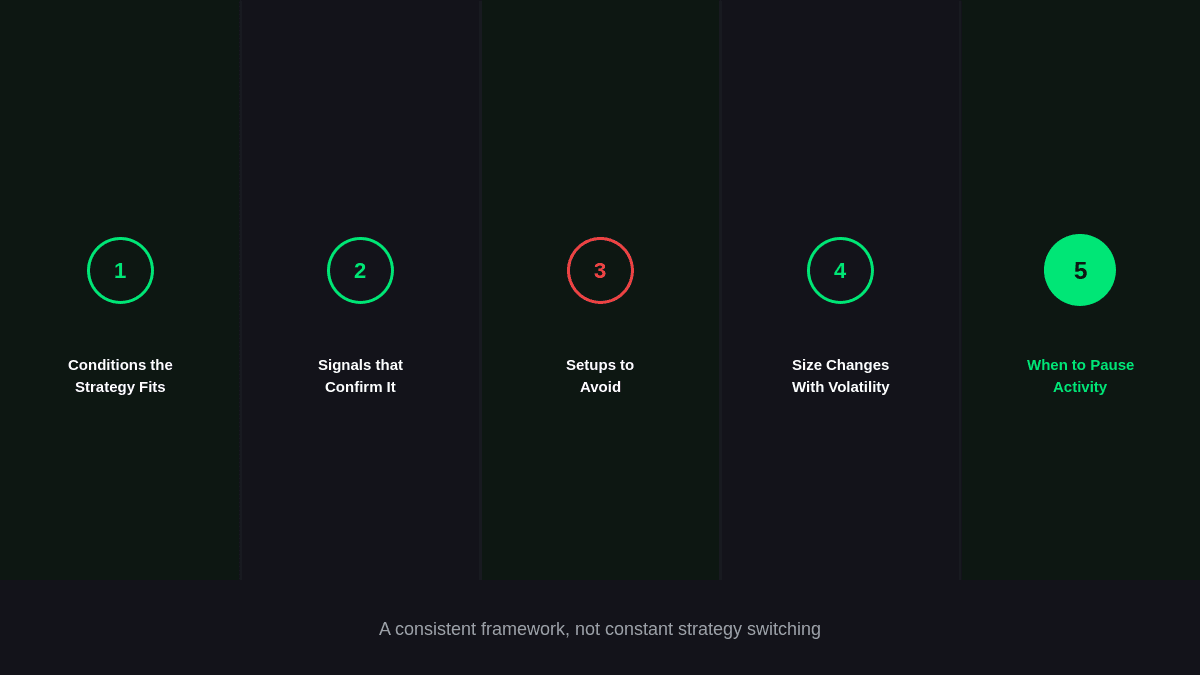
The most useful adaptation is often a structured decision process rather than constantly switching between strategies.
Traders can establish rules that define:
- Which market conditions their strategy is designed for
- What signals confirm those conditions
- Which setups should be avoided
- How position size changes when volatility increases
- When trading activity should be reduced or paused
This creates a more consistent framework for responding to changing conditions. Instead of asking whether one strategy works in every market, traders can ask whether the current environment provides the conditions that strategy was designed to handle.
Conclusion
Understanding how traders adapt strategies to different market regimes helps explain why the same setup can perform differently from one period to another.
Trending, range-bound, high-volatility, and low-volatility environments create different challenges for entries, exits, and risk management.
Traders can respond by identifying the prevailing market structure, selecting suitable tactics, and adjusting exposure without abandoning their overall trading framework.
A flexible process cannot remove uncertainty from financial markets. It can, however, give traders a clearer way to respond when price behavior changes while keeping strategy rules, testing, and risk management at the center of their decisions.