When placing a trade, choosing the right order type can affect both the price you receive and how quickly your position is opened or closed. Market Orders vs Limit Orders is essentially an important comparison to consider while prioritizing execution and controlling the price. A market order aims to execute at the best available price, while a limit order only executes at a specified price or better. The choice can also influence how traders act on entry exit signals when managing a position.
Understanding this distinction helps traders choose an order type that fits the conditions of a particular trade.
What Is a Market Order and Limit Order?
Market and limit orders give traders different ways to control how their trades are executed. The key difference is that one focuses on getting the trade filled, while the other focuses on controlling the price.
What Is a Market Order?
A market order instructs the broker to execute a trade at the best available price in the market at that time.
- Prioritizes execution: The order is designed to fill as quickly as possible.
- No fixed price: The final execution price can differ from the displayed market price.
- Useful for fast decisions: It may suit traders who consider immediate entry or exit more important than getting an exact price.
What Is a Limit Order?
A limit order lets a trader specify the price at which they are willing to buy or sell. The order executes only when the market reaches that price or provides a better one.
- Provides price control: Traders set the maximum price they will pay when buying or the minimum price they will accept when selling.
- Execution is not guaranteed: The order may remain unfilled if the market does not reach the specified price.
- Useful for price-sensitive trades: It may suit traders who are willing to wait for a particular entry or exit level.
The Core Difference Between Market Orders vs Limit Orders
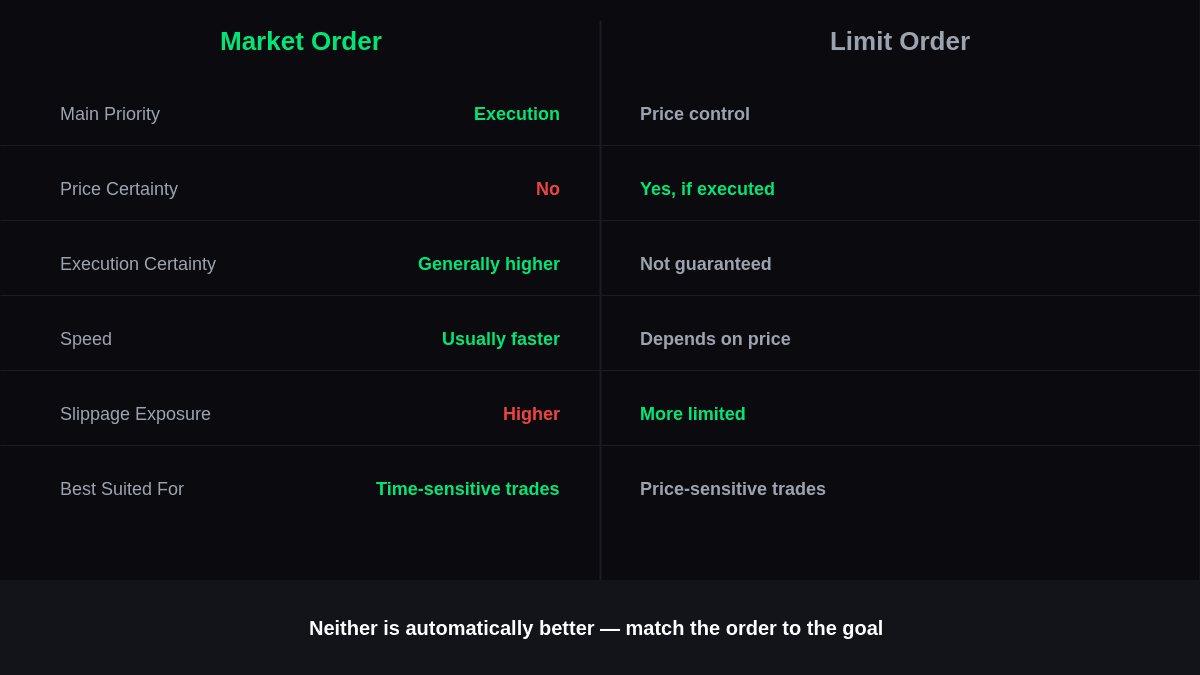
The main difference is what the trader prioritizes when submitting an order.
A market order prioritizes execution. It tells the broker or exchange to execute the trade at the best available price in the market. The final execution price can differ from the price displayed when the order is submitted.
A limit order prioritizes price control. The trader specifies the maximum price they are willing to pay when buying or the minimum price they are willing to accept when selling. The order executes only if the market reaches a price that satisfies those conditions.
This creates a straightforward trade-off:
| Factor | Market Order | Limit Order |
|---|---|---|
| Main priority | Execution | Price control |
| Price certainty | No | Yes, if executed |
| Execution certainty | Generally higher | Not guaranteed |
| Speed | Usually faster | Depends on market price |
| Slippage exposure | Higher | More limited |
| Best suited for | Time-sensitive trades | Price-sensitive trades |
Neither order type is automatically better. The appropriate choice depends on whether getting into or out of the position matters more than controlling the exact execution price.
How a Market Order Gets Filled
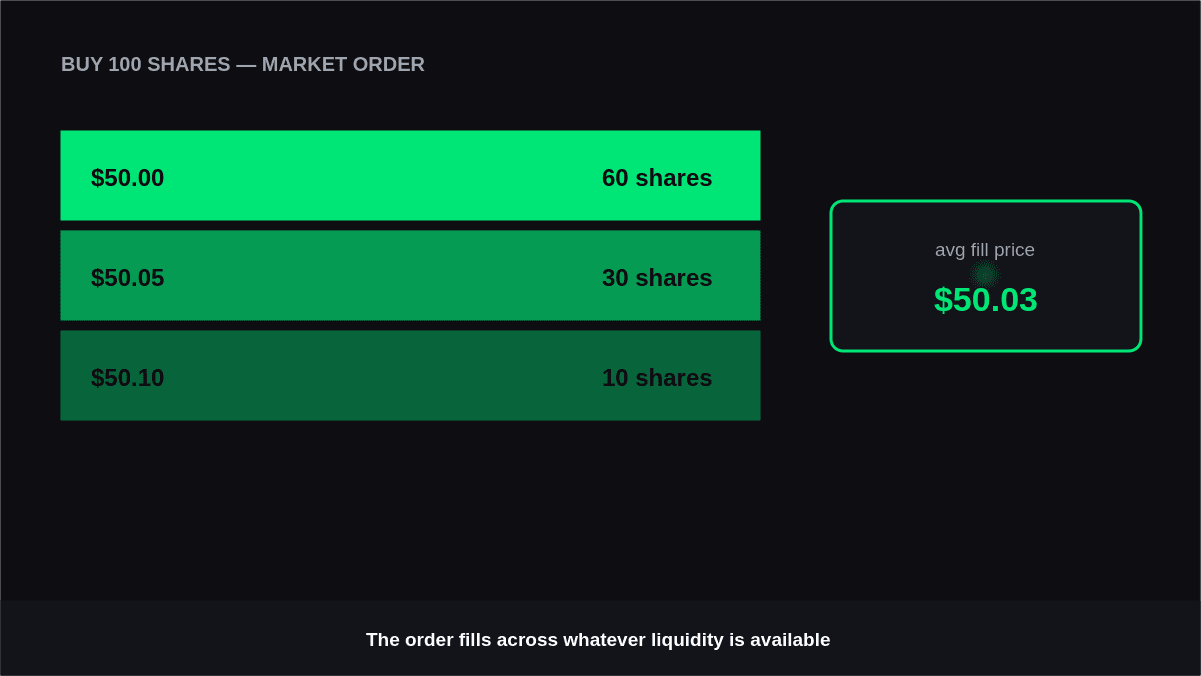
When a trader submits a market order, the order is matched with available liquidity at the time it reaches the market. The final execution depends on the prices and quantity available at that moment.
For example, suppose a stock is currently displaying an ask price of $50. A trader submits a market order to buy 100 shares. If enough shares are available at $50, the order may be filled there. If only part of the order is available at that price, the remaining shares may be filled at higher prices.
Market conditions can also influence the result. During periods of high volatility, rapid price movement, or limited liquidity, the difference between the expected price and actual fill can become larger.
How a Limit Order Controls the Entry Price
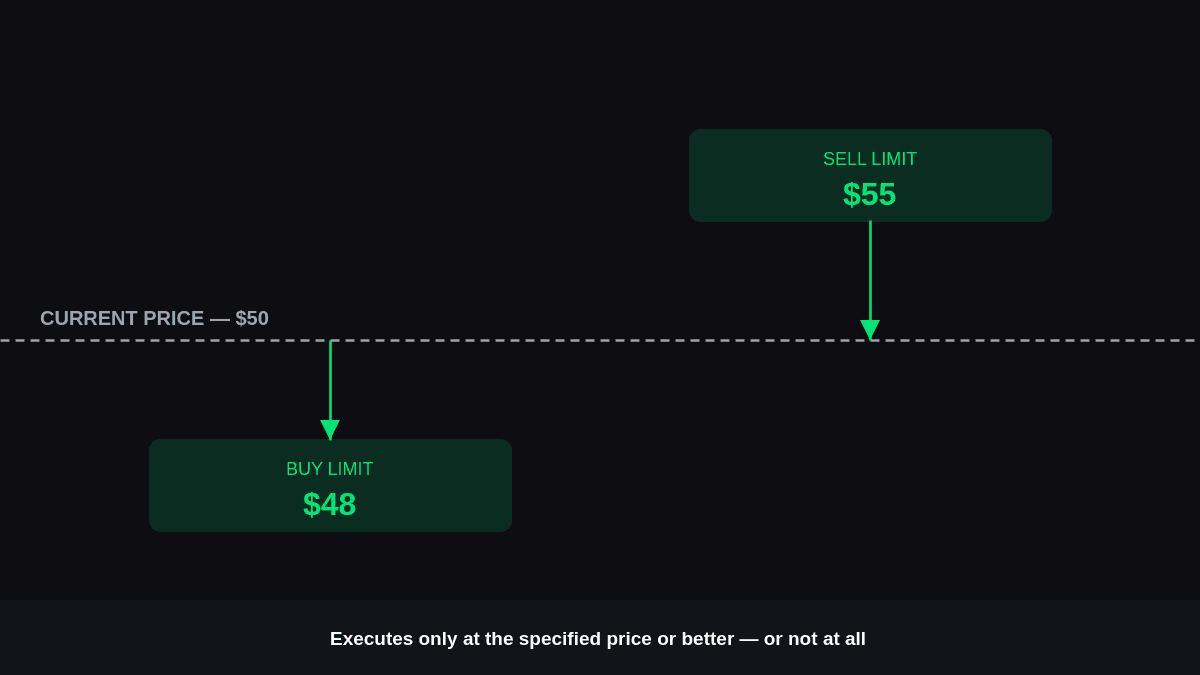
A limit order gives the trader a defined price condition. Instead of accepting the next available market price, the trader specifies the price they are willing to accept.
Imagine a stock is trading at $50, but a trader only wants to buy it at $48 or lower. They can place a buy limit order at $48. The order remains pending until the market reaches a price at which the order can be executed. This approach can be useful when traders identify support resistance levels and want greater control over where an order is placed.
The same principle applies to selling. A trader holding shares at $50 could place a sell limit order at $55. The order can execute at $55 or better, depending on the market and available liquidity.
The main advantage is greater control over the execution price. The trade-off is that the position may never be opened or closed if the required price is not available.
Choosing an Order Type Based on Trading Conditions
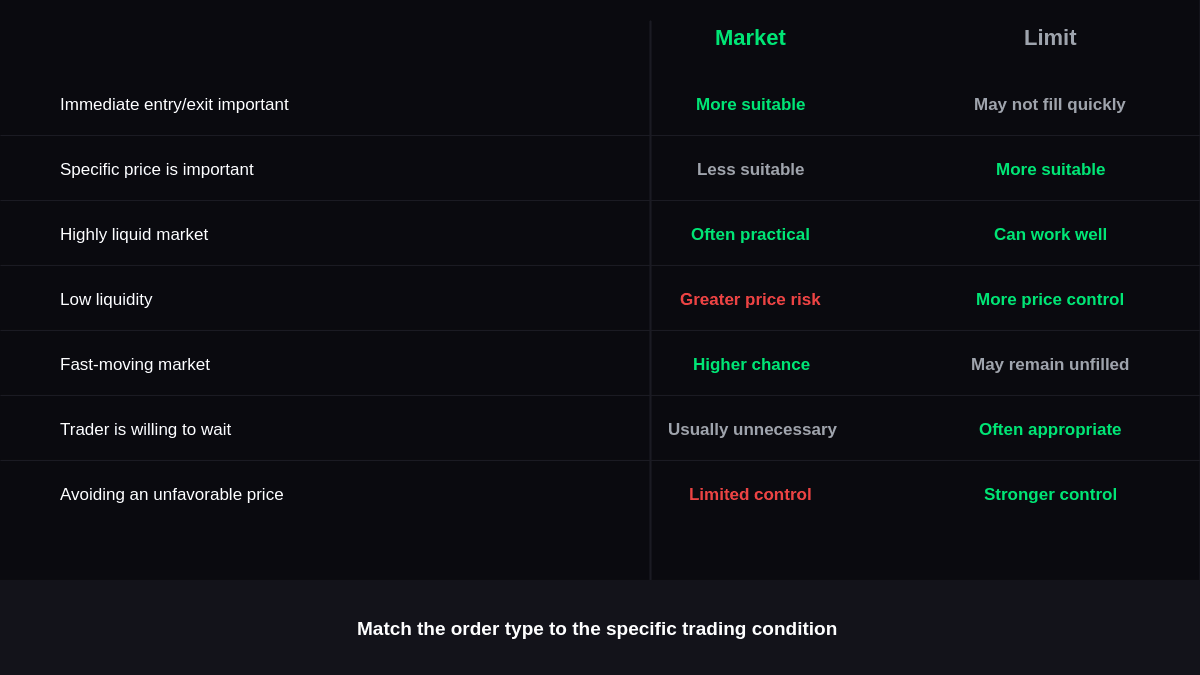
The right order type depends on what the trader wants to prioritize during a trade. To understand how to choose an order type in detail follow the given table:
| Trading Condition | Market Order | Limit Order |
|---|---|---|
| Immediate entry or exit is important | More suitable | May not fill quickly |
| Specific price is important | Less suitable | More suitable |
| Highly liquid market | Often practical | Can also work well |
| Low liquidity | Greater price risk | More price control |
| Fast-moving market | Higher chance | May remain unfilled |
| Trader is willing to wait | Usually unnecessary | Often appropriate |
| Avoiding an unfavorable price | Limited control | Stronger control |
There is no universally better order type. Traders should match the order with the market conditions and the objective of the individual trade.
What Actually Changes During Trade Execution?
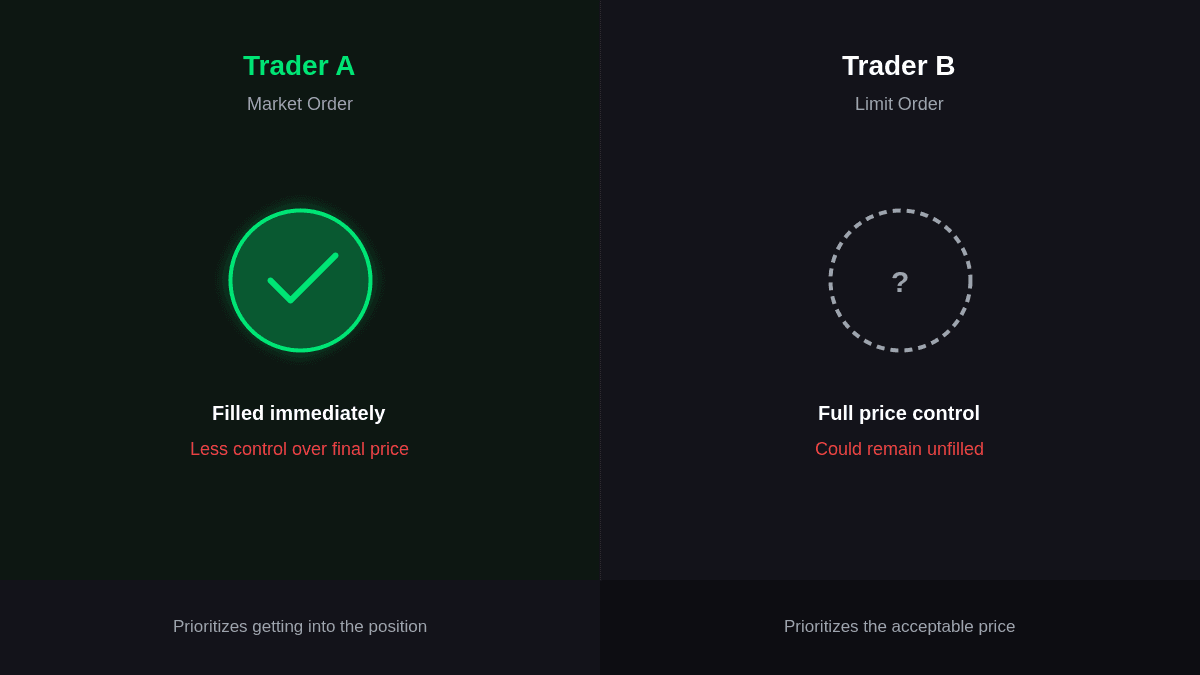
The biggest practical difference appears in the relationship between price and execution certainty.
Consider two traders looking at the same stock:
- Trader A believes entering immediately is more important and submits a market order.
- Trader B believes price discipline is more important and submits a limit order below the current market.
Trader A is more likely to get an immediate position but has less control over the final price. Trader B has greater control over the acceptable price but could remain unfilled if the market never reaches the specified level.
This distinction becomes particularly important when liquidity or volatility changes quickly.
When Market Orders May Make More Sense
Market orders can be useful when execution speed is the primary concern.
A trader may prefer this approach when:
- They need to enter or exit a position quickly.
- The market has sufficient liquidity.
- The difference between nearby available prices is relatively small.
- Waiting for a specific price could cause the trading opportunity to disappear.
However, speed should not be confused with guaranteed pricing. A market order can execute quickly while producing a less favorable price than expected, particularly in a rapidly moving market.
When Limit Orders May Be More Appropriate
Limit orders can be useful when the acceptable entry or exit price matters more than immediate execution.
They may suit situations where a trader:
- Has identified a specific entry price.
- Wants to avoid paying above a predetermined level.
- Is planning an exit at a particular target.
- Is willing to miss the trade rather than accept an unfavorable price.
For example, if a trader believes a stock is attractive only below $40, a buy limit order can enforce that preference. If the stock stays above $40, there is no trade, but the trader also avoids automatically buying at a higher price.
Final Thoughts
Understanding Market Orders vs Limit Orders comes down to recognizing the trade-off between execution and price control.
Market orders generally emphasize getting the transaction completed, while limit orders establish a price condition before execution can occur.
The right choice depends on the market environment and the trader's objective.
Before submitting an order, consider whether the immediate fill or the specified price is more important for that particular trade, particularly when assessing price action concepts around the potential entry and exit.