A market holiday is a scheduled day when a financial exchange is closed or operates on a modified schedule. During these periods, regular trading activity may pause, meaning investors cannot execute trades through the exchange in the usual way.
Market holidays are typically established in advance and can vary by country, exchange, and financial market.
Knowing when an exchange will be closed is an important part of planning trades. A holiday can affect order execution, liquidity, price discovery, settlement timelines, and the timing of market-moving events.
Traders who understand these changes can better manage positions and plan around the Best time of day to day trade to avoid unexpected delays.
In this blog, we will explore what a market holiday means, why exchanges close, and the main ways a holiday can influence trading activity. We will also look at practical considerations traders should keep in mind before an exchange closes.
What Is a Market Holiday?
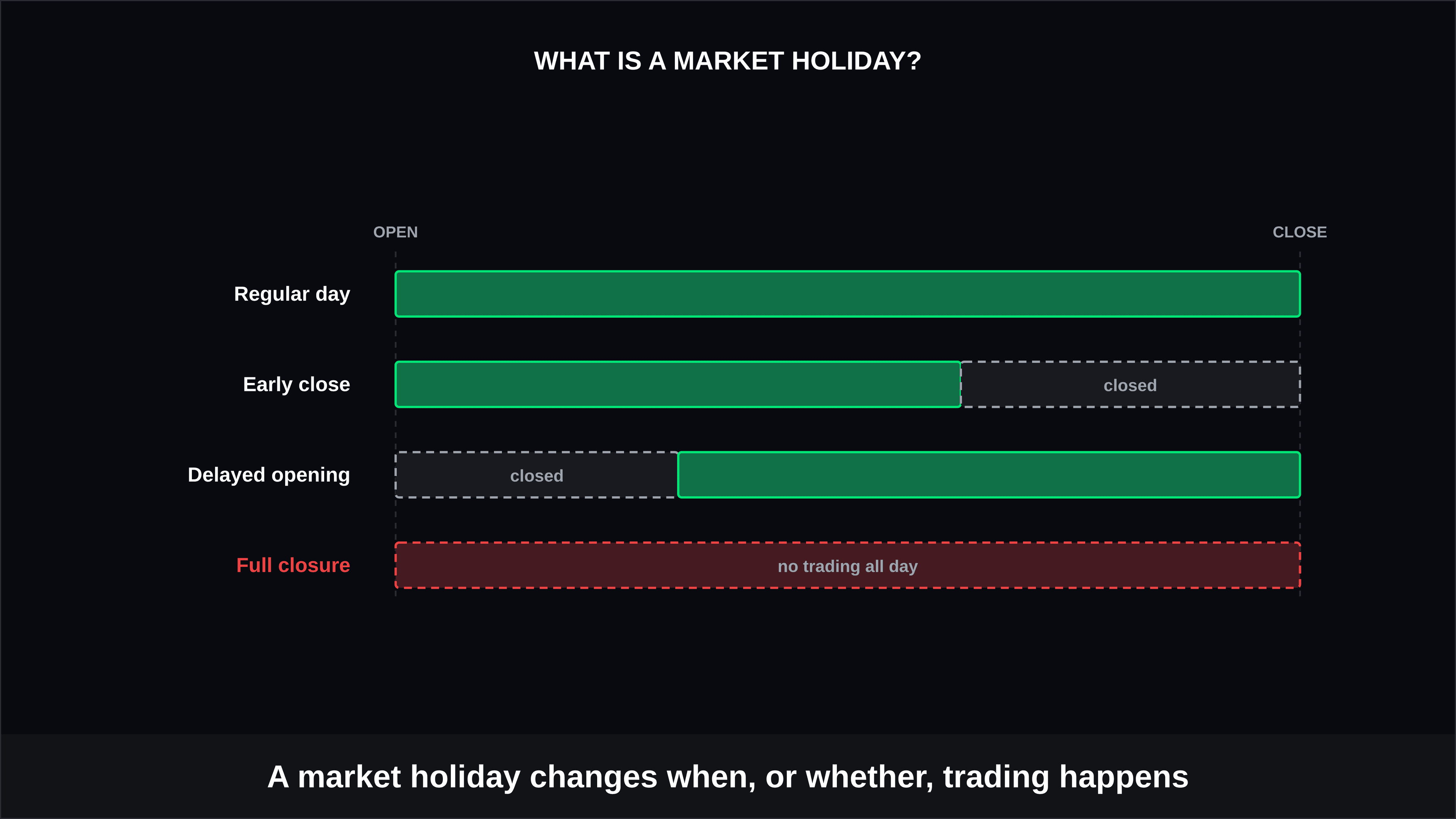
A market holiday is a date designated by an exchange or financial market when normal trading is suspended or shortened. These dates are usually published in an exchange's annual calendar and may correspond with national holidays, religious observances, or other officially recognized events.
Not every financial market follows the same holiday calendar. For example, a stock exchange may be closed while another international market remains open. Some exchanges also use early closing sessions instead of shutting down for the entire day.
A market holiday can involve:
- Full closure: Regular trading does not take place during the scheduled session.
- Early closure: The exchange stops trading earlier than its normal closing time.
- Delayed opening: Trading begins later than usual.
- Modified settlement schedules: Transactions may take longer to settle because processing days are affected.
- Different calendars across markets: Exchanges in different countries may observe different holidays.
7 Ways a Market Holiday Affects Trading
A holiday does more than remove a trading session from the calendar. It can change when orders are processed, how much liquidity is available, and when traders receive opportunities to react to market developments.
The following seven effects are particularly important when planning around an exchange closure.
1. Trading Sessions May Be Shortened or Suspended
The most immediate effect is a change in the normal trading schedule. Depending on the exchange's calendar, traders may encounter a complete closure or a shortened session.
This means traders should:
- Check the official exchange calendar before placing time-sensitive trades.
- Confirm whether the session is fully closed or ends early.
- Review opening and closing times for the specific market.
- Avoid assuming that all financial markets follow the same schedule.
A schedule adjustment can matter especially when a trader is relying on a particular entry or exit window.
2. Order Execution Can Be Delayed
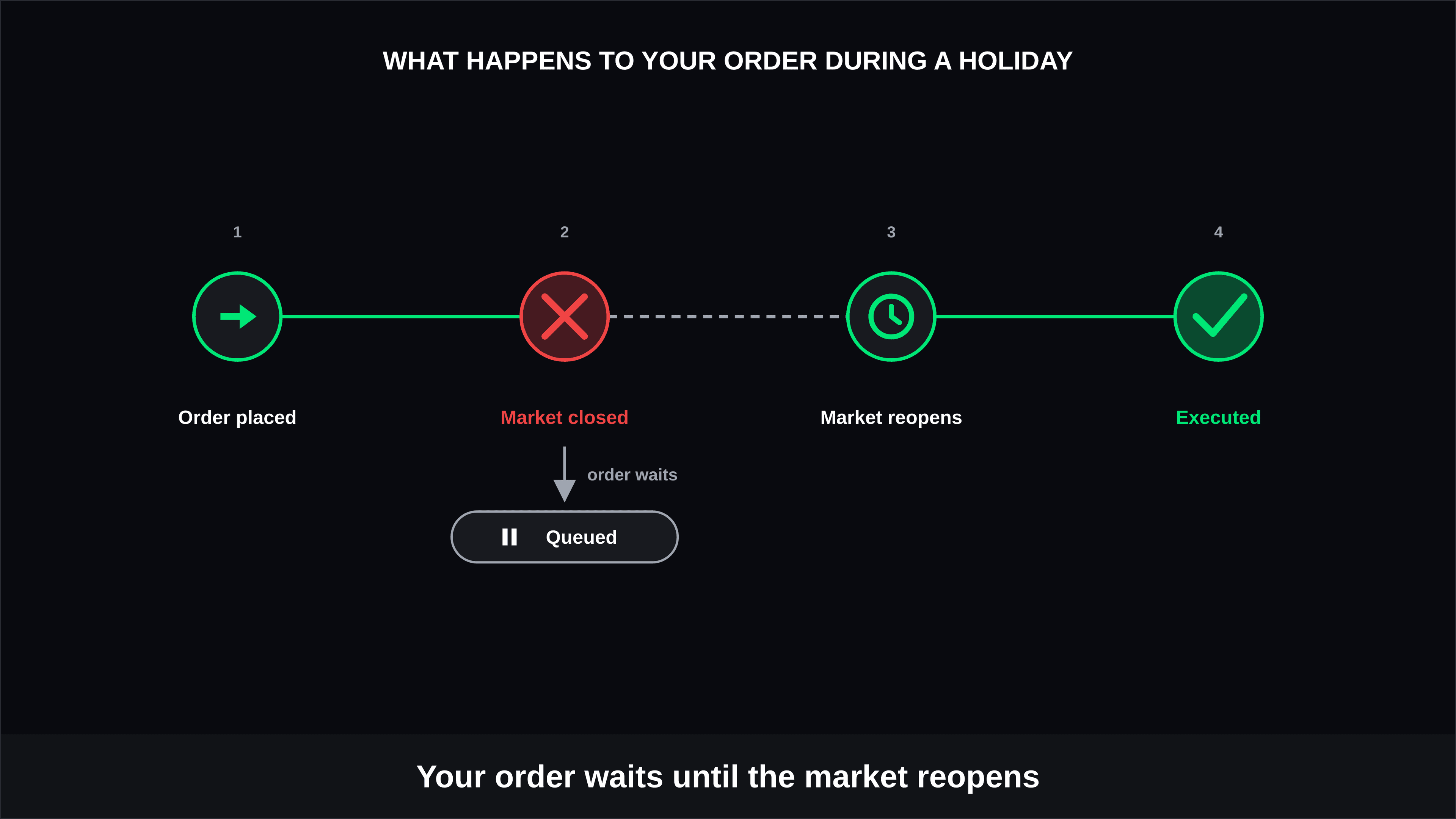
Orders submitted around a holiday may not be processed in the same timeframe as they would during a regular session. The exact treatment depends on the broker, exchange, order type, and trading venue.
Traders should consider:
- Whether an order can be submitted while the exchange is closed.
- When an unexecuted order will become eligible for execution.
- Whether time-in-force instructions remain active.
- How the broker handles orders placed before a closure.
An order entered successfully does not necessarily mean the trade will execute immediately.
3. Liquidity Can Change Around the Closure
Trading activity often changes before and after a scheduled closure. Some participants may reduce activity ahead of the holiday, while others may adjust positions before the market shuts.
Lower participation can affect:
- Bid-ask spreads
- Available order depth
- Execution quality
- Short-term price movements
- The ease of entering or exiting larger positions
The effect is not identical for every market, so traders should evaluate the specific instrument rather than assuming liquidity will always fall by the same amount.
4. Price Gaps May Occur When Trading Resumes
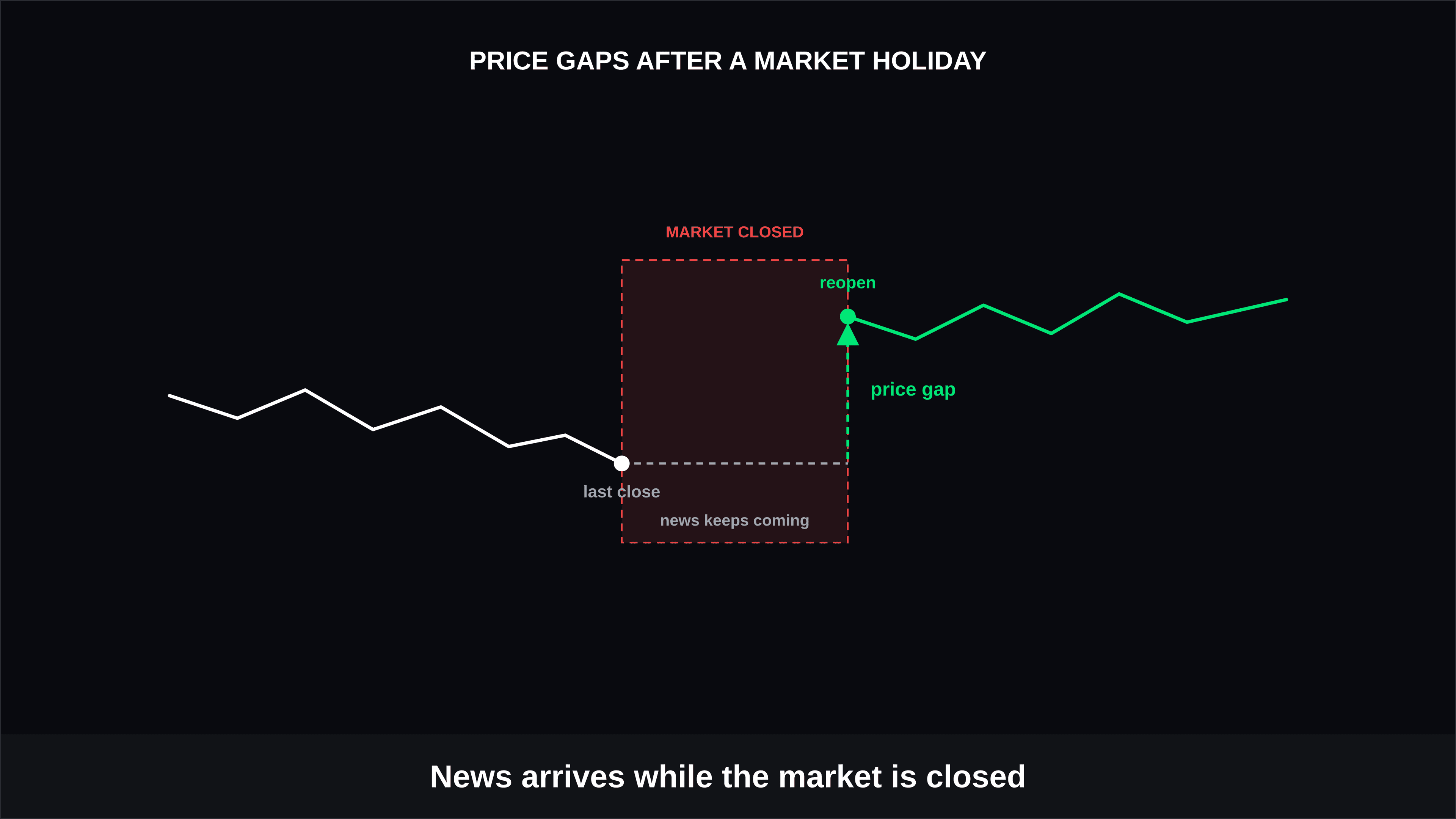
When an exchange is closed, prices on that venue cannot continuously reflect new developments through regular trading. However, economic announcements, corporate news, geopolitical events, and movements in related markets can still occur.
When trading resumes, the opening price may therefore differ substantially from the previous session's close.
Traders managing positions across a closure should:
- Monitor major scheduled announcements.
- Understand their exposure to overnight or weekend-style gaps.
- Avoid assuming the previous closing price will remain relevant.
- Review risk controls before the next session begins.
This is particularly important for positions that remain open while the exchange is inactive.
5. Settlement Timelines Can Shift
A holiday can affect more than buying and selling. Settlement involves processes that occur after a transaction is completed, and non-business days can change when those processes take place.
Possible effects include:
- Settlement occurring on a later business day.
- Cash became available later than expected.
- Securities delivery being pushed back.
- Different settlement dates for trades executed around the holiday.
Traders who need funds or securities for another transaction should account for the altered business-day schedule.
6. Market Reaction to News Can Be Deferred
Important news does not necessarily stop simply because an exchange is closed. Companies can release information, governments can publish economic data, and global events can develop while a particular market is inactive.
When trading resumes, participants may respond to several developments at once.
This can lead to:
- Larger opening moves
- Increased trading activity
- Rapid repricing of securities
- Greater attention to pre-market or related-market information
- A buildup of orders waiting for the next available session
The impact depends heavily on what occurs during the closure and how relevant the information is to the affected securities.
7. Trading Plans May Need Adjustment
A market holiday can change the timing assumptions behind an existing strategy. A setup that normally depends on consecutive trading sessions may behave differently when one session is removed from the calendar.
Before a closure, traders can:
- Review open positions.
- Check pending orders.
- Confirm the next available session.
- Reassess upcoming economic and corporate events.
- Verify whether their broker has special holiday procedures.
- Account for changes in settlement dates.
Planning around the calendar helps prevent operational issues from interfering with an otherwise well-defined trading approach.
Market Holiday vs. Regular Trading Day
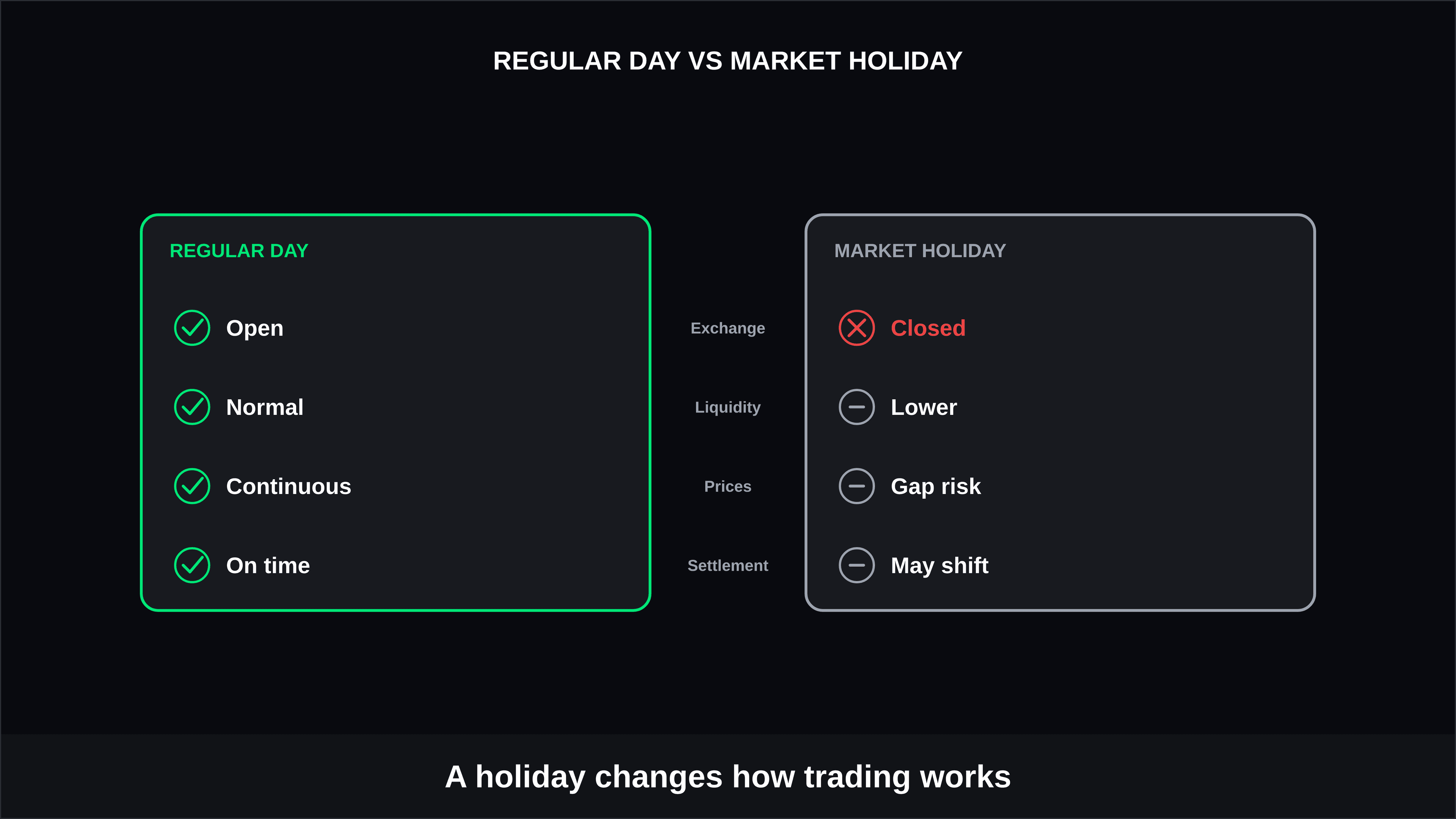
Understanding the difference between a normal session and a holiday schedule makes it easier to anticipate changes in market activity.
| Factor Regular | Trading Day | Market Holiday |
|---|---|---|
| Exchange availability | Normal session | Closed or modified |
| Order execution | Generally follows normal schedule | May be delayed or unavailable |
| Liquidity | Based on typical participation | May be reduced around closure |
| Price discovery | Continuous during active session | Paused on the closed venue |
| Settlement | Follows normal business calendar | May move to a later date |
| News response | Can occur during trading | May be reflected when trading resumes |
| Planning requirements | Standard session preparation | Requires calendar and order review |
The key distinction is that a holiday changes the market's operating conditions, rather than simply removing a date from a trader's calendar.
How Traders Can Prepare for a Market Holiday
Preparation does not require changing a trading strategy solely because an exchange is closed. Instead, traders should understand how the altered schedule interacts with their existing positions and orders.
Useful steps include:
- Check the exchange's official holiday calendar.
- Identify any early-closing or delayed-opening sessions.
- Review open positions before the closure.
- Confirm pending orders and their expiration rules.
- Check upcoming economic or company announcements.
- Account for changes to settlement dates.
- Review risk exposure if positions will remain open during the closure.
These checks are especially useful when trading across multiple markets because their schedules may not match.
Conclusion
A market holiday changes when and how normal trading activity takes place. Depending on the exchange, the closure may stop trading entirely or create a shortened session, while related effects can extend to Market Orders vs Limit Orders, liquidity, settlement, price gaps, and the timing of market reactions.
Understanding the holiday calendar allows traders to plan positions, orders, and cash requirements more carefully.
Rather than treating a closure as simply a day without trading, it is better to view it as a temporary change in market conditions that can influence what happens before the closure and when trading resumes.