Market behavior is never quite as predictable as one might expect, which makes understanding leading vs lagging indicators important for making informed trading decisions. Instead of trying to find one best indicator, successful traders learn to know when a particular signal is valuable and when they should ignore it.
There are indicators aimed at finding future price action, as well as those confirming that there is some trend already. Both methods are not superior to each other in any way; rather, both have their own place to play in a trading strategy.
This blog covers the differences between leading and lagging indicators, their respective strong points, typical pitfalls to avoid, and how traders can use them both without making things complicated.
Why the Difference Matters
Trading errors occur due to traders’ assumptions that all indicators will have similar functions.
For instance, a trader may use a trend-following indicator with an assumption of early entries or using an oscillator in a trend environment and continuously trade against momentum.
Knowledge of what each indicator is supposed to do will assist traders to:
- Select indicators based on market situations.
- Prevent conflicting signals.
- Formulate trading rules.
- Be less emotional.
The objective is not to make perfect forecasts but good trading decisions.
Leading vs Lagging Indicators: What's the Real Difference?
The main difference of leading vs lagging indicators is timing, where leading indicators attempt to signal changes in prices in advance, lagging indicators in trading provide confirmation after the changes have already occurred.
A decision between the two should be made based on what approach suits one’s strategy better.
| Difference | Leading Indicators | Lagging Indicators |
|---|---|---|
| Main purpose | Identify potential price movements before they develop fully | Confirm movements that are already underway |
| Signal timing | Usually provides signals earlier | Usually provides signals later |
| Primary focus | Potential reversals and turning points | Existing trends and momentum |
| Entry timing | Can support earlier entries | Often results in later entries |
| False signals | More likely, particularly in strong trends | Generally fewer premature signals |
| Trend confirmation | Limited | Strong |
| Best market conditions | Ranges, potential reversals, and turning points | Established trends and sustained momentum |
| Main advantage | Earlier identification of possible opportunities | Greater confirmation before taking action |
| Main limitation | Signals can occur before a move actually develops | Part of the price move may already have occurred |
| Typical examples | RSI, Stochastic Oscillator, CCI | Moving Averages, MACD, Bollinger Bands |
The Biggest Trade-Off: Speed vs Confirmation
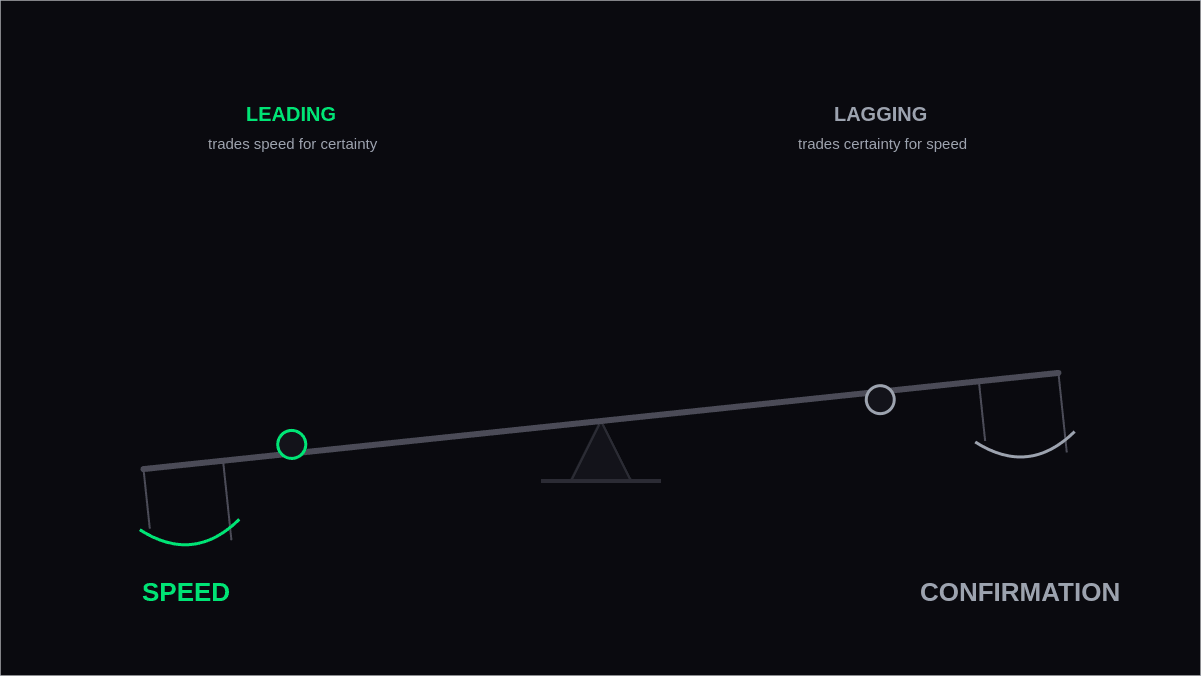
The main issue in choosing between leading vs lagging indicators involves the trade-off between timing and certainty.
In this section, you can learn the meanings of speed and confirmation and how they influence the decision to use leading and lagging indicators:
Speed
Leading indicators usually take the edge in situations where time plays an important role. In such a case, an RSI value may show that an asset is getting oversold without any clear indication of a reversal taking place in the price action chart. Even though the trader gets early signals, prices may fall further rather than reversing.
On the other hand, lagging indicators are based on price action that has taken place already. In the case of a moving average crossover, the confirmation of an uptrend is seen after prices have risen already.
Confirmation
Lagging indicators will usually offer more confirmation since they react to already-existing price action. They might be helpful when the trader seeks to get confirmation about whether the momentum or a trend is forming at all.
Leading indicators offer less confirmation since they seek to find out what might occur next. Their signals might prove quite valuable especially around the possible reversal, but they should normally be confirmed by something else, by price action, structure of the market, etc.
Leading Indicator Or Lagging Indicator Best Performance
The better choice depends on the market environment and the objective of the trading strategy. Below you will find when these two performs best:
When Leading Indicators Perform Best
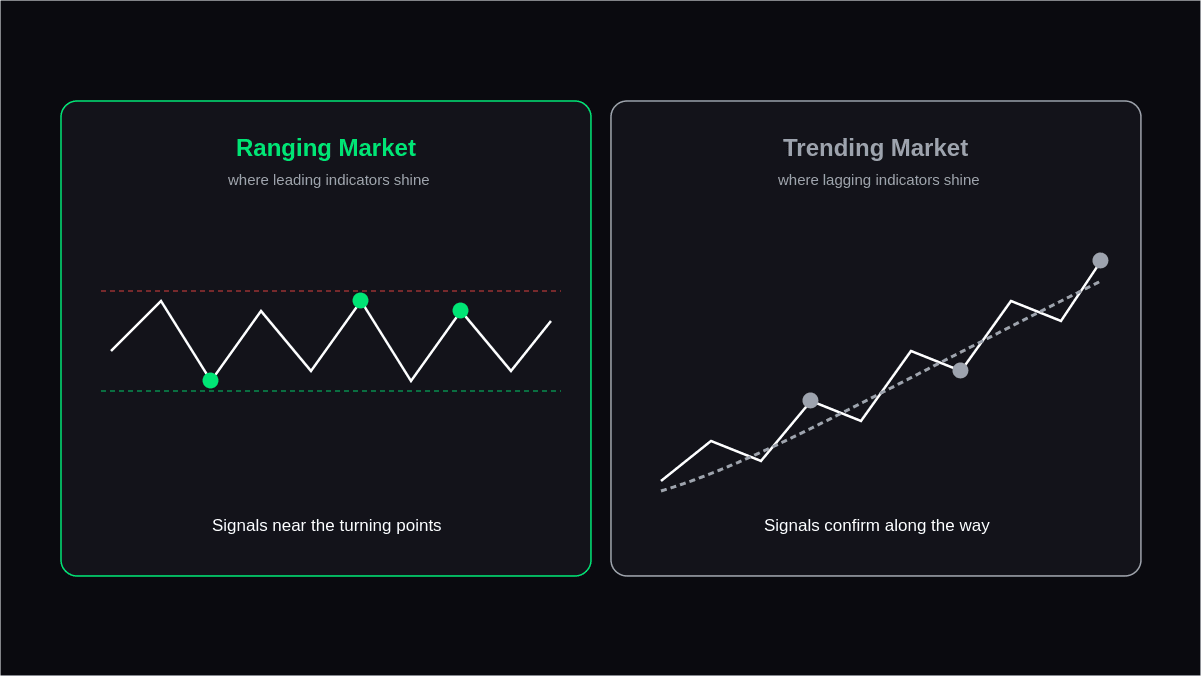
Leading indicators will be more helpful where there is no confirmed directional trend in price movements.
Examples include:
- Range bound markets.
- Tests of support and resistance.
- Breakout preparations.
- Momentum divergences.
But it is important to bear in mind that leading signals are not sure fire indications. Further confirmation from price action can help avoid false trading.
When Lagging Indicators Perform Best
Lagging indicators become especially useful once momentum is already in place.
Some instances where they are usually helpful are:
- Trend continuation.
- Entry into pullback trades on trending markets.
- Position management.
- Exit confirmation.
Rather than trying to call reversals, these indicators ensure that traders do not fight market momentum. Financial research and educational frameworks consistently show that pairing forward-looking signals with retrospective verification leads to more balanced and disciplined decision-making.
Incorporating them alongside algorithmic trading tools can further help in executing disciplined entries without emotional bias.
How Professional Traders Combine Both Approaches
Experienced traders do not necessarily choose between leading and lagging indicators. Instead, they can use each for a different part of the decision-making process.
Here you can find how you can combine both approaches:
Step 1: Identify the Market Condition
Start by determining whether the market is trending, ranging, or showing signs of a potential reversal. The same indicator can behave differently depending on the environment.
Step 2: Look for an Early Opportunity
Use a leading indicator to identify a possible change in momentum or direction. This creates a setup worth investigating rather than an automatic trade signal.
Step 3: Wait for Confirmation
Look for confirmation from a lagging indicator, price structure, or another predefined condition. This helps filter out setups where the initial signal fails to develop.
Step 4: Check the Price Action
Confirm that the indicator signal agrees with what the price is actually doing. For example, a potential bullish signal becomes more meaningful if price also breaks above a relevant resistance level.
Step 5: Apply Risk Management
Before entering, define the entry, stop-loss, position size, and exit conditions. A strong indicator combination cannot eliminate trading risk.
Step 6: Review the Setup
After the trade, record whether each condition was met and how the trade performed. Reviewing these results can reveal which combinations work consistently and which produce unnecessary signals.
Common Mistakes Traders Make
Using indicators without considering their limitations can lead to poor entries, unnecessary trades, and conflicting signals. Avoiding a few common mistakes can make an indicator-based strategy simpler and more consistent.
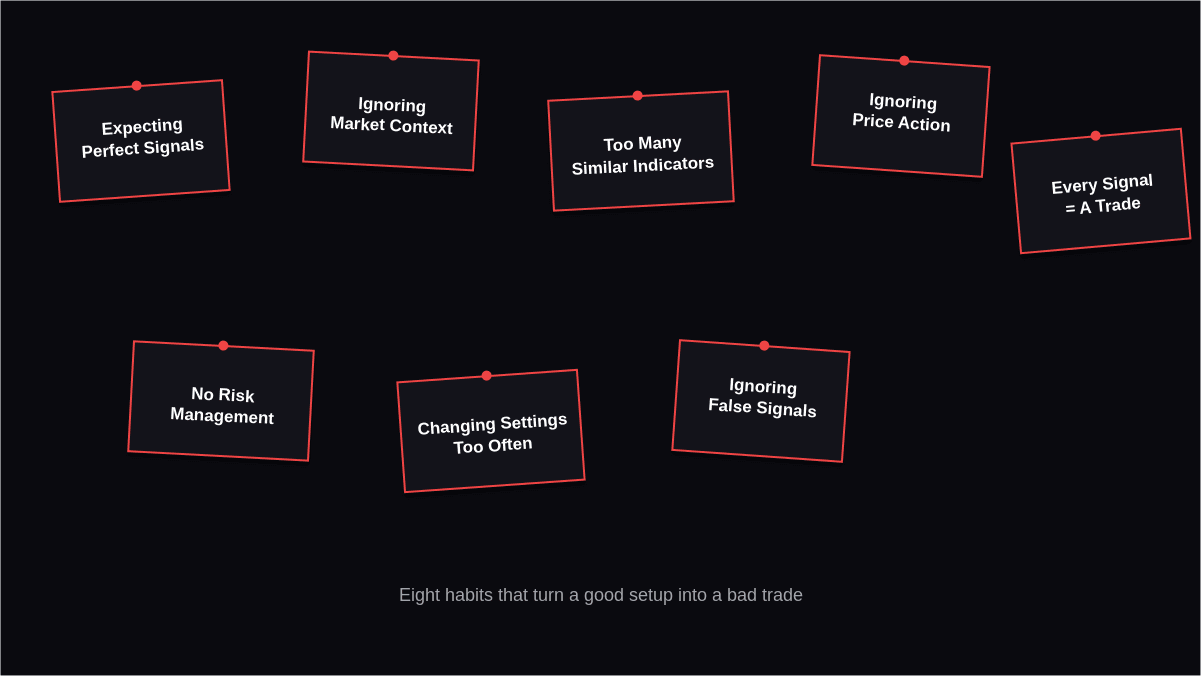
- Expecting Early Signals to Be Perfect
- Ignoring Market Context
- Using Too Many Similar Indicators
- Ignoring Price Action
- Treating Every Indicator Signal as a Trade Signal
- Relying on Indicators Without Risk Management
- Changing Indicator Settings Too Frequently
- Ignoring False Signals
Should Beginners Use Leading or Lagging Indicators?
For newer traders, the safest approach is usually learning both categories instead of choosing sides.
A practical learning path is:
- Start with one leading indicator.
- Pair it with one lagging indicator.
- Practice identifying different market conditions.
- Keep rules simple.
- Track results consistently.
This approach builds experience without overwhelming the trading process.
Final Thoughts
Knowing the difference between leading vs lagging indicators is not really about choosing one over the other, but rather understanding which type suits the prevailing market conditions. Leading indicators can give early indications, whereas lagging indicators are useful for confirming whether the early indications are being realized into trends or not.
The best trading setups would normally consist of market context, proper risk management, and thorough testing rather than expecting that one type of indicator could predict everything. For experienced traders, it will be crucial to learn which indicator to look for and when.
FAQs
1. What is the difference between leading and lagging indicators?
Leading indicators attempt to identify potential market moves before they fully develop, while lagging indicators confirm trends after price has already begun moving.
2. Are leading indicators more accurate than lagging indicators?
Not really. Leading indicators give you an early indication, but they usually give more false indications than lagging indicators.
3. Which indicators are considered leading indicators in trading?
Common leading indicators include RSI, Stochastic Oscillator, and CCI, especially when traders look for potential reversals or momentum changes.
4. When should traders use lagging indicators?
Lagging indicators are usually better at times when there are already existing trends since they will aid in confirming momentum and minimizing early entries.
5. Can traders combine leading and lagging indicators?
Yes. Most traders rely on the use of a leading indicator to signal a possible setup and lagging indicator to ensure the trend is going as anticipated.