Trading may appear difficult because of charts, indicators, order types, and market terminology for a beginner. But learning how to start trading as a complete beginner does not mean you need to know everything about trading.
The most important steps are understanding how markets operate, choosing a market and broker, choosing a trading style that suits you, practicing with a well-thought-out strategy, and managing risk effectively.
Some traders later move to rules-based or algorithmic trading once they understand the basics and have a defined trading process.
This guide walks through the key steps beginners can follow to build a practical foundation and approach their first trades with realistic expectations.
How Much Money Do You Need to Start Trading?
There is no single amount that every beginner needs to start trading. The amount depends on the market you choose, the broker you use, the account type, trading fees, margin requirements, and whether you are trading with cash or leverage.
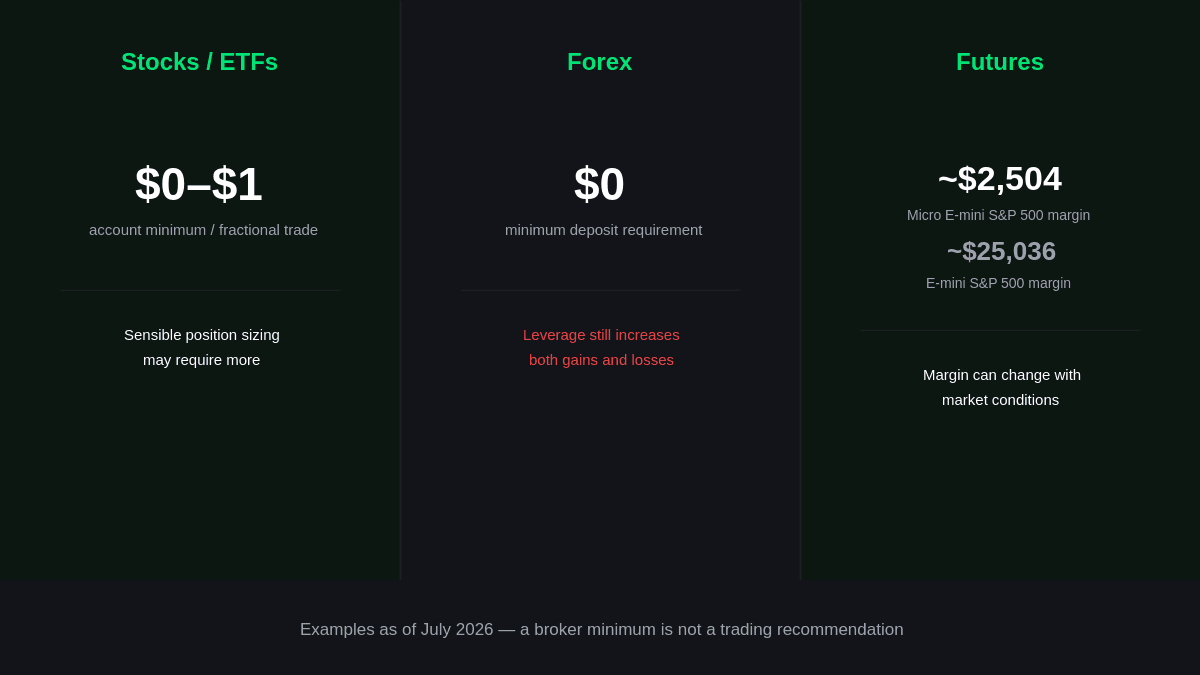
For example, some U.S. brokers allow customers to open a standard brokerage account with a $0 minimum deposit. Fidelity also allows eligible fractional stock and ETF trades from $1, while Charles Schwab lists a $0 minimum deposit for its standard brokerage accounts. These minimums mean you can open an account with little or no initial deposit, but they do not necessarily mean that amount is appropriate for active trading.
Forex can also have a low account-opening threshold. For example, OANDA states that its U.S. individual forex accounts have no minimum deposit requirement.
However, a low deposit does not make forex trading low risk. Leverage can increase both potential gains and losses, so beginners should consider position size, spreads, and their ability to absorb losses before trading.
Futures work differently because traders generally need to meet margin requirements rather than simply deposit an amount chosen as a minimum account balance.
CME Group's current estimates show that, as of July 7, 2026, the estimated margin for one Micro E-mini S&P 500 futures contract was about $2,504, compared with about $25,036 for one E-mini S&P 500 contract.
Futures margin requirements can change as market conditions change, and a broker may require more than the exchange-level requirement.
The following examples show why the amount needed can vary significantly by market:
| Market | Example current starting requirement | What beginners should know |
|---|---|---|
| Stocks/ETFs | $0 account minimum at Fidelity and Schwab; eligible Fidelity fractional trades from $1 | A broker may allow a very small starting balance, but the amount needed for sensible position sizing can be higher. |
| Forex | $0 minimum deposit at OANDA | A low deposit does not remove the risks associated with leverage, spreads, and position size. |
| Futures | About $2,504 estimated margin for one Micro E-mini S&P 500 contract; about $25,036 for one E-mini contract | Margin is not the same as the maximum amount you can afford to lose. Requirements can change with market conditions, and your broker may require more. |
These figures are examples rather than universal minimums. A broker's account-opening requirement is different from the amount that may be appropriate for trading. Your actual starting capital should also account for position sizing, transaction costs, spreads, potential losses, and the market's volatility.
For margin trading, U.S. regulations also establish minimum requirements, while brokers can impose higher requirements.
The SEC explains that investors generally need at least $2,000 or 100% of the purchase price of marginable securities, whichever is less, to open a margin account, although broker requirements may be higher.
This requirement applies to margin accounts and is not a universal minimum for starting stock trading with a cash account.
Most importantly, use only money you can afford to lose. Do not use money needed for rent, food, bills, emergency savings, debt payments, or other essential expenses. A broker allowing you to start with a small deposit does not mean that you should risk your entire available balance.
Step by Step Guide to Start Trading as Beginner
Trading is much simpler if you make the process easy by breaking it into steps that will help you learn how to trade without exposing yourself to excessive risk.
Below you will find a proper 10-step guide following which you can start trading as a beginner:
Step 1: Understand What Trading Actually Involves
Trading refers to buying and selling of financial assets in order to gain profits from changes in their prices. In contrast to investing, which is a relatively long-term strategy, trading is generally done within short periods of time.
Before entering any positions, new traders should remember that making money from trades is not always possible. A price can go against a trader due to several reasons such as information about the company, economy or any other unforeseen factor.
A beginner should first become familiar with:
- Stocks, ETFs, forex, or other available markets
- Bid and ask prices
- Market and limit orders
- Trading volume and liquidity
- Price charts and timeframes
- Stop-loss and take-profit orders
- Trading fees and spreads
This basic knowledge makes later strategy decisions easier to understand.
Step 2: Choose One Market to Learn First
Trying to trade in multiple markets at once will unnecessarily complicate the learning process since each market will have its own timing, liquidity, volatility, and price determinants.
Stocks can be a good choice for beginners since information is available regarding companies and the market. Others can choose forex or futures markets depending on their experience, money, and risk taking capacity.
The important point is to start with one market and learn how it behaves before expanding into other instruments.
When comparing markets, consider:
| Factor | Why It Matters |
|---|---|
| Trading hours | Determines when opportunities are available |
| Liquidity | Affects how easily positions can be entered or exited |
| Volatility | Influences potential gains and losses |
| Fees | Reduces returns when trading frequently |
| Leverage | Can increase both gains and losses |
| Complexity | Determines how much knowledge is needed |
Choosing fewer variables at the beginning can make it easier to identify mistakes and improve your process.
Step 3: Choose a Trading Style
Once you understand the market you want to trade, decide how you want to approach your trades. Your trading style should match the amount of time you can dedicate, your risk tolerance, and the type of market movements you want to trade.
Common approaches include:
- Day trading, where positions are generally opened and closed within the same trading day
- Swing trading, where positions may be held for several days or weeks
- Position trading, where trades may remain open for weeks or longer
- Rules-based trading, where predefined conditions determine entries, exits, and risk
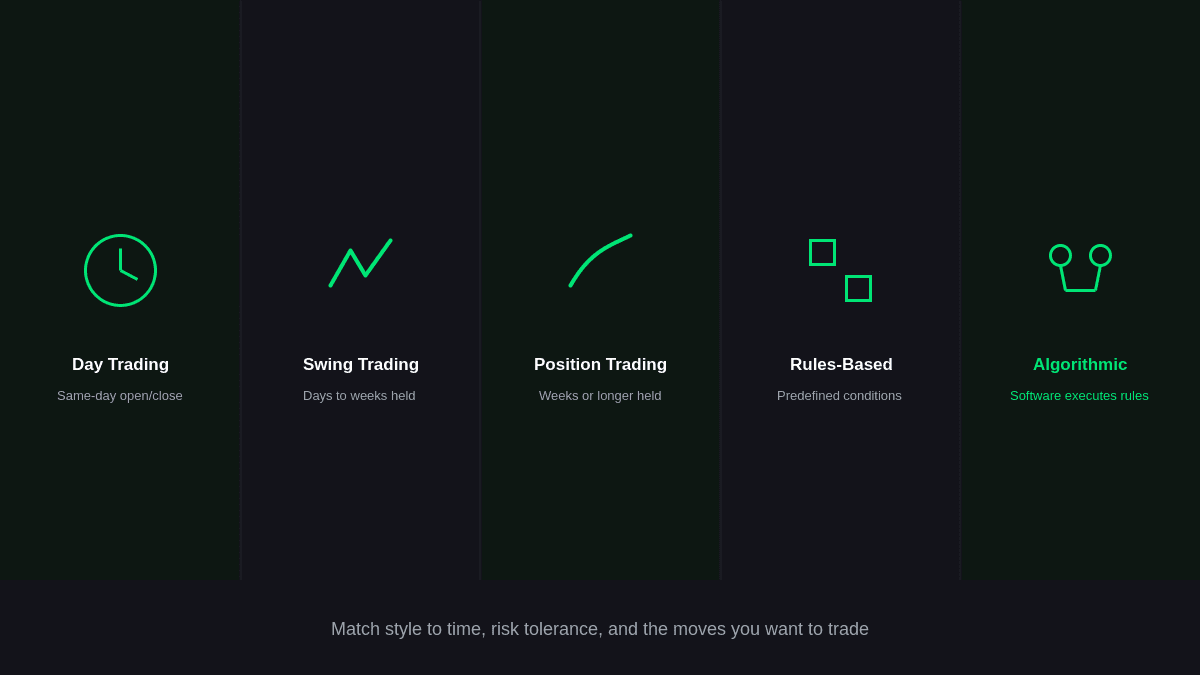
- Algorithmic trading, where software can execute rules-based decisions automatically
Beginners do not need to start with complex systems. Some traders later move to rules-based or algorithmic trading once they understand the basics and have a defined trading process.
Step 4: Learn How to Read a Trading Chart
You don’t have to remember a dozen indicators to understand the chart. Start with the data that is specifically related to price action.
Candlestick charts show the opening, closing, high, and low prices for a selected period. By observing several candles together, traders can identify whether price is moving upward, downward, or sideways.
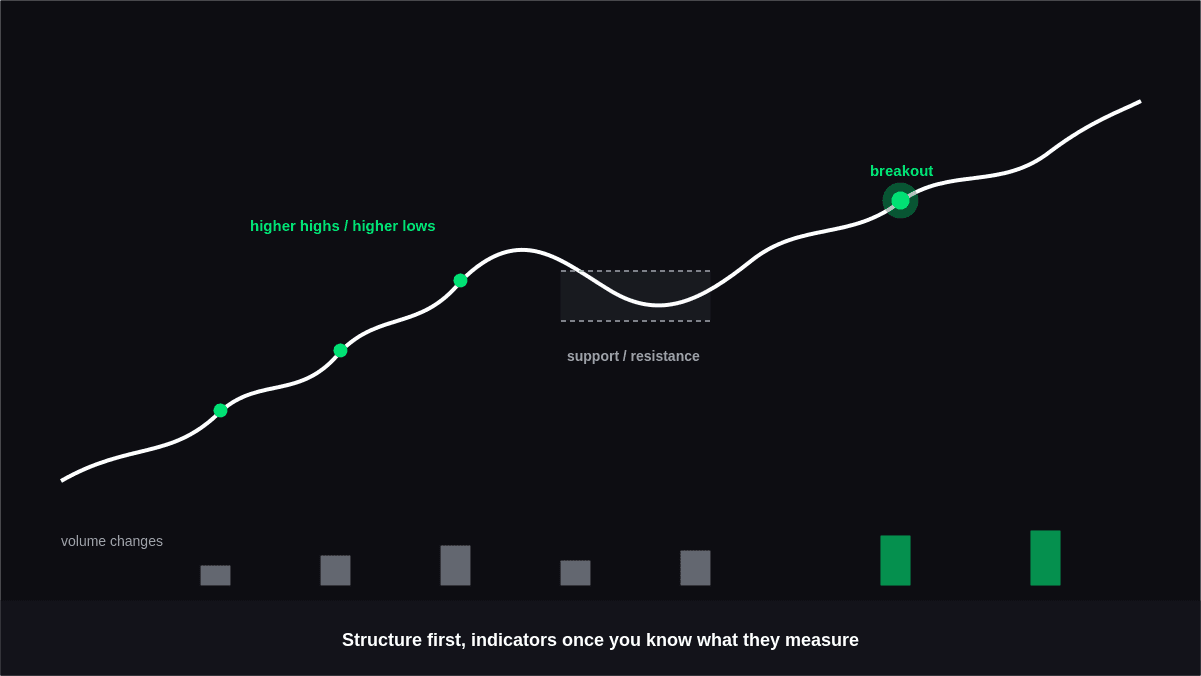
Next, learn to recognize basic market structure:
- Higher highs and higher lows
- Lower highs and lower lows
- Support and resistance areas
- Breakouts and failed breakouts
- Trends and consolidation
- Changes in trading volume
Indicators can be added later when you understand what information they provide. Using multiple indicators without knowing their purpose can create conflicting signals rather than improving decision-making.
Step 5: Build a Simple Trading Plan Before Entering
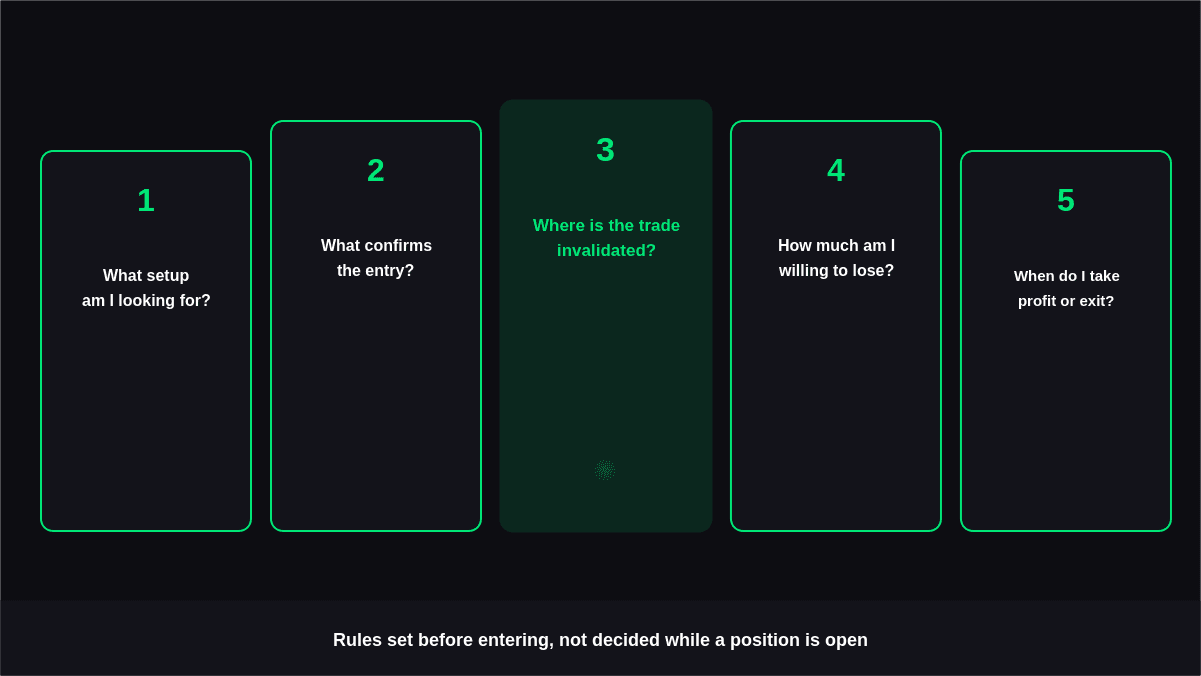
A trading plan turns vague expectations into specific rules. Instead of deciding what to do after a position is already open, establish the conditions for entering and exiting beforehand.
A beginner's plan can answer five basic questions:
- What setup am I looking for?
- What confirms the entry?
- Where is the trade invalidated?
- How much am I willing to lose?
- Under what conditions will I take profit or exit?
This is where beginner trading strategies become useful. Start with one straightforward setup that you can study repeatedly rather than constantly switching between strategies.
A strategy should be evaluated over multiple trades. One winning trade does not prove that a method works, just as one losing trade does not automatically make it ineffective.
Step 6: Treat Risk Control as Part of the Strategy
Many new traders spend lots of time trying to figure out how to enter trades and ignore what will happen if the trade goes against them. Trading risk management solves this problem as it sets the rules on how much capital can be exposed in one single position and how the losses are going to be controlled.
There are several ways of managing the risks - via position size, via placing stop-losses, via diversification, or via limiting the exposure altogether. The correct size depends on the trading conditions and the capital of the trader.
The general rule is to set the maximum allowable loss before entering the trade and if it makes you feel uneasy about the position size, then it is too big.
Only use money you can afford to lose. Avoid using money needed for essential expenses. Trading capital should be money you can afford to lose without creating financial hardship.
Step 7: Decide How to Choose Stocks for Trading
If you decide to trade stocks, screening can help narrow thousands of listed companies into a manageable watchlist. However, a stock appearing on a screener does not automatically make it a good trade.
When considering how to choose stocks for trading, beginners can examine factors such as:
- Average trading volume
- Current price movement
- Volatility
- Recent news or catalysts
- Bid-ask spread
- Market capitalization
- Overall market conditions
Liquidity deserves particular attention. A stock with limited trading activity can have wider spreads and may be harder to exit at the expected price.
The goal of screening is not to predict which stock will rise. It is to identify instruments that meet the conditions defined by your trading plan.
Step 8: Practice Before Risking Significant Capital
A demo or paper-trading account allows beginners to practice entries, exits, order types, and position sizing without immediately putting real money at risk.
Paper trading is useful, but it has limitations. Emotional pressure can feel very different when real money is involved. For that reason, simulated results should not be treated as proof that a trader is ready to take large positions.
Use practice sessions to test whether you can consistently follow your rules. Track the setup, entry, exit, result, and reason for every trade.
Step 9: Keep a Journal and Review Your Decisions
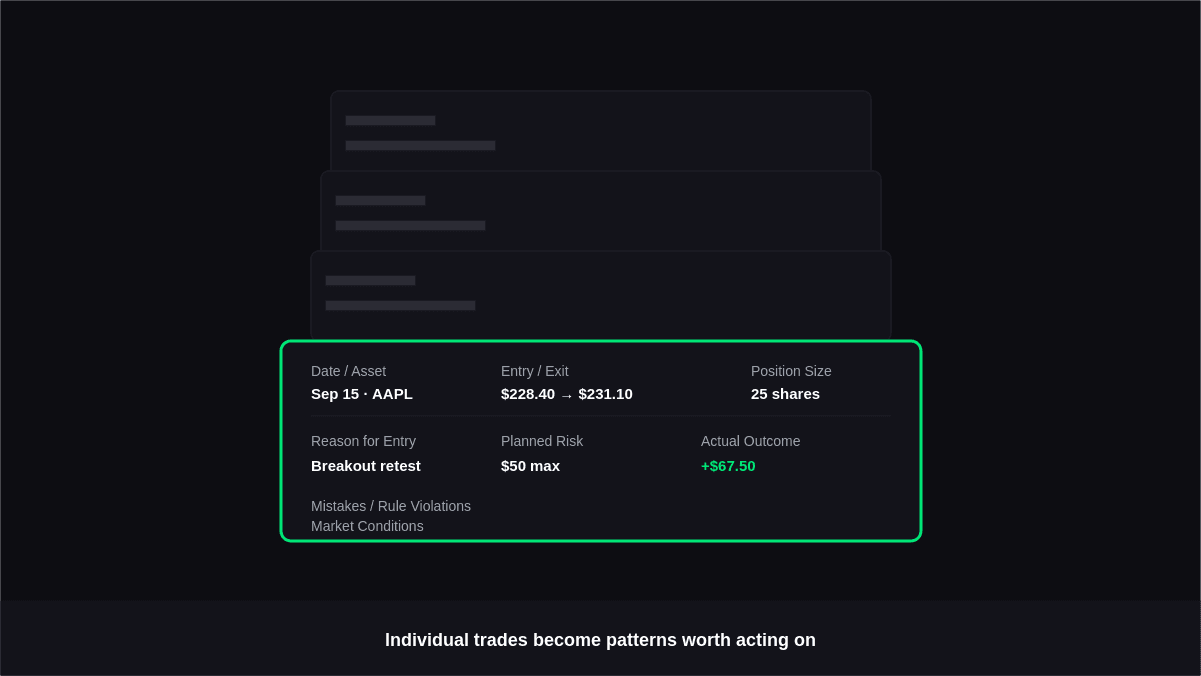
A trading journal turns individual trades into useful feedback. Record more than whether a trade made or lost money.
Include:
- Date and time
- Asset traded
- Entry and exit
- Position size
- Reason for entering
- Planned risk
- Actual outcome
- Mistakes or rule violations
- Market conditions
After collecting enough trades, look for patterns. You may discover that certain setups perform better at particular times or that losses frequently come from entering without confirmation.
This review process can improve the trading process without requiring constant strategy changes.
Step 10: Start Small and Increase Complexity Gradually
Your first goal should never be to make big profits. Your goal should be proving that you can stick to a repeatable system with controlled risk.
Do not expand positions just because you made several winning trades. Sometimes it may happen purely randomly. You should expand only if your results, risk control, and capital allow you to do so.
Also, avoid high levels of leverage, revenge trading, and trading only because there is a movement on the charts. Not trading may also be a good choice when there is no setup according to your rules.
Conclusion
Learning how to start trading as a complete beginner is less about finding a perfect indicator and more about developing a disciplined process.
Select one market and learn its dynamics, formulate a basic strategy, practice your entry point, and incorporate trading risk management into every move that you make.
Begin with realistic expectations and concentrate on gathering data on how you trade. Beginners can validate trading strategies through consistent practice and review, helping them identify mistakes and make more informed decisions. It is through practice and review that beginners can progress from knowing the basics to making informed decisions.