The amount of money you need to begin trading depends on the market, strategy, broker, and how much risk you are able to take. The most frequently asked question is, “How Much Money Do You Need to Start Trading?” There is no fixed figure that applies to everyone who wants to enter the trading market. A beginner with a cash account can start with a few hundred dollars, while a day trader may require more capital. The major question is not simply how much capital you can put into your trading account, but how much allows you to trade without taking on unnecessary risk. Your capital should also support your entry exit signals and overall risk management without putting too much of your account at stake.
In this blog we will cover everything related to the money you need to start trading, the risks involved and what actually you need.
What Determines How Much You Need to Start?
The amount you need to start trading will be determined by more than just the cost of the asset. Several other factors should be taken into account to determine the amount of money that can be invested.
Below you can find some common factors to consider:
Your Risk Per Trade
Risk management should be one of the first things you calculate. For example, if you limit each trade to 1% of your account, a $1,000 balance gives you $10 of planned risk, while a $10,000 balance gives you $100.
A smaller account may leave little room to use realistic position sizes while maintaining strict risk limits. This is why the smallest possible deposit is not always the most practical starting point.
The Market You Trade
The capital requirements and risk profiles vary depending on whether you trade stocks, options, forex, futures, or crypto assets. Certain financial instruments permit trading smaller positions while others require contract sizes, margin calls, and leverage that can substantially impact the capital requirements.
Before making any deposits, know the effects of the market’s pricing and positions on the amount you can gain or lose.
Your Trading Frequency
The number of trades you make can also influence the amount of capital you need. Frequent trading can increase the impact of commissions, spreads, slippage, and other transaction costs.
A trader making a few swing trades each month may have very different capital requirements from someone entering and exiting several positions during the same trading session.
Your Position Size
Your position size links your balance with your potential win and loss on any given trade. If you require bigger positions in order for your set-up to work, you may require a higher balance in order to keep the same risk-to-reward ratio.
It’s not about selecting the balance that would allow you to get the desired profit, but rather the position size you really require with the capital at your disposal.
Capital Requirements by Trading Style
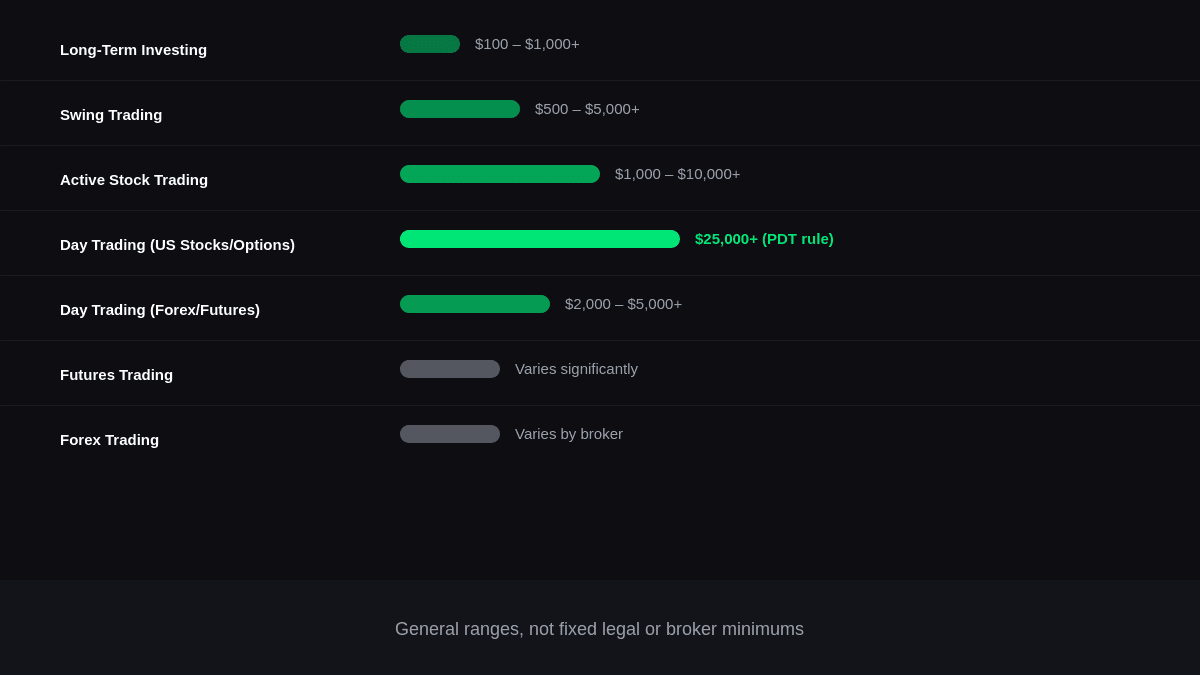
Different approaches place different demands on your account. The following ranges are general examples rather than fixed requirements.
| Trading Approach | Example Starting Range | Main Capital Consideration |
|---|---|---|
| Long-term investing | $100–$1,000+ | Ability to build positions gradually via fractional shares |
| Swing trading | $500–$5,000+ | Position size flexibility and managing stop-loss risk |
| Active stock trading | $1,000–$10,000+ | Absorbing frequent entry fees and transaction costs |
| Day trading (U.S. Stocks/Options) | $25,000+ | Legal PDT Requirement: Account must stay above $25k |
| Day trading (Forex/Futures) | $2,000–$5,000+ | Managing intraday margin and leverage risks |
| Futures trading | Varies significantly | Exchange-mandated contract sizes and margin limits |
| Forex trading | Varies by broker | Broker leverage allowances and micro/mini lot choices |
These figures should not be treated as minimum legal or broker requirements. Requirements can vary by country, asset class, broker, and account type.
A Practical Way to Decide Your Starting Amount
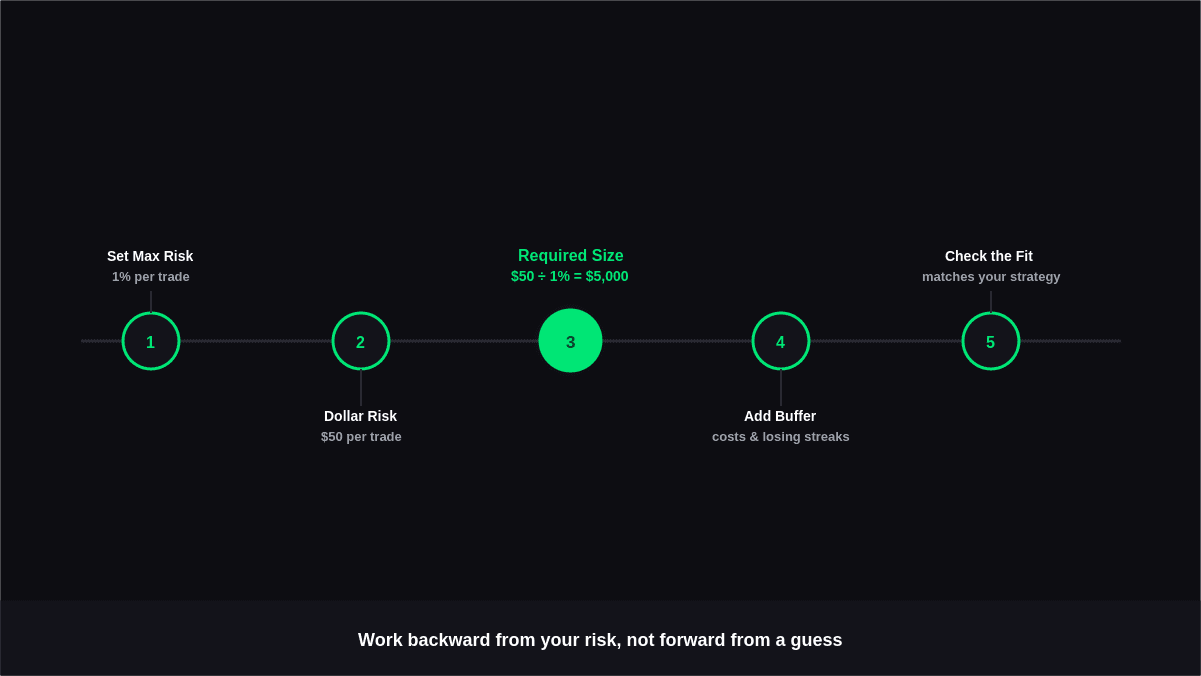
Instead of selecting the starting balance at random, you should follow a proper approach to decide your starting amount. Here is how you can determine a suitable starting balance for your trading plan.
Step 1: Set Your Maximum Risk Per Trade
Determine the amount of capital that you will be willing to allocate for each trading move. For example, you may choose to risk no more than 1% of your account on each position.
Step 2: Determine the Dollar Amount at Risk
Estimate the highest possible amount that can be lost by your trading system based on the entry point, the stop-loss point, and the position size. Assume that your total risk per trade is $50.
Step 3: Calculate the Required Account Size
Divide the dollar amount you are willing to risk by your chosen risk percentage.
$50 ÷ 0.01 = $5,000
In this example, a $5,000 account would allow $50 of planned risk at a 1% risk level.
Step 4: Add Room for Trading Costs and Losing Streaks
Your calculation shouldn't be the only thing that counts. Take into account some space for commissions, spreads, slippage, and losing strings. This will help to avoid a situation when several bad deals make you reconsider the whole trading strategy.
Step 5: Check Whether the Amount Fits Your Strategy
Finally, compare the calculated balance with the position sizes and market requirements of your strategy. If the account is too small to execute your trades while maintaining your risk limits, consider reducing position size or waiting until you have sufficient capital.
Why a Bigger Account Is Not Automatically Better
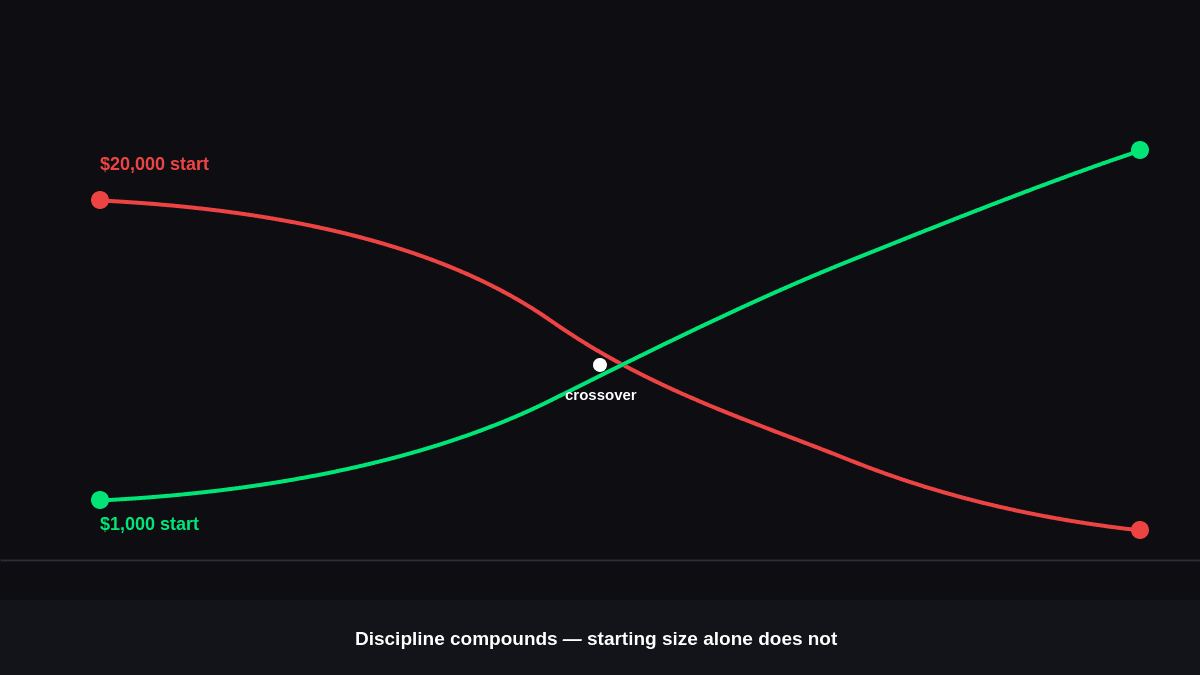
A larger account gives you more flexibility, but it does not solve poor decision-making.
A trader with $20,000 can still lose money by:
- Entering positions that are too large for their risk limits
- Moving or ignoring stop-loss levels
- Trading without a clearly defined setup
- Increasing risk after a losing trade
Meanwhile, a smaller account can serve as a controlled environment for learning execution and developing consistency.
The goal should be to have enough capital to follow your strategy while keeping potential losses manageable. More money should increase flexibility, not encourage greater risk
Start Day Trading Without Overexposing Yourself
While considering the amount of money one should use to begin day trading, remember that the focus should be on money you can afford to lose rather than funds needed for rent, tuition fees, or other necessary expenses. A Position Sizing Calculator can help determine how much of your available trading capital to put at risk on a particular trade.
Define first what maximum percent of your total capital you would be prepared to risk per each trade. Then work backward from the position size your strategy requires.
For example, suppose your plan allows a maximum risk of 1% per trade:
- $1,000 account = $10 maximum planned risk
- $5,000 account = $50 maximum planned risk
- $10,000 account = $100 maximum planned risk
- $25,000 account = $250 maximum planned risk
These numbers do not guarantee profitability. They simply show how account size affects the dollar value of a predefined risk percentage.
Choosing the Right Trading Account Size
The size of your trading account should be determined by your trading strategy and risk constraints. Choosing an amount that is manageable enables you to concentrate on implementing your trading strategy without worrying about recouping losses.
The table below shows how different account sizes may affect planned risk at a 1% risk-per-trade level:
| Trading Account Size | 1% Risk Per Trade | Suitable Starting Focus |
|---|---|---|
| $500 | $5 | Learning basic execution |
| $1,000 | $10 | Practicing risk management |
| $5,000 | $50 | Applying a structured strategy |
| $10,000 | $100 | Greater position flexibility |
| $25,000 | $250 | Supporting active strategies |
These figures are examples, not recommendations or guarantees of profitability. Your actual position size should also account for the asset's volatility, stop-loss distance, and trading costs.
It is also useful to keep trading capital separate from personal savings. This creates a clearer boundary between money allocated to trading and funds needed for everyday financial obligations.
Costs to Include Before You Start
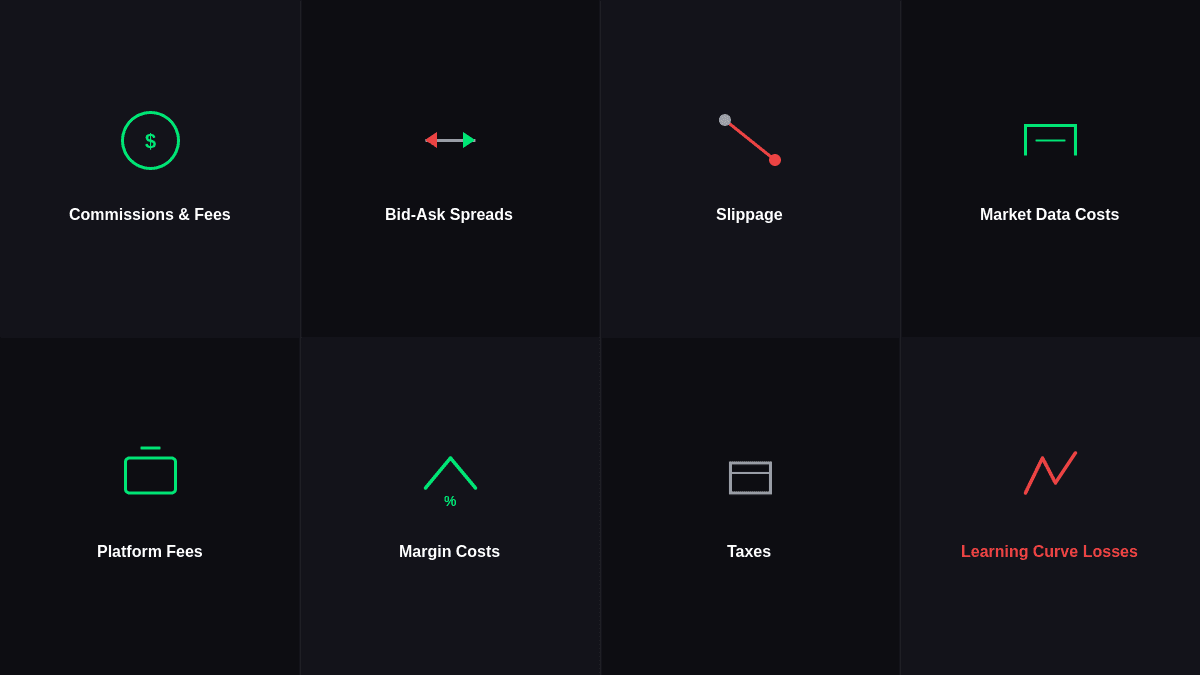
The amount you deposit is not the only financial consideration when starting to trade. Your overall budget should also account for the costs that can reduce your returns, especially if you trade frequently.
Common expenses include:
- Broker commissions and account fees
- Bid-ask spreads
- Slippage
- Market data costs
- Platform or software fees
- Borrowing or margin costs
- Taxes where applicable
- Losses during the learning process
Some of these costs may seem small when viewed individually, but they can add up through repeated trades. Frequent traders should pay particular attention to spreads, commissions, and slippage because these expenses can affect the results of an otherwise profitable strategy and should be considered when reviewing backtesting metrics.
Understanding these costs before placing your first trade gives you a more realistic view of how much capital you actually need. It also helps you avoid setting profit expectations without accounting for the expenses involved in executing your strategy.
Final Thoughts
All questions related to How Much Money Do You Need to Start Trading are sorted now. The answer depends on what you trade, how you trade, and how much risk your strategy requires. A small balance can be useful for learning, while a larger account may provide greater flexibility for active strategies.
Instead of selecting an account size in accordance with a set income target, determine how much you can afford to lose on each trade, your cost of trading, position sizes, and losing runs. Your Trading Strategy Benchmarks can help you assess whether your system can support greater exposure. Begin with capital that does not put your finances at risk, and only increase exposure if your trading system allows for it.