A stop loss defines a point where a trade is exited when price moves against the position. But the way that level is determined can vary considerably. A Fixed Stop Loss vs Dynamic Stop Loss approach compares two different ways of managing that exit level.
A fixed stop generally remains at the original level once the trade is opened. A dynamic stop can adjust as the trade develops, using rules based on price movement, volatility, market structure, or another predefined condition.
Neither method should be treated as universally suitable. The important question is how each approach fits the trading strategy, market conditions, and amount of risk the trader is prepared to accept.
What Is a Fixed Stop Loss?
A Fixed Stop Loss uses a predetermined price level that is established when the trade is opened.
For example, a trader entering a long position at $100 might place a stop at $95. If the strategy does not include any rule for moving the stop, that level remains unchanged while the position is open.
The distance can be determined using several methods, such as:
- A fixed dollar amount
- A percentage of the entry price
- A technical price level
- A recent swing high or low
- A predefined risk amount
The defining characteristic is not how the original level is calculated. It is that the stop does not automatically adjust as the trade moves.
According to Investor.gov, a stop order becomes a market order when its specified stop price is reached. The execution price can differ from the stop price, particularly when prices move quickly.
What Is a Dynamic Stop Loss?
A Dynamic Stop Loss changes according to predefined rules after the trade has been opened.
Instead of keeping the same exit level throughout the position, the stop may move when certain conditions occur.
Common approaches include:
- Trailing the price by a fixed percentage
- Trailing by a fixed dollar distance
- Using market structure
- Adjusting according to volatility
- Moving the stop after a predefined profit milestone
- Following swing highs or lows
A trailing stop loss is one example of a dynamic approach. Investor.gov describes a trailing stop as one where the stop price adjusts as the security moves in a favorable direction, while remaining unchanged when the price moves against the position.
The important point is that the adjustment rule should be defined before the trade rather than changed emotionally in response to price movements.
Fixed Stop Loss vs. Dynamic Stop Loss
The main difference is how the exit level behaves after entry.
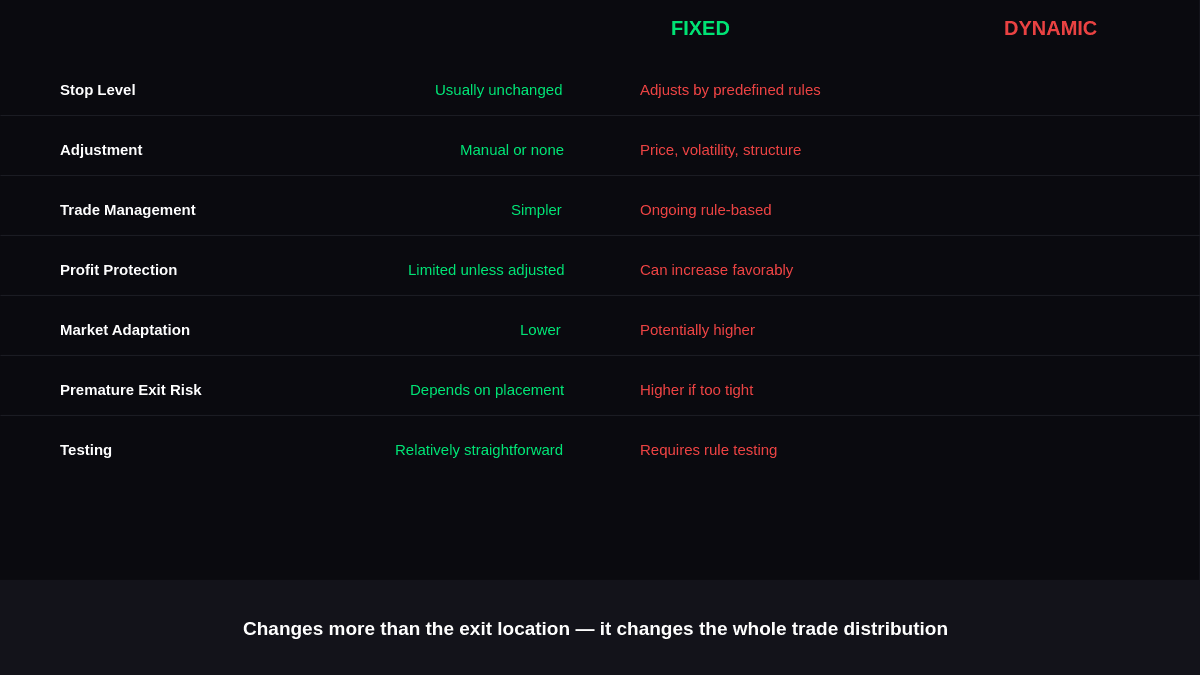
| Factor | Fixed Stop Loss | Dynamic Stop Loss |
|---|---|---|
| Stop level | Usually remains unchanged | Can adjust according to predefined rules |
| Adjustment | Manual or none | Based on price, volatility, structure, or another rule |
| Trade management | Simpler | Requires ongoing rule-based management |
| Profit protection | Limited unless manually adjusted | Can increase as the trade moves favorably |
| Market adaptation | Lower | Potentially higher |
| Risk of premature exit | Depends on initial placement | Can increase if the adjustment is too tight |
| Testing | Relatively straightforward | Requires testing of adjustment rules |
This distinction affects more than the location of the stop. It can also change the distribution of winning and losing trades produced by the overall strategy.
How Fixed Stop-Loss Strategies Work
A fixed approach starts by identifying the level at which the original trade idea would no longer be valid or where the planned risk limit is reached.
For example, suppose a trader buys at $50 and determines that a move below $47 invalidates the setup. The stop is placed at $47 and remains there unless the trading plan specifically allows an adjustment.
This approach can make the rules easier to define and test because the exit condition does not continuously change.
A fixed stop can be based on market structure rather than an arbitrary percentage. For instance, a trader may place the stop below a meaningful swing low instead of choosing a predetermined 2% distance.
CME Group similarly notes that stop placement should be tied to a logical level rather than selected randomly, while position size can then be adjusted based on the distance between the entry and stop.
How Dynamic Stop Loss Strategies Work
A dynamic approach introduces another layer of rules into trade management.
Suppose a trader enters a position at $100 with an initial stop at $94. If the price rises to $108, the strategy might move the stop to $101. If price continues higher, the stop may continue adjusting according to the same rule.
The exact mechanism can vary significantly.
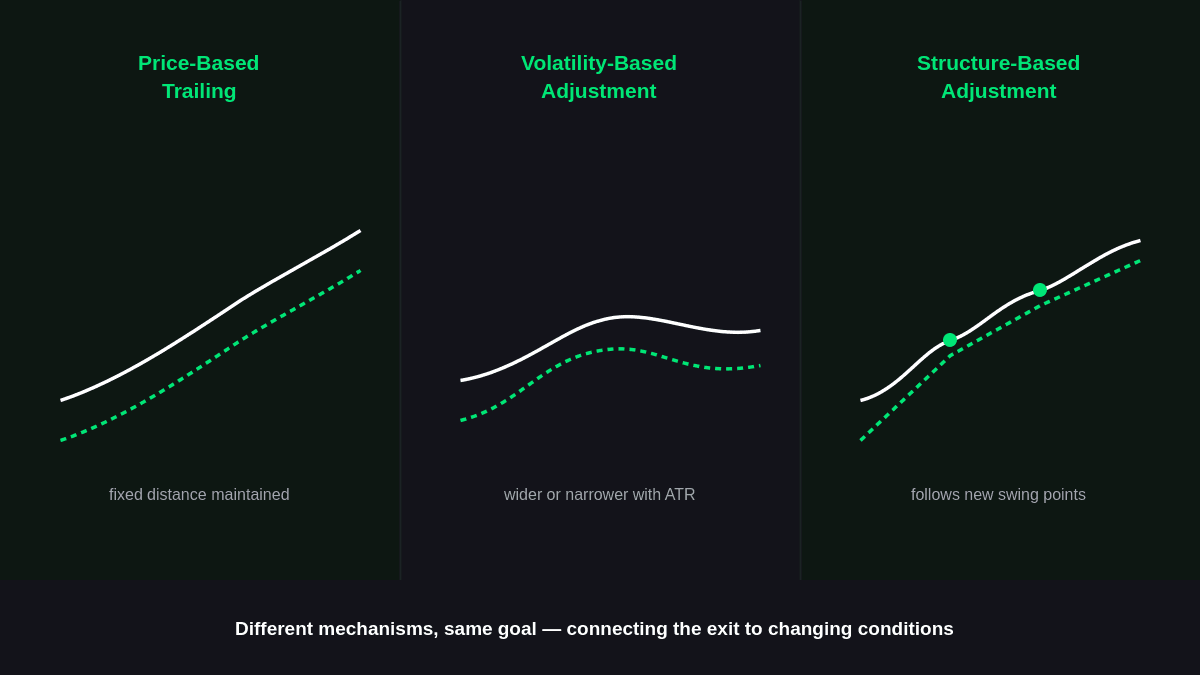
Price-Based Trailing
The stop follows price by a predetermined distance.
For example, a strategy could maintain a $3 distance between the current price and the stop for a long position.
Volatility-Based Adjustment
The stop distance can be connected to current volatility. An indicator such as Average True Range (ATR) can be used to estimate recent price movement and create a wider or narrower stop according to a predefined formula.
This can be useful when market ranges change because a fixed price distance does not necessarily represent the same amount of market movement in every environment.
Structure-Based Adjustment
The stop can move according to new swing lows in a long position or swing highs in a short position.
This approach attempts to keep the exit connected to changing market structure rather than simply following every price movement.
When a Fixed Stop Can Make Sense
A fixed approach can fit strategies where the original invalidation level remains meaningful throughout the trade.
It may also be useful when the strategy has a clearly defined maximum loss and the trader does not want the stop to change simply because the position temporarily moves in either direction.
For example, a breakout strategy may define the trade as invalid if price returns below a specific breakout structure. Moving the stop too quickly could change the original logic of the setup.
The main requirement is consistency. If the stop is fixed in the strategy rules, moving it because a trade looks uncomfortable changes the tested system.
When a Dynamic Stop Can Make Sense
A dynamic method may be considered when the strategy is designed to stay with a position while the market continues moving favorably.
For example, a trend-following system may allow a position to remain open while new price highs or lows continue supporting the trade. A trailing mechanism can then adjust the exit as the trend develops.
The method can also be useful when the strategy explicitly accounts for changing volatility.
However, a moving stop is not automatically more protective. If the adjustment is too aggressive, normal price fluctuations can trigger the exit before the broader trade idea has failed.
Investor.gov specifically warns that short-term market fluctuations can activate stop and trailing stop orders, making the selected stop distance important.
Fixed vs Dynamic Stops and Market Volatility
Volatility is an important consideration because the same stop distance can behave differently under different market conditions.
Consider two periods:
- A relatively quiet market with small daily ranges
- A volatile market with large intraday movements
A $2 stop may provide substantial room in the first environment but very little room in the second.
This does not mean that a dynamic stop should automatically replace a fixed one. Instead, traders can test whether the stop methodology remains appropriate across different volatility conditions.
How Stop Placement Affects Position Size
Stop distance and position size are connected.
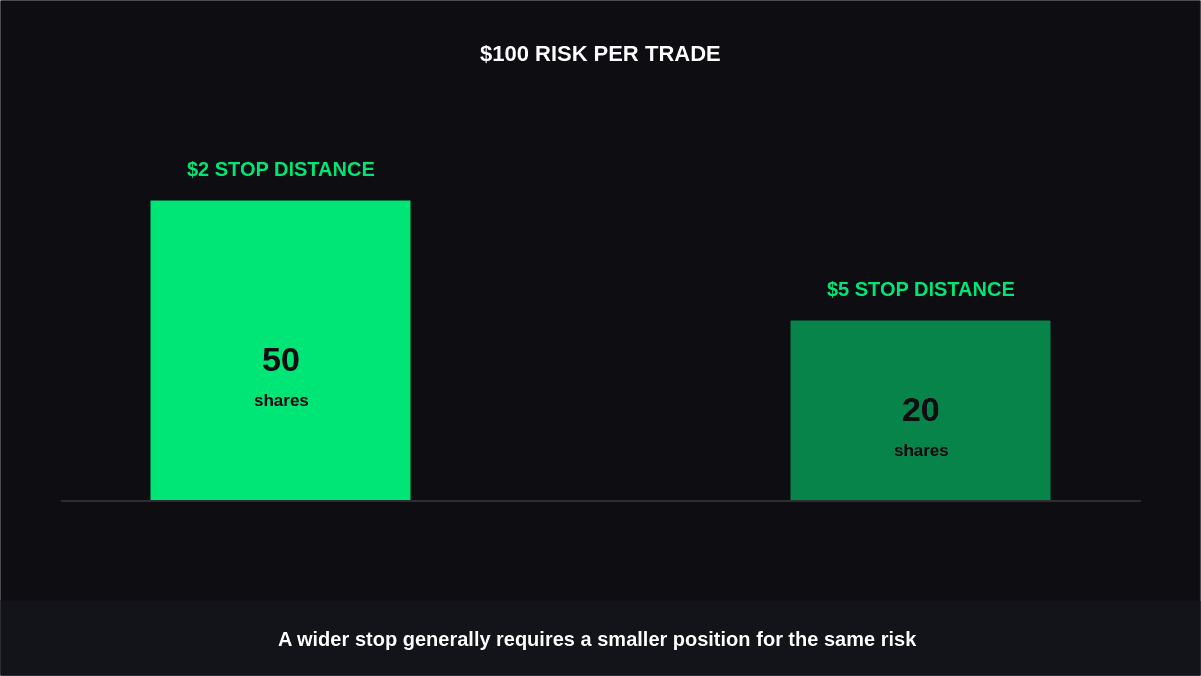
If the planned risk per trade remains constant, a wider stop generally requires a smaller position, while a narrower stop can allow a larger position under the same risk constraint.
For example, assume a trader is willing to risk $100 on a trade.
If the distance between entry and stop represents $2 per share, the position would be sized differently than if the stop were $5 away.
CME Group's position-sizing guidance similarly explains that traders need to know both the stop location and the amount they are willing to risk before determining position size.
This is why stop placement should not be considered separately from the rest of the risk plan.
Common Mistakes With Stop Loss Strategies
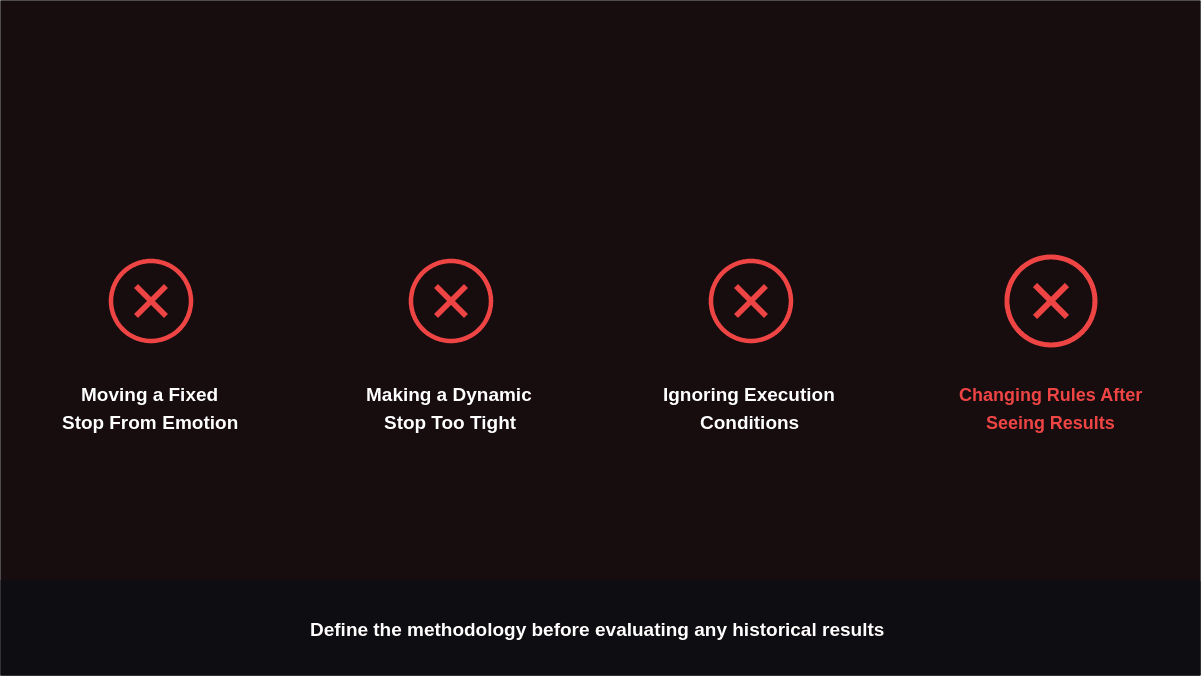
Here are a few common mistakes that you should avoid.
Moving a Fixed Stop Because of Emotion
A fixed stop loses its purpose if it is repeatedly moved farther away whenever the trade approaches the planned exit.
If the original level represents invalidation, moving it simply to avoid taking a loss changes the risk profile of the trade.
Making a Dynamic Stop Too Tight
A dynamic stop that reacts to every small price movement may close positions during normal market fluctuations.
The adjustment method needs enough room for the strategy's expected price behavior.
Ignoring Execution Conditions
A stop price is a trigger, not necessarily a guaranteed execution price. In fast-moving markets, the actual execution can differ from the specified stop level.
Traders should therefore account for execution assumptions when testing a stop loss strategy.
Changing the Rules After Seeing Results
Testing a fixed stop and then changing the rules after observing which trades would have been more profitable creates a risk of overfitting.
The stop methodology should be defined before evaluating historical results.
How to Test Fixed and Dynamic Stops
A useful comparison should test both methods under the same broader trading strategy.
Keep the following consistent where appropriate:
- Entry conditions
- Markets being traded
- Trading sessions
- Position-sizing rules
- Transaction-cost assumptions
- Testing period
- Performance metrics
Then compare measurements such as:
- Maximum drawdown
- Average loss
- Average win
- Profit factor
- Expectancy
- Trade count
- Average holding period
- Exit distribution
- Performance across different market conditions
A trading strategy should not be validated solely by which stop produces the highest historical return. A large return can come with substantially different drawdown or exposure characteristics.
A Practical Decision Framework
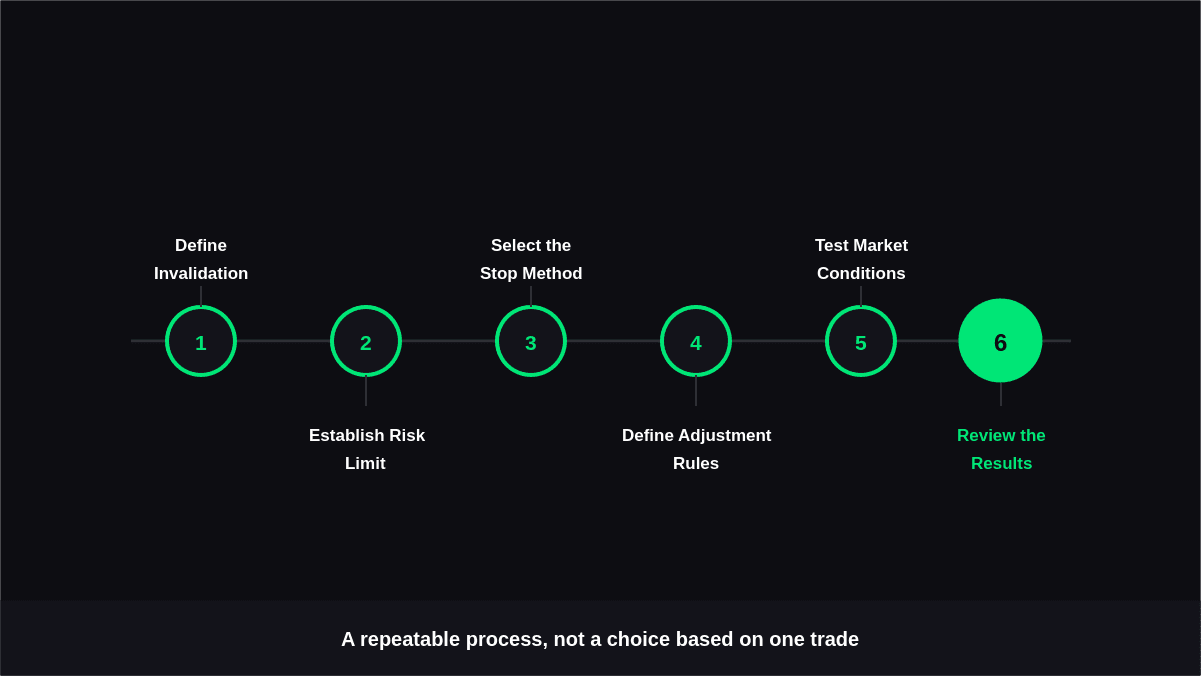
Instead of choosing a stop methodology based on a single trade or recent market movement, traders can work through a consistent process.
Step 1: Define the Trade Invalidation
Determine what price behavior would show that the original trade idea is no longer valid.
Step 2: Establish the Risk Limit
Decide how much capital the trade can expose before entering.
Step 3: Select the Stop Method
Choose whether the strategy requires a fixed level or an adjustment rule.
Step 4: Define Adjustment Rules
If using a dynamic method, specify exactly when and how the stop moves.
Step 5: Test Across Market Conditions
Include trending, ranging, volatile, and quieter periods where relevant.
Step 6: Review the Results
Compare risk and performance metrics rather than focusing only on total return.
This creates a repeatable process and makes it easier to determine whether the stop methodology actually supports the underlying strategy.
Conclusion
The Fixed Stop Loss vs Dynamic Stop Loss comparison is ultimately about how a trading strategy handles an open position after entry.
A fixed approach keeps the original stop level unchanged according to the strategy's rules, while a dynamic approach adjusts the exit level as the trade develops. Fixed stops can provide straightforward rules, while dynamic methods can incorporate changing price behavior, volatility, or market structure.
Neither method guarantees better trading results. The more useful approach is to define the logic in advance, connect stop placement with position size and risk, and test the complete system across different market conditions.
A stop loss should be part of the trading plan from the beginning rather than an adjustment made after a position starts moving.