Trading success is not just about identifying a market that looks ready for action. It is also about having well-defined entry and exit signals for opening, closing and non-trade situations. Such an approach may minimize emotional decision making and simplify the testing of the trading method.
Irrespective of what markets traders choose, stocks, forex, futures or cryptocurrency, it works the same way: an entry signal should provide a defined reason to open a position, while an exit signal should provide a specific reason to close it.
This article describes how traders may create their own criteria-based entry exit signals without using any specific indicator or treating every market event as a potential trading opportunity.
What Are Entry Exit Signals?
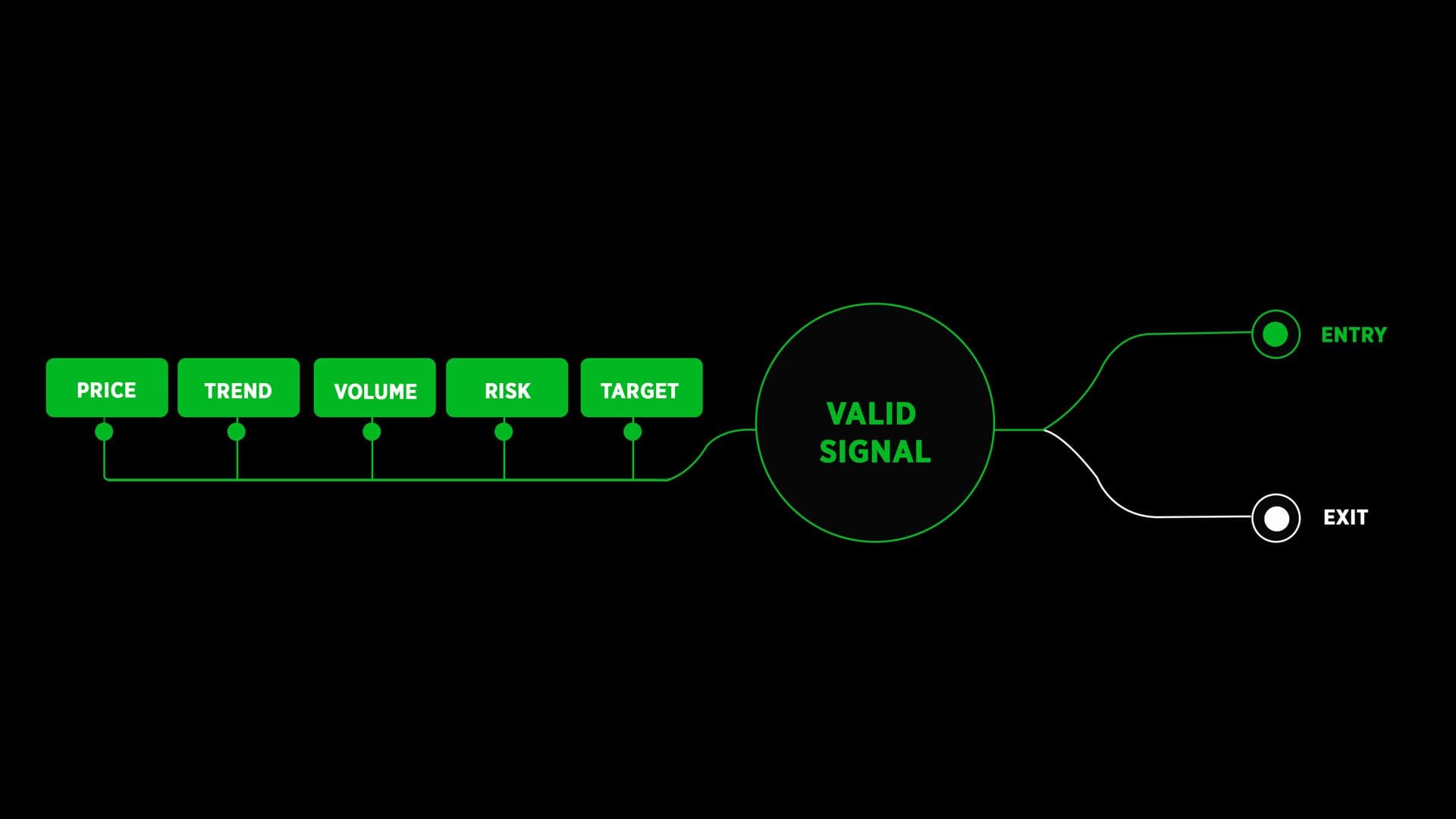
Entry exit signals are pre-set criteria, which will help the trader in deciding whether or not the trade can be executed or closed.
For instance, there could be some criteria that:
- Price needs to go above resistance level.
- A moving average criterion should confirm the trend.
- The volume needs to be present for the breakout.
- There should be a pre-set risk level prior to entering the trade.
- A target or trailing criterion needs to be met before closing the position.
The most important thing here is that there needs to be a signal within the overall trading strategy and not just some entry/exit alert.
Entry Signals vs. Exit Signals: What Is the Difference?
Entry signals answer the question: "When should I open the trade?"
Exit signals answer a different question: "When should I close the trade?"
This distinction is important because the conditions that make a trade attractive at entry do not necessarily determine when that trade should be closed.
For example, a trader may enter a long position after price breaks above resistance and volume confirms the move. Once the trade is open, however, the trader may use a stop-loss, profit target, trailing stop, or reversal condition to determine when to exit.
| Signal Type | Main Purpose | Example |
|---|---|---|
| Entry signal | Identify an opportunity to open a position | Price closes above resistance with confirmation |
| Exit signal | Determine when an open position should be closed | Price reaches the target or breaks the invalidation level |
| Entry confirmation | Reduce weak or premature entries | RSI confirms bullish momentum |
| Exit confirmation | Confirm that the position should be closed | Trend reverses or support fails |
| Risk exit | Limit potential loss | Stop-loss is triggered |
| Profit exit | Secure planned gains | Take-profit target is reached |
A complete strategy therefore needs both sides of the decision. A strong entry without a defined exit can leave a trader unsure about how to manage the position after it is opened.
How Trading Entry Signals Are Built
The development of a good entry signal begins with the observation of a market condition and formulating rules out of it.
1. Define the market setup
First and foremost, you should know what you want to trade. For instance, the trend following system may be based on higher highs and higher lows, whereas the mean reversion system will be based on extreme price action.
2. Add a confirmation condition
This step prevents the strategy from over-reacting to all minor price movements. It might be an occurrence of a moving average crossover, momentum indicator value, volume increase, or breakout confirmation.
3. Establish the trigger
Trigger is the exact occurrence that initiates the trade. For instance, rather than specifying that a trade should be made on strong momentum, the strategy can state that the candle must close above a certain resistance while the momentum stays above a specified level.
4. Check the trade environment
Even with a valid system, performance may be poor under inappropriate market conditions. Some of the elements to consider include volatility, trading period, liquidity, significant economic news and general market trend.
How Trading Exit Signals Are Built
The exit trading strategy gives instructions as to when a particular trade should be exited due to certain events that take place after the trade is entered. Rather than depending on the feelings of the trader, this particular trading system may set rules on how and when to exit the trade.
1. Define the Exit Trigger
Define the exact trigger to exit the trade. The trigger may be based on price target, indicator signal change, breakout of support/resistance, or any other identifiable criterion.
2. Set the Invalidation Point
Identify when the trade signal becomes invalid. In the case of a long trade, the position can be exited if price drops below the swing low that gave rise to the initial signal.
3. Establish the Profit Condition
Establish how the strategy deals with positive price changes. One of the following can be used: fixed target, risk-to-reward ratio, or trailing criteria, depending on the strategy.
4. Add a Time-Based Rule
If the anticipated move does not occur within a set period of time, the strategy will be able to terminate the position instead of holding it open indefinitely.
5. Test the Complete Exit Logic
All the exit criteria should be tested alongside the entry criteria. This is to establish whether the exit strategy improves the overall performance of the strategy or simply yields more successful individual transactions.
A Practical Entry-to-Exit Framework
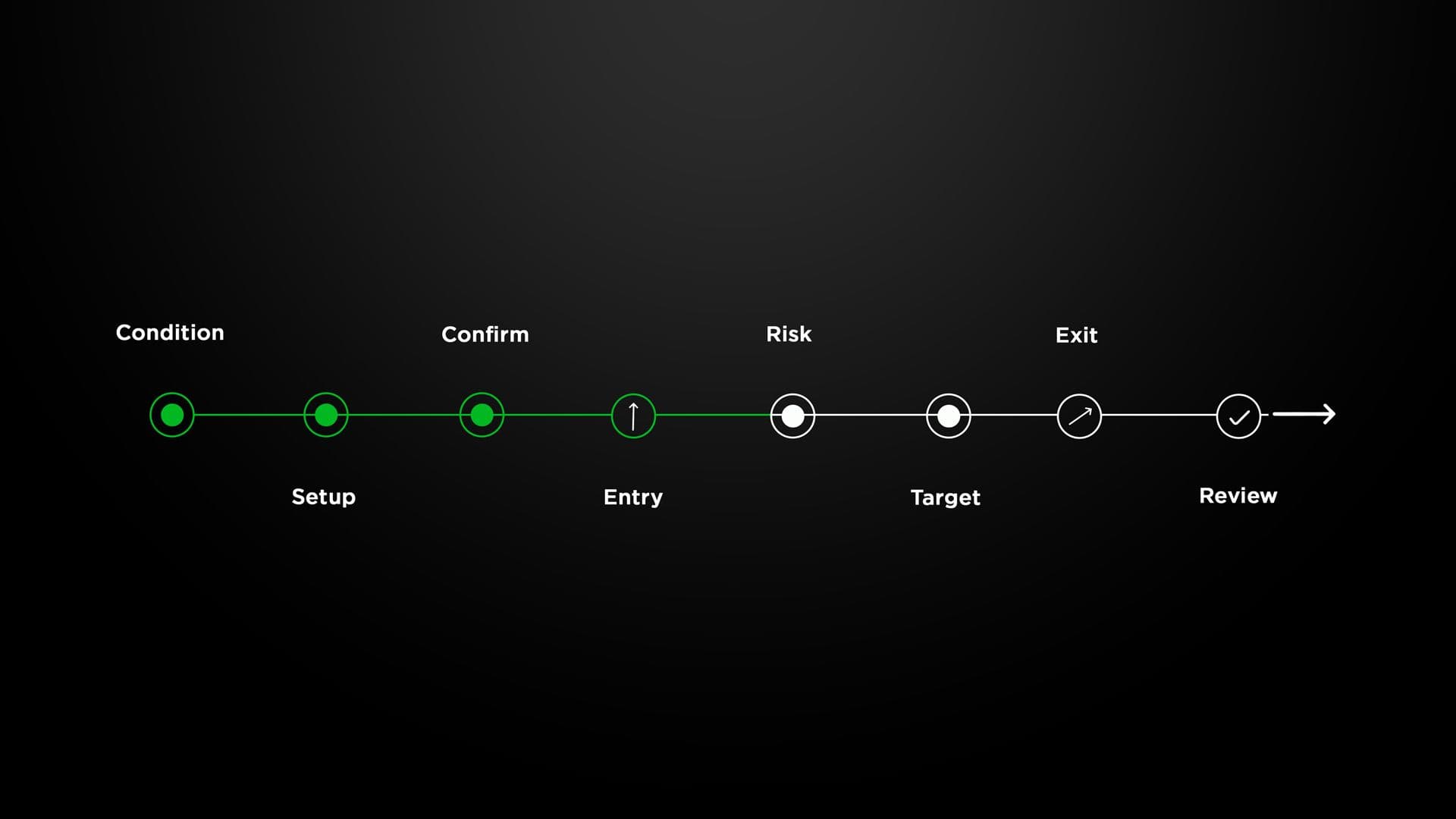
A complete signal framework should connect the initial setup with the eventual trade management.
| Trading stage | Question to answer | Example rule |
|---|---|---|
| Market condition | What environment supports the strategy? | Trade only during an established trend |
| Setup | What pattern creates interest? | Price pulls back toward a moving average |
| Confirmation | What validates the idea? | Momentum turns back in the trend direction |
| Entry | What activates the position? | Candle closes above the trigger level |
| Risk | Where is the setup invalidated? | Stop placed below recent swing low |
| Profit objective | Where can gains be taken? | Target based on risk/reward or structure |
| Exit | What closes the trade? | Target, stop, or reversal condition |
| Review | What should be measured afterward? | Win rate, expectancy, drawdown, and execution |
This structure makes a strategy easier to understand, backtest, and improve because each decision has a defined purpose.
Common Indicators for Confirming Entry and Exit Signals
The indicators may assist the trader in transforming the observation into measurable criteria. However, the indicator should be in aid of a trading rule and not necessarily a reason for trading.
RSI
Relative Strength Index (RSI)is an indicator of momentum and is often applied to determine whether the price action has been very strong in a certain direction.
As far as trading entry signals are concerned, the RSI may serve as confirmation rather than a trigger. For instance, when trying to find bullish conditions, a trader may need RSI to stay above 50.
For exits, the trader may track either a shift in the momentum or a crossing of a pre-set RSI level.
What is important is that the RSI reading should play its part in the strategy.
MACD
The Moving Average Convergence Divergence (MACD) indicator is often used as an analysis tool to analyze momentum and direction of the trend.
The MACD crossover can act as a signal of confirmation for entering a trade if it corresponds with the general market structure. The traders could also consider the momentum shift in MACD as a part of their exit strategy.
But the MACD crossover alone cannot determine if the trade setup is a good one or not.
Moving Averages
Moving averages assist traders in determining the overall trend in prices and are useful as dynamic levels for trading purposes.
For instance, a system could demand that prices stay above the moving average for any long entries to be considered.
A crossover of two different moving averages could be used as an additional condition for entries.
An important consideration for exiting trades would be a breakdown below a particular moving average.
Therefore, moving averages can be useful in entering and exiting trades, although their role needs to be determined prior to testing.
Average True Range (ATR)
ATR is an indicator of market volatility and not one that tells if the market is bullish or bearish.
This is why it becomes an excellent tool for making decisions related to risk management and trading. It could be used by the trader to gauge whether the market has sufficient volatility for executing a certain strategy or determining the stop loss value.
For instance, instead of setting a stop loss of a fixed number of pips, it could have been set as a ratio of the ATR value.
Volume
Volume can assist in validating whether a price move is backed by real volume. For instance, when looking for a breakout trade, a trader might want to see the volume surpassing an existing average before considering the breakout as valid.
Volume can also be used by traders in measuring whether a price move looks more or less powerful compared to usual. But volume should always be considered in relation to the market and time frame being traded.
Support and Resistance
Both support and resistance levels serve as significant reference points when exiting or entering a trade.
It is possible to use a break in resistance as the signal for entering into a trade, assuming that all other elements are met. The same setup can be used to set the stop-loss level for the trade.
Therefore, support and resistance can be applied in all three phases of a trading strategy – the entry phase, risk management phase, and the exit phase.
Combining Indicators Without Overcomplicating the Strategy
Increasing the number of indicators will not necessarily result in superior entry/exit signals.
For instance, a trading system can include:
- Moving averages to determine trend direction.
- RSI to verify momentum.
- Volume to confirm breakouts.
- ATR to indicate volatility and manage risks.
- Support and resistance to establish the structure of prices.
The aim should be to have a unique function for each indicator. When multiple indicators convey almost identical information, the addition of such indicators could only serve to complicate things.
Stop Loss and Take Profit Within Entry Exit Signals
The entry/exit signals should have clearly defined risk/reward setups prior to entering a position. The stop-loss signal determines whether the trade will be exited in case the setup is wrong, and the take-profit signal determines how much profit could be taken from the setup.
This could be determined using:
- Recent swing high or swing low
- Support and resistance levels
- Average market volatility
- Average True Range (ATR)
- Size of the position and account risk
- Expected reward/risk ratio
For instance, a long trade could be opened on the basis of a confirmed breakout, with the stop set below the most recent swing low and using a predetermined price objective for the profit target. Position size could be based on the difference between the entry and stop price levels.
How to Improve Entry Exit Signal Quality Over Time
An enhancement of entry/exit signals does not necessarily mean that we should introduce new signals. We need to examine where the sample strategy provides poor entries or exits and find out why this happens.
Analysis should include the following factors:
- Market trend: Examine how good the signals are in case of a trend or ranging market.
- Volatility: Test the signals during low and high volatility.
- Trading session: Find out whether some trading sessions provide better signals.
- Asset: Test whether the signals are consistent for different assets.
- Setup: Examine different entry/exit setups.
For instance, the breakout strategy might provide excellent entries in trending markets but bad exits if the prices are moving sideways. Rather than adding indicators, the trader can:
- Tweak the exit criteria.
- Use a simple market regime filter.
- Modify the profit taking criteria.
- Eliminate trades which keep failing.
In this way, the signals are retained without adding additional indicators while fixing one specific problem that was found through testing.
Testing Entry Exit Signals Before Live Trading
Not every signal that appears to be convincing in terms of chart analysis necessarily is a profitable one. Back-testing of a system may help in finding out how those rules were acting under different market conditions.
In back-testing, besides percentage of winning trades, some useful metrics to monitor are:
- Total return
- Maximum draw-down
- Profit-factor
- Average trade
- Expectancy
- Number of trades
- Losing trades streaks
- Market regime performance
Following the historical test, one can utilize a different out-of-sample period to ascertain if the rules still work on the data that has not been involved in the testing process.
Algorithmic traders may convert the rules to code through software like TradingView and Pine Script.
Choose the Right Entry and Exit Conditions Instead of Guessing
Strong entries and exits must be based on pre-existing conditions and not on assumptions being made during the development of the trade. Here you can find separate checklists for making sure that both sides of the trade have strategy behind them.
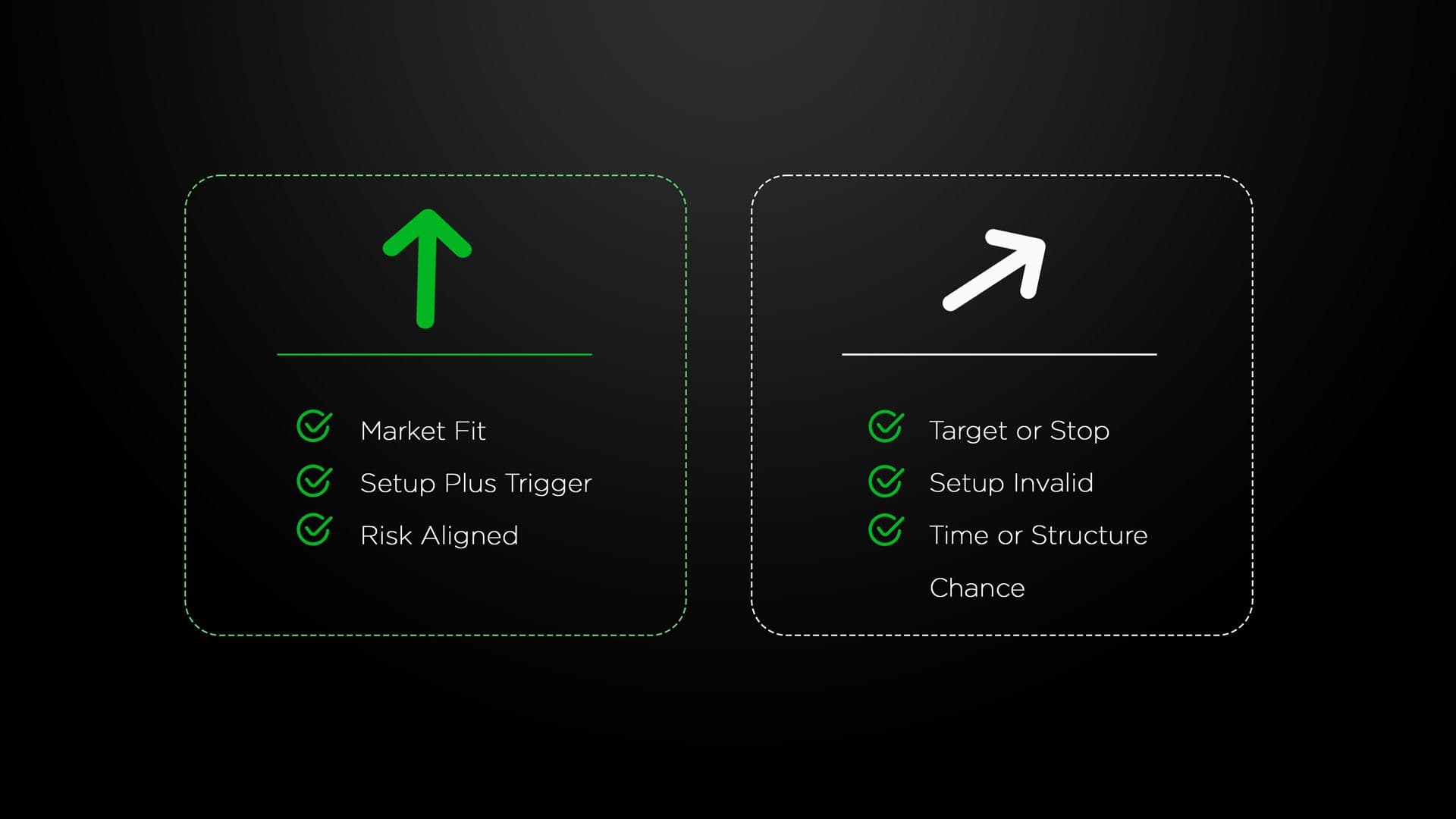
Entry Checklist
- Is the market condition suitable for the strategy?
- Has the required setup appeared?
- Has the entry trigger been confirmed?
- Is the broader trend aligned with the trade?
- Is there sufficient room for the expected price movement?
- Is the planned risk within the strategy's limit?
Exit Checklist
- Has the profit target been reached?
- Has the stop-loss condition been triggered?
- Has the original trade setup become invalid?
- Has market structure changed against the position?
- Has the trailing-exit condition been reached?
- Has the trade exceeded its planned holding period?
Common Mistakes With Entry and Exit Rules
Even a good setup can be unreliable if its rules are badly executed. Below you will find some common mistakes that traders make with entry and exit rules:
- Pulling back the stop after entering.
- Exiting for profit without having a set reason.
- Changing the rules after every loss.
- Optimizing too much based on past data.
- Not considering slippage and transaction costs.
- Having a different set of rules during testing and actual trading.
By avoiding such mistakes it can help you to execute consistently and evaluate objectively.
Conclusion
An effective system of entry and exit signals helps traders to have a consistent decision-making process instead of depending on instincts within a hectic market environment. The best way is having an identifiable setup that correlates with confirmation, risk management, and an exit signal that aligns with the system.
As opposed to finding the perfect signal, create a set of rules for determining reasons for entering into the trade, situations that would cause its invalidity, and how it should be managed from then on. Test these rules by examining their effectiveness and making adjustments based on the results.
Frequently Asked Questions
What are entry exit signals in trading?
The entry/exit signals are the pre-defined criteria to decide when to enter or exit a trade. These signals can be based on prices, technical analysis, structure of the market, volatility, or anything else that can be measured.
What is a good entry signal?
A good entry signal is the one which is definable, testable and executable and should also go along with the market condition required by your strategy and an appropriate risk and exit criterion.
Should entry and exit signals use the same indicators?
No. The entry signal is not necessarily going to be the same as the exit signal. For example, trend confirmation may help in the entry but for exiting from the position, you may use the structure of the market or volatility.
How do stop loss and take profit affect a strategy?
They are responsible for risk tolerance and the locations where potential profits can be made. Adjusting any of the two levels can greatly affect a strategy’s win rate, expected profit, maximum drawdown, and expectation.
Can entry exit signals be automated?
Yes. Well-defined rules can be turned into automated systems through programming languages like Pine Script and Python. The rules have to be tested first before employing them in the live trading environment.