Understanding Dark pool prints meaning can help traders to learn large orders which do not get displayed in the normal public exchange just like ordinary market orders. Dark pools refer to a private place for trading which is mainly used for executing large orders with less transparency in the market.
For retail traders, dark pool data can provide additional context around institutional activity. However, a large print is not automatically a buy or sell signal. Its size, price, timing, and relationship to broader market structure all matter.
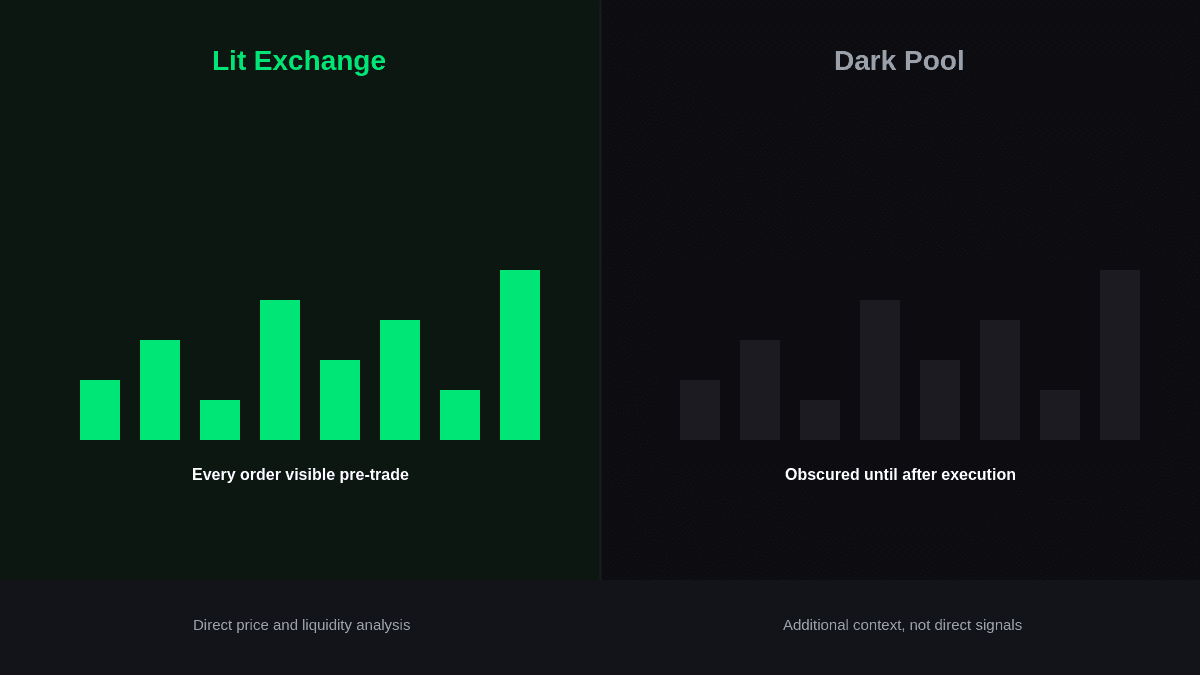
The guide outlines how dark pools function, the meaning of dark pool prints, how traders can analyze them, and their place in an overall trading strategy.
What Is a Dark Pool?
A dark pool is a private trading system used by market participants to conduct stock transactions secretly without showing their orders on an exchange order book before the execution.
Large institutions may use these pools when they need to trade substantial positions without immediately revealing their intentions to the entire market. This can be especially relevant when analyzing smart money concepts, as publicly displayed large orders may attract other participants and potentially move the price before the institution completes its transaction.
Dark pools are not entirely secretive. Trades made using dark pools can normally be incorporated into market data reports after the trade has been made. The critical difference here is that the market would not have seen the order on the order book prior to the trade being executed.
This makes dark pools different from the visible order flow traders commonly observe on public exchanges.
Dark Pool Prints Meaning: What the Print Actually Shows
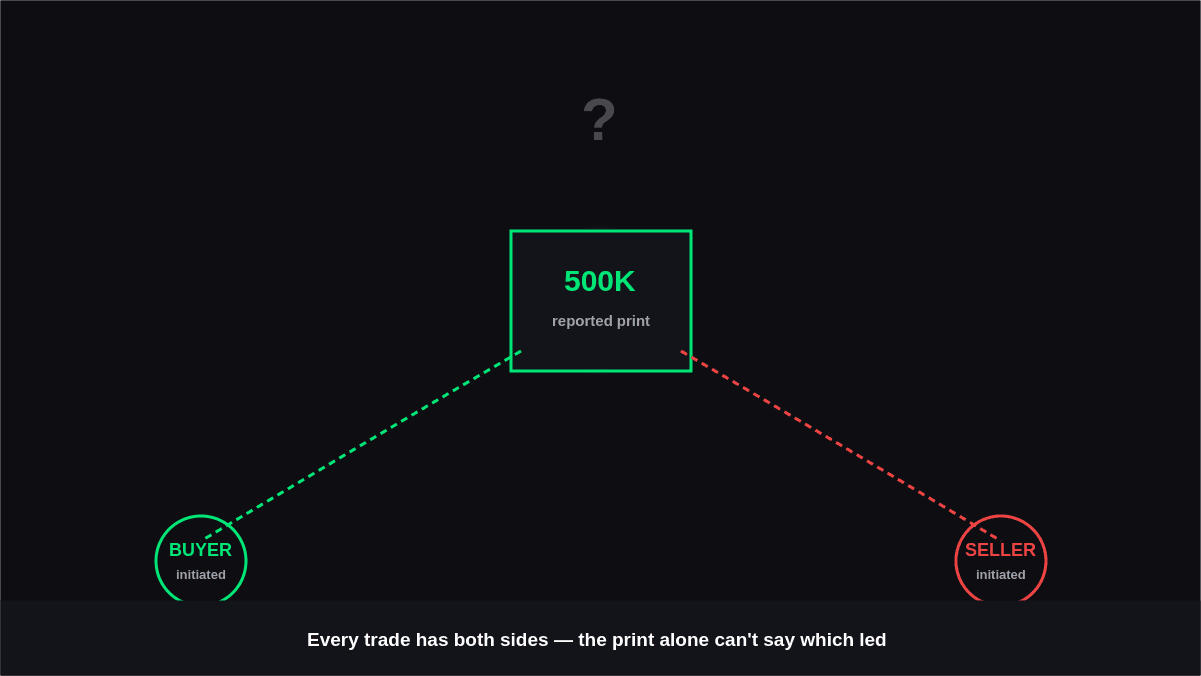
A dark pool print is a reported transaction associated with trading activity that took place away from a traditional displayed exchange order book.
The print can show useful information such as:
- The securities that were exchanged
- The reported cost of the trade
- The quantity of shares that were exchanged
- The time the trade took place
- Sometimes additional information depending on the data provider
The critical point is that a print does not always reveal whether the institution was buying or selling.
For instance, consider a stock transaction of 500,000 shares. This means a large number of stocks have been traded; however, it does not automatically prove that an institution was accumulating shares.
Buyer and seller are found in every completed trade. In the absence of more context, it is advisable for investors to refrain from making assumptions regarding which party had initiated the trade.
Why Large Traders Use Private Trading Venues
Large traders often use private trading venues because their orders can be big enough to move the market. Keeping these trades less visible can help them complete large orders without drawing too much attention or pushing prices in an unwanted direction.
To understand it better, follow this table:
| Factor | Why It Matters for Institutions |
|---|---|
| Order size | Large positions can be difficult to execute without affecting price. |
| Liquidity | Greater liquidity can make substantial orders easier to fill. |
| Market impact | Visible demand or supply may cause other traders to react. |
| Execution timing | Institutions may spread activity across different periods to manage exposure. |
| Price visibility | Limiting pre-trade visibility can reduce the chance of revealing intentions. |
Dark pools can therefore provide institutions with another way to manage large transactions while reducing some pre-trade exposure. However, their use does not mean that every large transaction is suspicious or designed to manipulate the market.
How Dark Pool Prints Differ From Regular Market Activity
Retail traders typically see displayed bids and offers through public exchanges and market-data feeds. These visible orders provide information about available liquidity at particular prices.
Dark pool transactions operate differently because the original orders are not displayed publicly in the same manner.
For a better comparison, follow this:
| Feature | Dark Pool Print | Public Exchange Activity |
|---|---|---|
| Order visibility before execution | Limited | Generally visible |
| Typical users | Institutional investors and large participants | Institutions, traders, market makers, retail traders |
| Large-order use | Common | Also possible |
| Pre-trade transparency | Lower | Higher |
| Reported transaction | Can appear after execution | Visible through normal market data |
| Direction automatically known? | No | Not necessarily |
| Best use for traders | Additional market context | Direct price and liquidity analysis |
The distinction matters because traders should not treat a dark pool print as equivalent to an ordinary displayed order.
Step by Step Guide on How to Track Dark Pool Activity
Learning how to track dark pool activity requires more than watching for unusually large numbers.
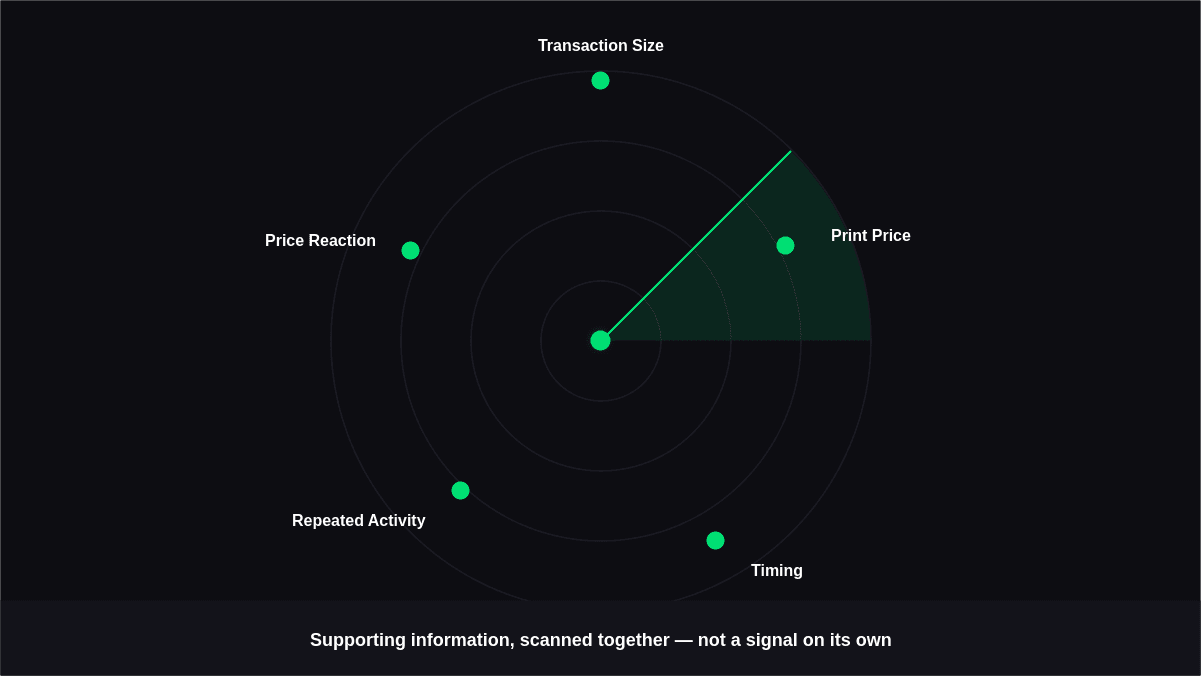
To track it follow this step by step guide:
Step 1: Check Transaction Size
First check the transaction size but remember big chart prints show big volumes of trades taking place however this does not necessarily mean that the buyer or seller is in control.
Step 2: Compare the Print Price
Look at where the transaction occurred compared with the stock’s current trading range and nearby key levels.
Step 3: Watch the Timing
Take note of the time when the print was generated. An activity involving key market events may be interpreted differently from a significant trade made on an inactive period.
Step 4: Look for Repeated Activity
Several large prints around a similar price can provide more useful context than a single transaction.
Step 5: Observe the Price Reaction
Watch how the price moves following the print. An extreme move could offer further confirmation, whereas a small move or no move at all could reduce the importance of the trade.
The goal is to use dark pool data as supporting information rather than treating every large print as a direct trading signal.
Dark Pool vs Lit Exchange: What Traders Should Know
The main difference between a dark pool and a lit exchange is how much trading information is visible before a trade happens. Lit exchanges show public orders and quotes, while dark pools offer less pre-trade visibility for large transactions.
For more clarification, below is a comparison table:
| Feature | Dark Pool | Lit Exchange |
|---|---|---|
| Order visibility | Limited before execution | Publicly displayed |
| Common use | Large institutional orders | Broad range of market orders |
| Price information | Less visible before execution | More transparent |
| Market impact | Can help reduce exposure from large orders | Large visible orders may affect market behavior |
| Public order book | Not displayed in the same way | Available to market participants |
Can Dark Pool Prints Predict Price Direction?
Not reliably on their own.
Probably one of the biggest mistakes that traders make is the idea that a large print means that prices have to move in the same direction. The trade itself simply doesn’t give enough information for making such a decision with any level of confidence.
Traders can use dark pools as context.
When there are lots of large prints at a certain price level, then that price level becomes one worth paying attention to. When prices start to react strongly around this level in the future, then this activity could become a more important context.
This method is much more practical than looking at every large print as a trade opportunity.
A Better Way to Use Dark Pool Information
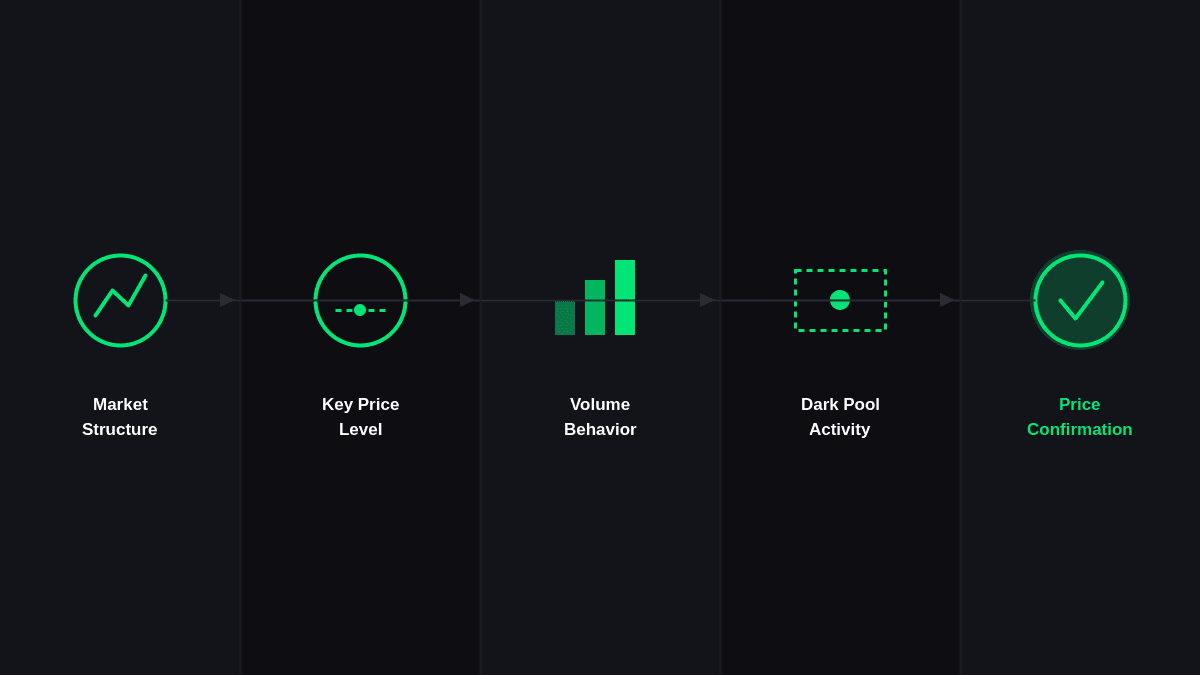
The most useful approach is to treat dark pool data as one layer of market analysis.
Begin with the general trend and key price points. After that, look at volume and volatility to see if there was any abnormal trading activity.
A simple framework is:
Market structure → key price level → volume behavior → dark pool activity → price confirmation
This ensures that the print maintains its rightful place. This may assist traders to explore areas of interest without making the print their only motive for conducting trades.
For example, if a stock is approaching a major technical level and unusually large transactions have previously occurred near that area, a trader may monitor the level more closely. Confirmation should still come from actual price behavior and the trader's established strategy.
Are Dark Pool Prints Useful for Retail Traders?
Yes, but the worth of that information relies on how it’s read.
It would be impossible for retail traders to read the entire intention of the institutions just from prints. However, the data can give additional perspective regarding where the important trades are done.
Most of the time, the most valuable role the information plays is validation.
By incorporating volume, technical levels, volatility, and price movement, the data from the dark pools can help traders understand the market activity better.
Conclusion
Understanding Dark pool prints meaning is less about finding a hidden buy or sell signal and more about understanding how large transactions fit into the market. A reported print can reveal significant trading activity, but it does not automatically identify the buyer's or seller's intention.
Dark pool trades can be utilized by retail traders to determine which sections need to be watched out for and whether the price movements are aligned with significant price levels. The key is to avoid treating dark pool data as a standalone prediction tool.
Used alongside a well-defined trading strategy, dark pool information can add another layer of context without replacing sound analysis, support resistance, or risk management.