Confidence rating signals allow traders to determine how well their trading setup matches a particular set of criteria. Rather than assuming that all trading signals have equal confidence, a confidence rating signal gives traders another criterion for comparing setups, based on things like trend direction, momentum, volatility, and market structure.
The value of the confidence score for beginners does not lie in its ability to predict the next move in the market; rather, its function is to organize data and show how well a trading setup fits the criteria of a certain trading system.
Knowledge of what exactly these scores evaluate will prevent traders from acting on one indicator or an appealing-looking chart alone.
What Are Confidence Rating Signals?
Confidence rating signals are numbers, grades, or categories assigned to a trading setup to show how closely it meets predefined criteria. Confidence rating indicators are typically constructed in such a way that they reflect the total number of conditions that favor either a bullish, bearish, or neutral market outlook.
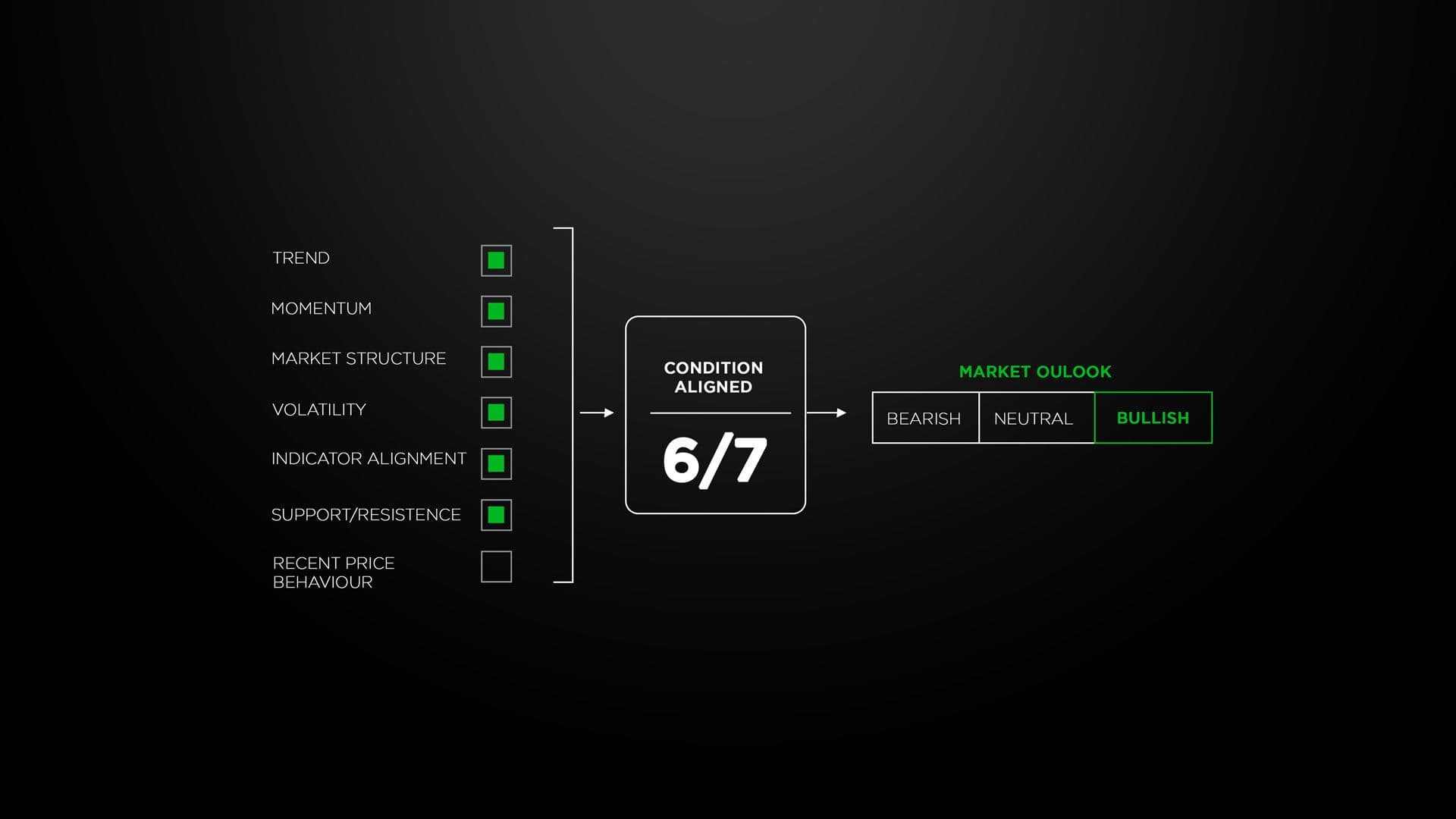
For instance, such an analysis could consider:
- Direction of the trend
- Price momentum
- Structure of the market
- Volatility
- Indicator alignment
- Support and resistance
- Behavior of recent prices
A higher rating may indicate that more conditions agree with the setup. However, the score should be viewed as evidence within a trading process, not as a guarantee of success.
How Confidence Ratings Are Typically Calculated
The calculation depends on the trading system or confidence rating signal methodology. There is no universal formula that determines what a confidence rating must mean.
A simple model could assign points to individual conditions. For example:
| Market Condition | Example Contribution |
|---|---|
| Trend agrees with setup | +2 |
| Momentum supports direction | +2 |
| Price reacts from a key level | +1 |
| Volatility is suitable | +1 |
| Market structure confirms bias | +2 |
| Conflicting signal appears | -2 |
The resulting score could then be converted into categories such as low, moderate, or high confidence.
This approach makes the rating easier to understand because traders can see why a setup received a particular score rather than relying on an unexplained number.
Why Confidence Ratings Can Help Beginners
New traders may be faced with the challenge of having more data rather than insufficient data. Various data can give various signals, thus making it hard for one to know which signals to focus on.
A confidence rating can help traders focus on key factors by:
- Summarizing multiple conditions into one easy-to-read rating.
- Highlighting agreement between indicators instead of relying on a single signal.
- Making setups easier to compare when several opportunities appear.
- Supporting consistent decision-making by applying predefined criteria.
The trader may look at whether multiple independent factors agree on what needs to be done instead of checking whether an individual indicator shows buy or sell.
This can also encourage consistency. The evaluation system will provide a set of parameters by which the trader can judge similar trades without altering the criteria for each.
How to Read a Confidence Rating
The confidence score must always be judged within the context of the system that developed it. An 80% score from a particular software does not automatically equate to a situation where the set up has an 80% chance of generating profit.
A useful way to interpret the rating is to treat it as a relative measure of setup quality.
For example:
- Low confidence: Few conditions support the setup or several factors conflict.
- Moderate confidence: The setup has supporting evidence but still contains meaningful uncertainty.
- High confidence: Several predefined conditions align with the trading strategy.
These precise thresholds must be based on the rating methodology and not a supposed universal scale.
Confidence Rating Signals vs. Traditional Trading Signals
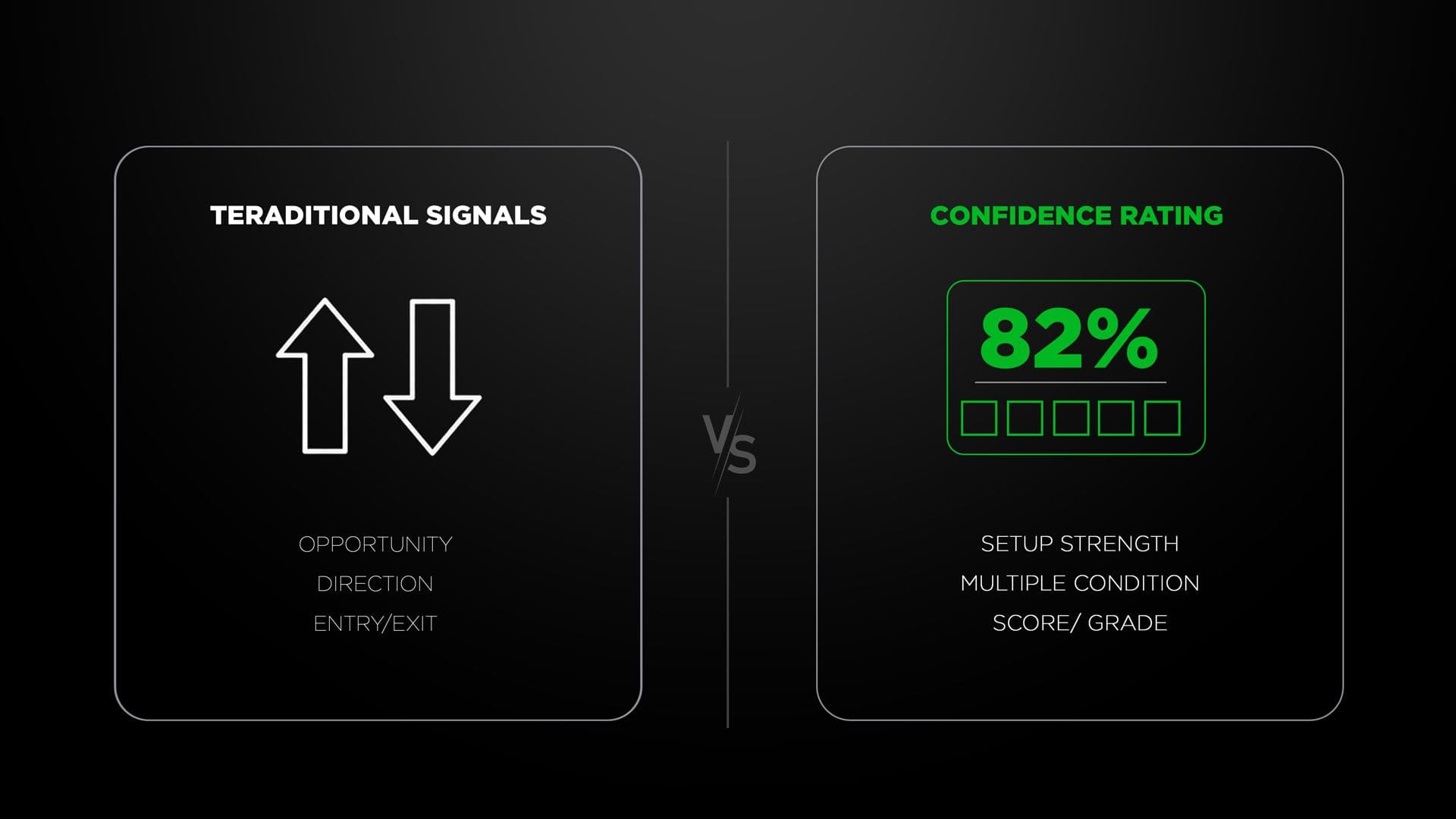
Traditional trading signals may simply provide an indication of the possible entry or exit opportunity according to the rules, indicators, or price action. Confidence rating signals add another layer by showing how strongly a setup meets the conditions defined by the trading system.
Below you will find a detailed comparison to understand them better:
| Factor Trading Signal | Confidence Rating Signal |
|---|---|
| Main purpose Identifies a possible opportunity | Assesses the strength of a setup |
| Output Buy, sell, entry, or exit indication | Score, percentage, grade, or category |
| Information provided Often focused on direction | Can summarize multiple conditions |
| Risk interpretation Requires separate evaluation | May help prioritize setups but does not replace risk analysis |
| Best use Finding potential opportunities | Comparing or filtering potential setups |
These concepts can work together rather than being treated as competing approaches.
How to Combine Confidence With Trade Confirmation
A high rating does not automatically mean that a trade should be entered. Traders can still wait for trade confirmation that matches their strategy.
Before entering, traders may look for:
- A clear price rejection at an important support or resistance level.
- A break of market structure that supports the expected direction.
- A successful retest after a breakout.
- Sustained momentum showing that the move has follow-through.
- Alignment with the broader market context rather than relying on the rating alone.
The important distinction is that the confidence rating summarizes the available evidence, while confirmation examines how price actually behaves at a decision point.
Using Confidence Ratings With Risk Management
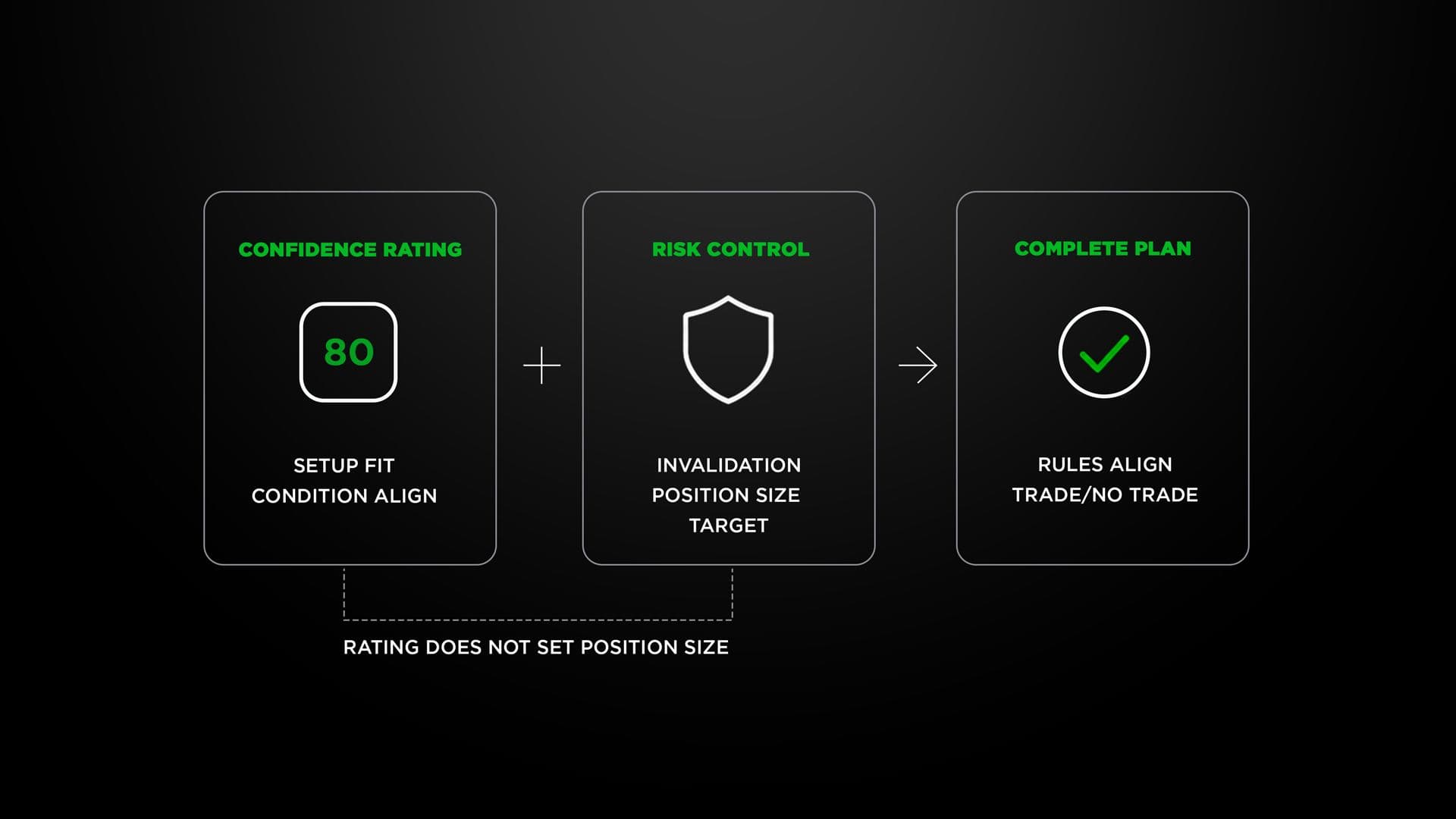
Trading risk management is still relevant no matter what level of confidence rating is obtained.
The trader will need to determine how much money he is ready to risk before entering the trade. The position size, stop loss setting, and target setting need to be considered separately from the confidence rating.
A practical framework is:
- Identify the setup.
- Review its confidence rating.
- Check whether the underlying conditions support the rating.
- Wait for any required confirmation.
- Define the invalidation level.
- Calculate an appropriate position size.
- Enter only if the complete plan meets the strategy's rules.
This stops the rating from being used as a reason to trade larger positions on the basis that the setup looks particularly attractive.
A Simple 4-Step Workflow for Beginners
Beginners can use confidence rating signals as one part of a trading procedure instead of relying on a confidence rating as an entry signal by itself.
Below you find a proper workflow for beginners:
Step 1: Identify the Market and Setup
Select the market and time frame which suit your trading plan. Then select a candidate for setup and see if it fulfills your basic trading strategy guidelines.
Step 2: Review the Confidence Rating
Now evaluate the factors that go into making up the rating. A higher rating means more of the predefined conditions are aligned, but it does not replace your own technical analysis.
Step 3: Confirm and Manage the Trade
Take into consideration the overall market environment, and look for any trade confirmation that might be needed for your trading approach. Prior to initiating the trade, determine the invalidation point and decide on the appropriate trade size.
Step 4: Record and Review the Outcome
Include the signal, its rating level, entry rules, and outcome in your trading journal. Once you have accumulated enough data, compare the performance of setups from various rating levels.
What Makes a Confidence Rating Useful?
A useful confidence rating should be transparent, consistent, and testable.
Ideally, traders should know what inputs influence the score, how the score changes when market conditions change, and whether historical testing supports the way the rating is interpreted.
The most useful question is therefore not simply, “Is this confidence rating high?” Instead, ask:
“Does this rating provide measurable value when combined with my trading rules?”
That question shifts attention away from attractive percentages and toward evidence.
Common Mistakes When Using Confidence Ratings
Confidence scores can become misleading when traders treat them as predictions rather than analytical tools.
- Treating a high score as a guarantee
- Ignoring how the score is calculated
- Relying on too many indicators
- Taking every high-rated setup
- Increasing risk because of a high rating
- Changing trading rules after each result
- Ignoring broader market context
- Using the rating without confirm
Conclusion
Confidence rating signals could provide traders with a systematic tool to analyze how similar a prospective setup is to the pre-defined requirements. The main advantage of such a confidence rating signal for beginners is that it provides a tool to combine several aspects of the market situation into a single framework, rather than an illusion of certainty.
A confidence score should be used as a complement to chart analysis, trade validation, and risk management in trading, rather than a replacement for these tools. Knowing the system behind the rating and how well it performed in the past will allow traders to make better decisions.
FAQs
1. What are confidence rating signals in trading?
Confidence rating signals are measures used to express how closely a potential trade setup fits a number of predetermined criteria. They will aid in the comparison of trading setups although they do not provide assurance of a result.
2. Is a higher confidence rating always better?
Not always. It could mean that the rating is more aligned with the criteria set by the system; however, market dynamics change, and the system could still send out losing signals.
3. Can confidence ratings predict profitable trades?
They must not be taken as sure predictions. The worthiness of such ratings relies on the approach taken for the rating, the data that is used, and how effective the system is in practice.
4. Should beginners use confidence ratings alone?
No. Beginners should use them in relation to the market situation, their trading system, confirmation criteria, and suitable risk management. The rating can be considered as one component of the comprehensive decision-making process.
5. How can I test whether a confidence rating is useful?
Record the rating, set up conditions, entry, results, and other considerations on a sufficiently large scale. Comparison of results at various levels of rating will help identify whether those set ups rated higher indeed perform better.