When you look at a stock, forex pair, or cryptocurrency, you may notice two prices listed instead of one. Understanding Bid vs Ask Price helps to explore what buyers are willing to pay and what sellers are willing to accept.
These two prices are fundamental to know how markets operate and can affect the price you receive when entering or exiting a trade.
For beginners, the difference can seem small, but knowing how these prices work can make it easier to understand entry exit signals and execute trades with greater clarity.
What Are Bid and Ask Prices?
Bid and ask prices show the two sides of a market. Understanding each price separately makes it easier to see how trades are executed.
What Is the Bid Price?
The bid price is the highest price a buyer is currently willing to pay for an asset. If a trader wants to sell immediately, their order may execute against the available bid, depending on the market and order size.
For example, if a stock has a bid of $49.95, buyers are currently offering $49.95 for the shares at that quoted level.
What Is the Ask Price?
The ask price is the lowest price a seller is currently willing to accept for an asset. A trader who wants to buy immediately may have their order executed against the available ask.
If the same stock has an ask of $50.00, sellers are currently offering shares at $50.00 at that quoted level.
How Bid vs Ask Price Works in a Live Market
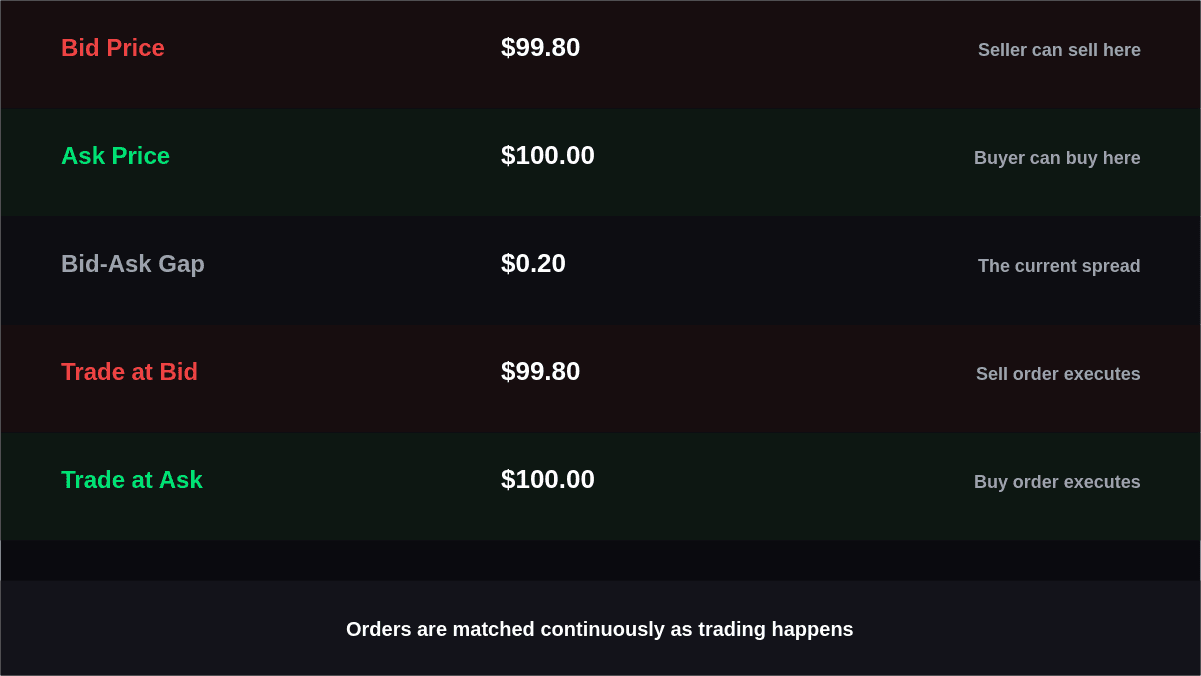
The market constantly matches buy and sell orders submitted by traders. The bid and ask show the prices currently available on each side, helping determine where a trade can take place.
To better understand how the bid and price works in a live market follow the given table:
| Price Type | Example Price | What It Means | Trader’s Action |
|---|---|---|---|
| Bid Price | $99.80 | Highest price buyers are currently offering | A seller can sell at this price |
| Ask Price | $100.00 | Lowest price sellers are currently accepting | A buyer can buy at this price |
| Bid-Ask Difference | $0.20 | Gap between the bid and ask | Shows the current spread |
| Trade at Bid | $99.80 | Seller accepts the highest available bid | Sell order can execute |
| Trade at Ask | $100.00 | Buyer accepts the lowest available ask | Buy order can execute |
The trade price depends on which available order is matched. This ongoing interaction between buyers and sellers helps establish the market price as orders are submitted, modified, executed, or canceled.
Understanding the Bid Ask Spread
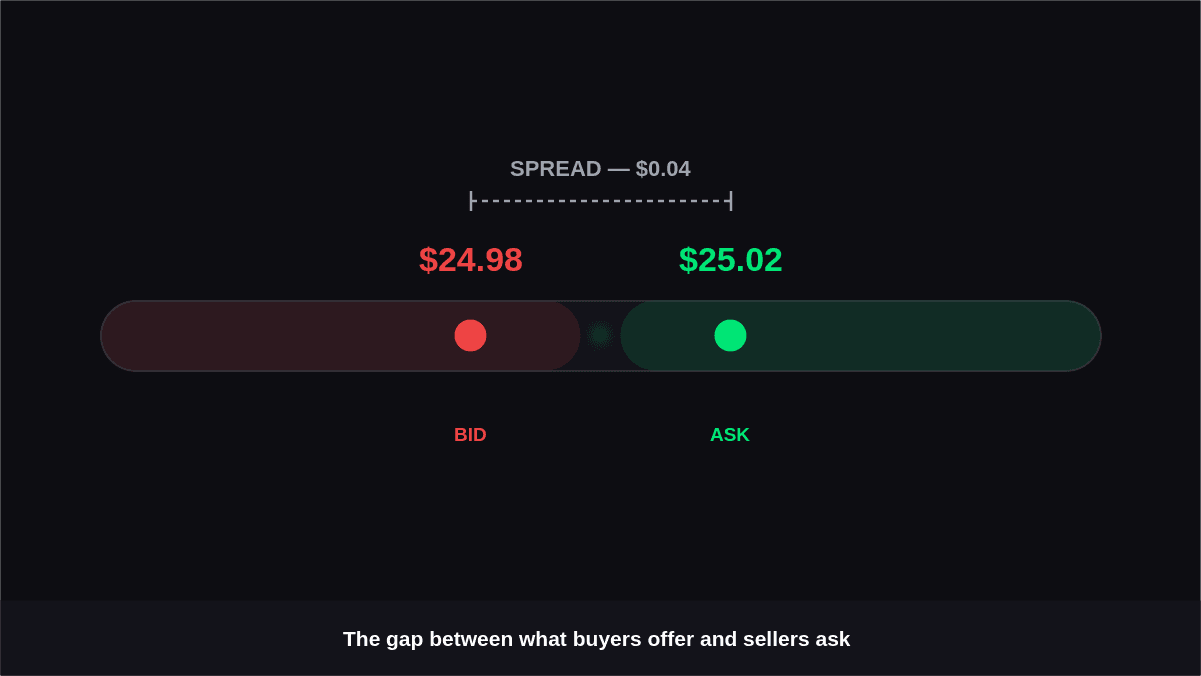
The bid ask spread is the difference between the bid and ask prices.
For example:
Bid: $24.98
Ask: $25.02
Spread: $0.04
The spread is not a fixed fee charged separately in the same way as a trading commission. Instead, it represents the gap between the best available buying and selling prices.
A narrower spread generally means the two prices are close together. A wider spread means there is a larger difference between them.
Market conditions, trading volume, liquidity, volatility, and the particular asset can all influence the size of the spread.
Why the Spread Can Matter to Traders
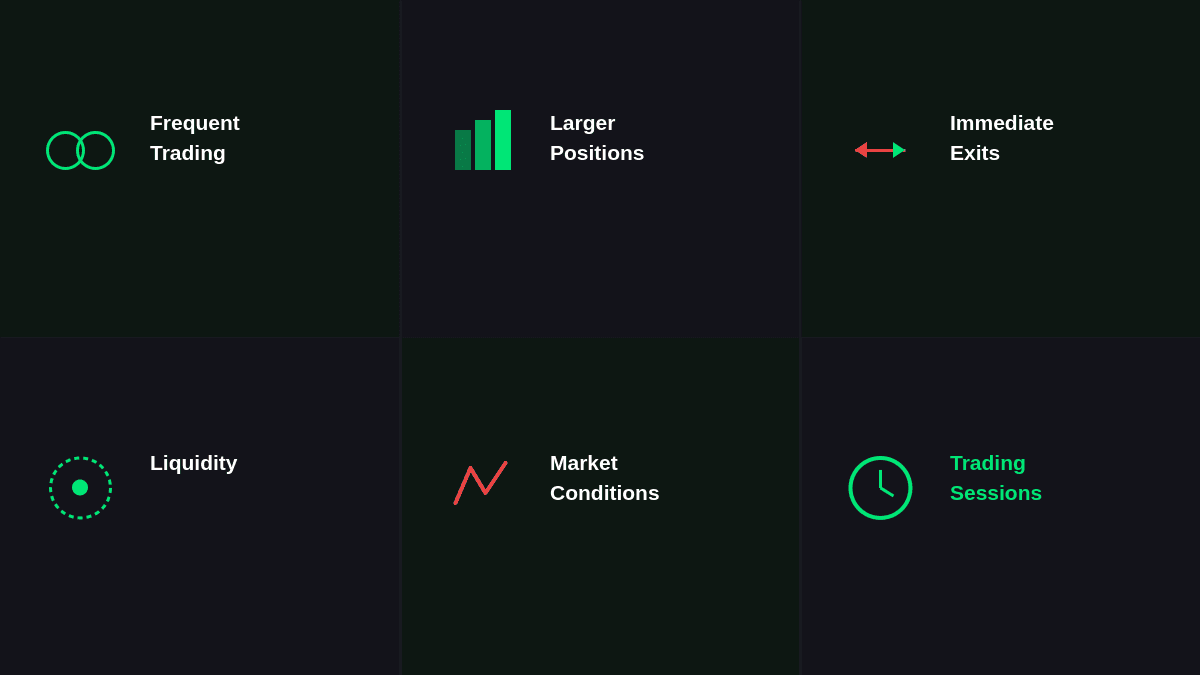
Even a small spread can affect trading costs, particularly when a trader makes frequent transactions or trades larger positions. Understanding how the spread behaves can help traders assess the cost and liquidity of an asset.
- Frequent trading: Small spreads can add up when a trader enters and exits many positions.
- Larger positions: A wider spread can have a greater dollar impact when trading more shares or contracts.
- Immediate exits: If a trader buys at the ask of $50.05 and immediately sells at a bid of $50.00, the $0.05 difference represents the spread before other trading costs.
- Liquidity: Highly traded assets often have tighter spreads because there are more buyers and sellers competing around the current price.
- Market conditions: Spreads can widen during periods of high volatility or when fewer orders are available.
- Trading sessions: The spread may change throughout the day as market activity and available orders fluctuate.
Looking at the bid, ask, and spread together gives traders more information about current trading conditions than simply looking at the asset's displayed price.
Bid Price and Ask Price in Different Order Types
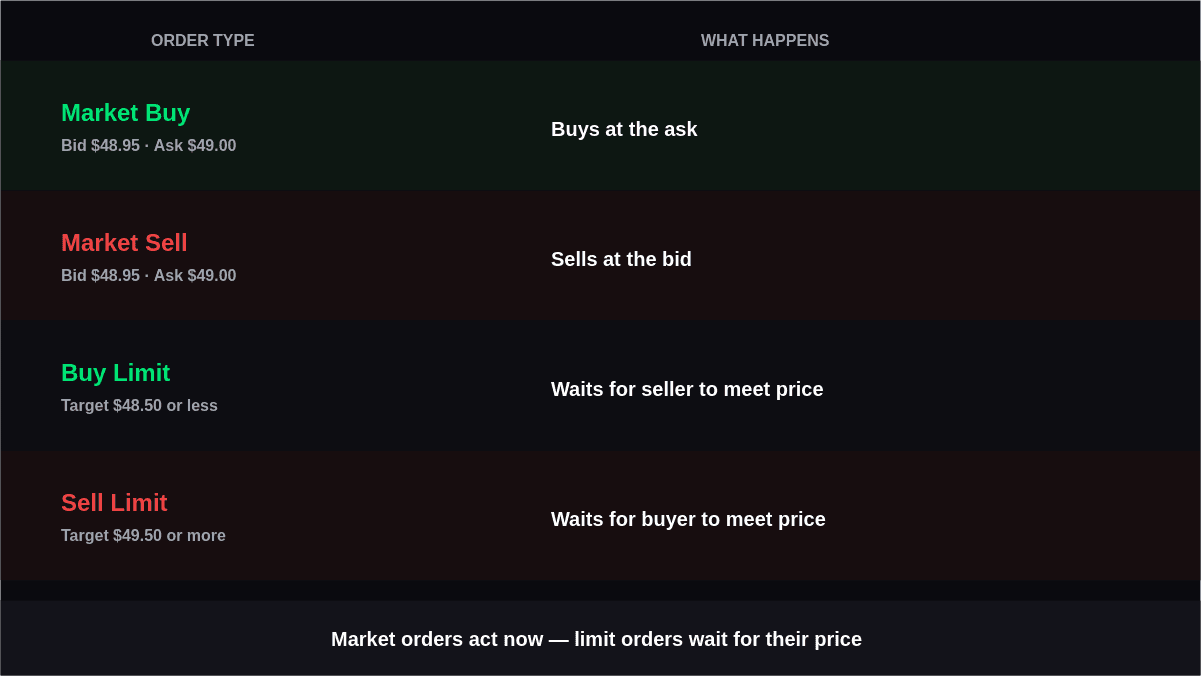
The type of order a trader chooses determines how their trade interacts with the current bid and ask. Understanding this difference is important because an order may execute immediately, remain pending, or receive a different price depending on market conditions.
| Order Type | Trader Wants to | Current Bid | Current Ask | What Happens |
|---|---|---|---|---|
| Market Buy | Buy immediately | $48.95 | $49.00 | Buys from available sellers at the ask |
| Market Sell | Sell immediately | $48.95 | $49.00 | Sells to available buyers at the bid |
| Buy Limit | Buy at $48.50 or less | $48.95 | $49.00 | Waits until a seller offers $48.50 or less |
| Sell Limit | Sell at $49.50 or more | $48.95 | $49.00 | Waits until a buyer is willing to pay $49.50 or more |
This shows why the bid and ask prices matter when choosing an order type. Market orders interact with available prices immediately, while limit orders only execute when their specified price condition is met.
What Happens When You Place a Buy Order?
Consider a stock showing:
- Bid: $75.90
- Ask: $76.00
If you submit a market buy order, the order typically interacts with available sell orders beginning around the ask price.
The exact execution price isn't guaranteed because the market can change between order submission and execution. If there aren't enough shares available at the displayed ask, portions of the order may execute at higher prices.
This becomes particularly important in fast-moving or thinly traded markets.
A limit buy order works differently. If you set your maximum price at $75.95, you are specifying the highest price you're prepared to pay. The order may remain unfilled if sellers aren't available at that price or lower.
What Happens When You Sell?
The same principle works in reverse.
Suppose:
- Bid: $120.00
- Ask: $120.08
A market sell order will generally interact with available buyers around the bid. If sufficient buying interest exists at $120.00, the order may execute there.
A sell limit order could instead specify $120.08 or another minimum acceptable price. That gives the trader more control over the price but does not guarantee execution.
The choice between immediate execution and price control depends on the trading situation and the trader's objectives.
Reading Bid and Ask on a Trading Platform
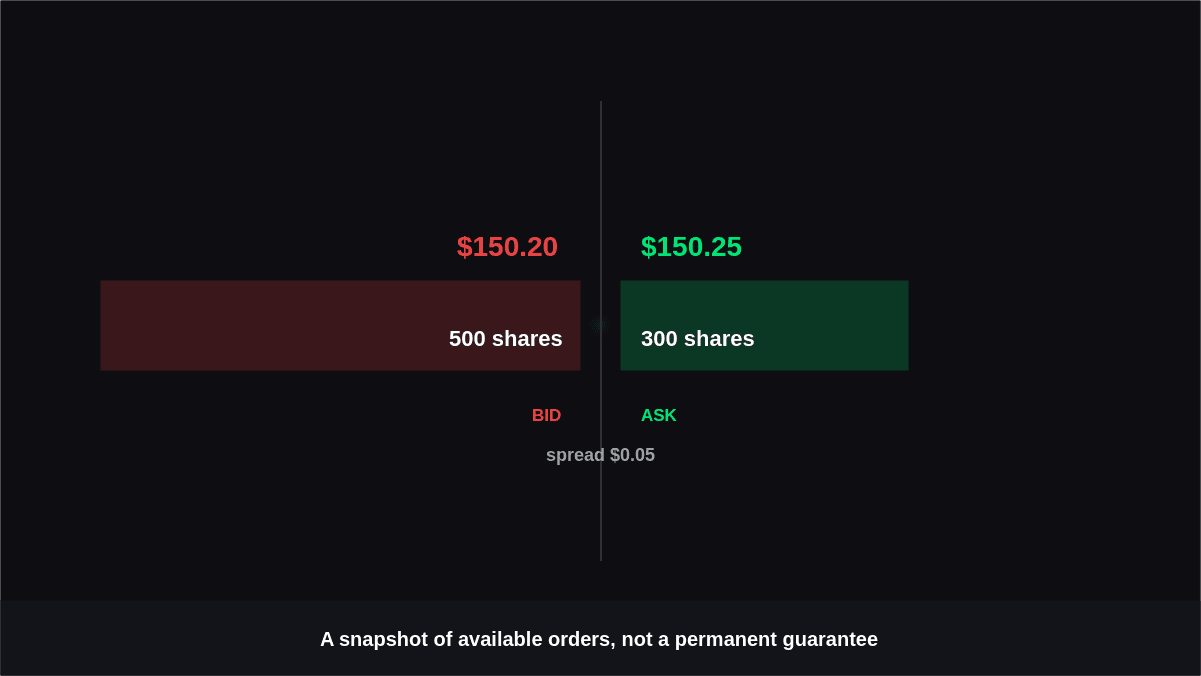
Most trading platforms show the bid and ask prices alongside an asset’s current quote. These figures give traders a quick view of the prices buyers are offering and sellers are requesting.
For example, a trading platform may display the information like this:
| Item | Price | Meaning |
|---|---|---|
| Bid | $150.20 | Highest displayed buying price |
| Ask | $150.25 | Lowest displayed selling price |
| Spread | $0.05 | Difference between bid and ask |
| Bid Size | 500 | Shares available at displayed bid |
| Ask Size | 300 | Shares available at displayed ask |
The displayed quantities can provide additional information about available orders, although they can change rapidly.
It's also important to remember that the visible order book represents available orders at that moment. It isn't a permanent guarantee that those orders will remain in place.
Why Bid and Ask Prices Change
Bid and ask prices can move whenever traders submit, modify, or cancel orders or when existing orders are executed. If buyers become more aggressive, they may raise their bids. If sellers become more aggressive, they may lower their asks.
During major news releases or periods of rapid volatility, these prices can change quickly. Liquidity can also shift, causing the spread to widen or narrow. This constant activity is especially noticeable in markets influenced by high-frequency trading, where large numbers of orders can be submitted and executed rapidly.
This means the bid and ask displayed on a trading platform should be viewed as a real-time snapshot rather than a permanent quote.
Bid vs Ask Price: A Simple Comparison
The bid and ask represent the two sides of a market, with buyers and sellers placing orders at different prices. The table below makes their roles easier to compare and understand at a glance.
| Feature | Bid Price | Ask Price |
|---|---|---|
| Represents | Highest price a buyer is willing to pay | Lowest price a seller is willing to accept |
| Market Side | Buying side | Selling side |
| Market Order | A market buying typically executes against the bid | A market sell typically executes against the bid |
| Shows | What buyers are currently offering | What sellers are currently requesting |
| Position in Quote | Usually below the ask | Usually above the bid |
| Difference | The gap between bid and ask forms the spread | The gap between ask and bid forms the spread |
The two prices work together and provide a clear picture of current buying and selling interest.
4 Common Beginner Mistakes With Bid and Ask Prices
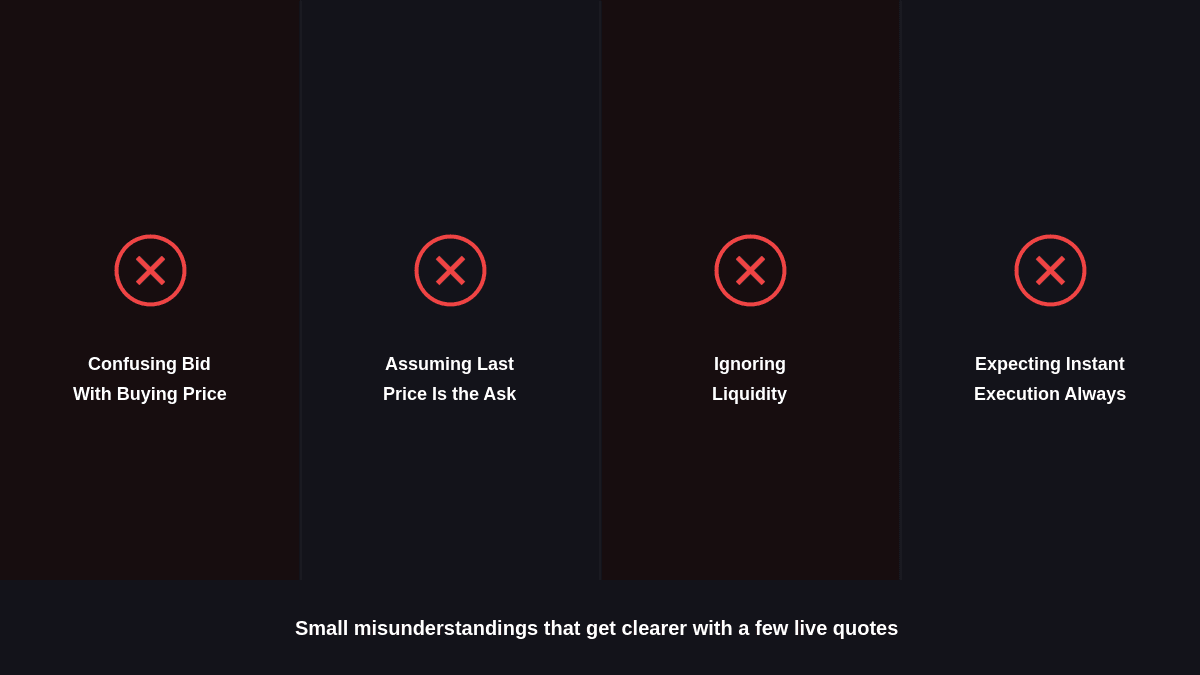
New traders can easily misread bids and ask quotes, especially when placing their first few orders.
Avoiding these common mistakes can make order execution and price differences much easier to understand.
1. Confusing the bid with the buying price: The bid is the highest price buyers are offering, not the price a buyer necessarily pays.
2. Assuming the last traded price is the current ask: The most recent trade may have occurred at a different price from the current ask.
3. Ignoring liquidity: Assets with similar prices can have very different spreads and available order sizes.
4. Expecting every order to execute immediately: A limit order can remain unfilled if the market does not reach its specified price.
Conclusion
Understanding Bid vs Ask Price gives beginners a clearer picture of how actual trades take place. The bid represents current buying interest, while the ask represents current selling interest.
The gap between them forms the spread, and order type determines how a trader interacts with those available prices when interpreting signals and overlays on a trading chart.
Once these concepts are clear, reading quotes, comparing liquidity, and understanding why an order may execute at a particular price becomes much easier.