Algorithmic trading may sound complex at first sight, considering the automated nature of trading, programming, back-testing, and market data. However, beginner algorithmic trading does not presuppose the need to develop a highly complex trading system at the very beginning.
It is advised to start learning the basics of algorithmic trading, choose a simple strategy, back-test it using historical data and proceed with automation.
The main difficulty that beginners face in this case is that there are a lot of things to learn, indicators, platforms, strategies, and other technical aspects. Without understanding the right order of learning, it is quite easy to move from one tool to another without developing any process.
This guide suggests the optimal way of learning how to do algorithmic trading.
What Is Algorithmic Trading?
Algorithmic trading employs predefined rules to decide on when a trade needs to be identified, initiated, managed, and exited.
An example algorithm could include the following rules:
- Trade long if the short-term moving average crosses the long-term moving average.
- Skip trades if volatility goes beyond the set limit.
- Close out the trade when the pre-defined stop loss and take-profit targets are hit.
It is important to note that an algorithm always follows the rules and never the emotions of the trader. However, this does not mean that automated trading will automatically lead to profitable results.
Beginner Algorithmic Trading : A Step-by-Step Roadmap
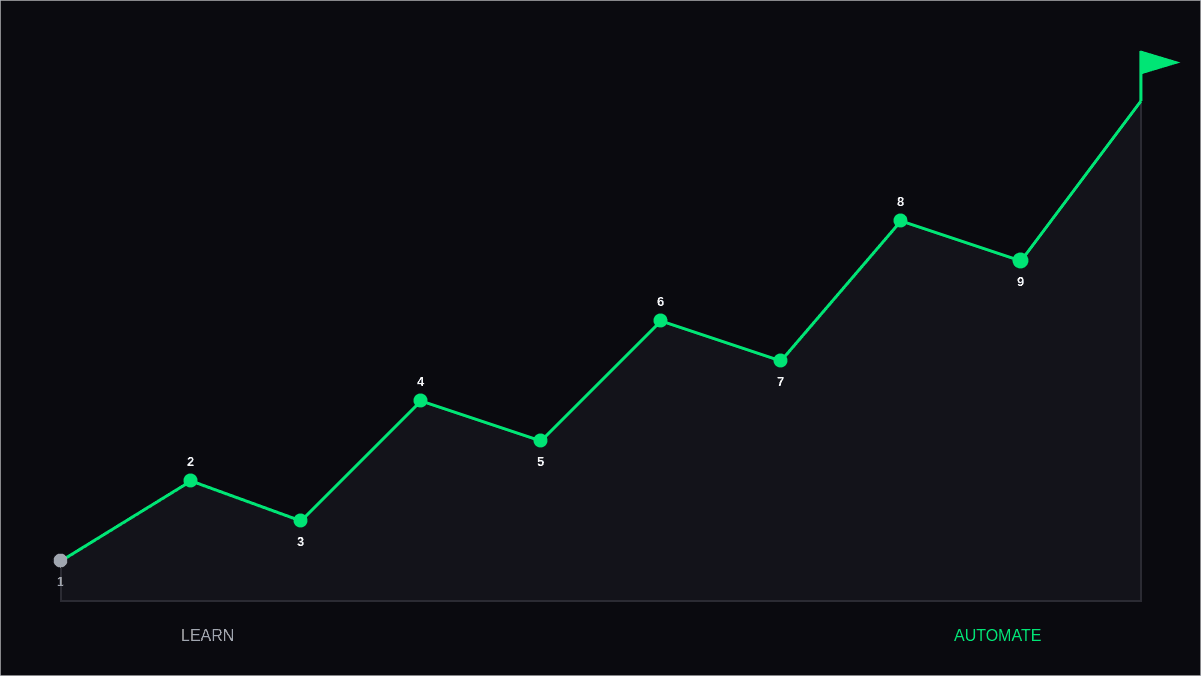
Starting programming without having a solid grasp on the logic of the trade is another widespread pitfall. A much more productive approach would be to build the strategy first and only then automate it.
Step 1: Learn the Trading Fundamentals
Prior to programming, know some beginner algorithmic trading basics including:
- Market order vs. limit order
- Bid price and ask price
- Spread and slippage
- Position sizing
- Stop-loss and take-profit
- Volatility
- Risk-to-reward ratio
- Drawdown
- Trading costs
You should be aware of what type of asset you will trade as well. Different markets such as stocks, forex, futures, and cryptocurrencies could have different characteristics.
Step 2: Choose One Market and One Trading Approach
Do not try to develop a system for all markets at once.
Instead, choose one market and develop an approach. This can include trend-following, mean-reversion, breakouts, or momentum.
At this stage of development, it is not the objective to find the "ideal" strategy. The objective is to develop a strategy that can be formulated objectively.
Step 3: Turn the Idea Into Rules
It is one of the crucial stages in algorithmic trading for beginners.
The ambiguous statement like “Buy when market seems good” cannot be made reliable through automation. Instead, the quantifiable parameters have to be set and know the right time to enter and when to get out.
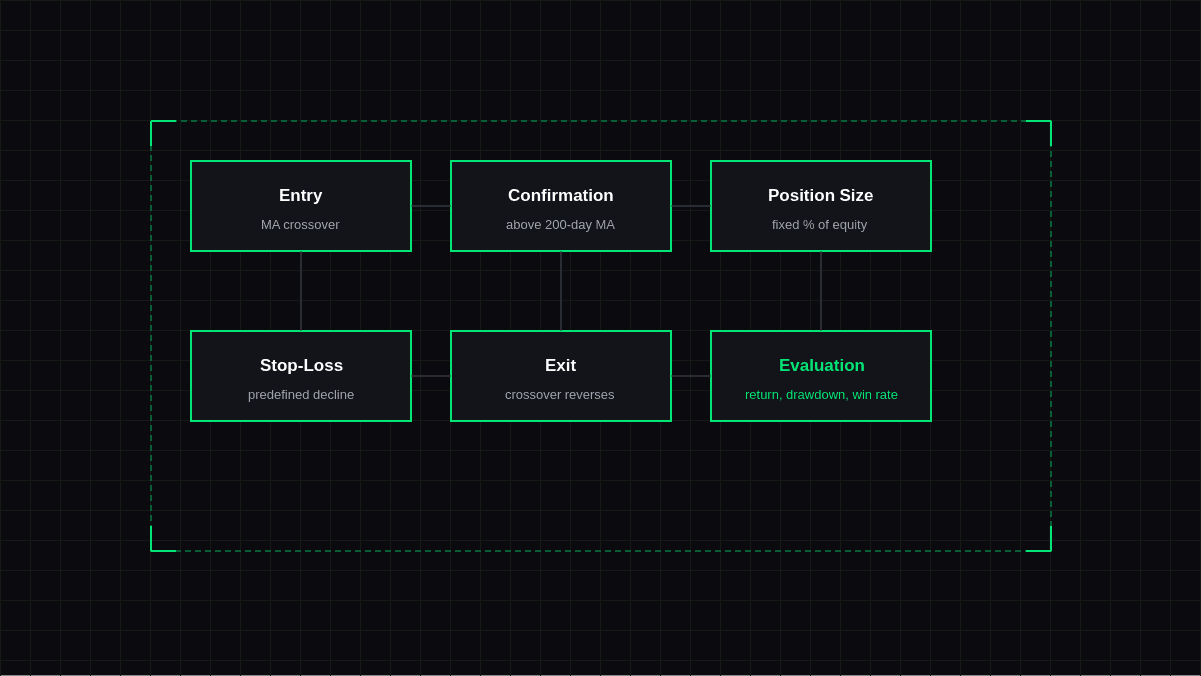
For example:
| Strategy Component | Example Rule |
|---|---|
| Entry | 20-day moving average crosses above 50-day moving average |
| Confirmation | Price is above the 200-day moving average |
| Position size | Risk a fixed percentage of account equity |
| Stop-loss | Exit after a predefined percentage decline |
| Exit | Moving-average crossover reverses |
| Evaluation | Measure return, drawdown, win rate, and risk-adjusted performance |
Step 4: Learn the Tools You Actually Need
It is not necessary that you learn all the programming languages or the trading platforms.
Depending upon your requirements, you can require:
- A charting software
- Market history data
- An electronic spreadsheet or any analytics software
- A programming language like Python
- A back-testing tool
- A paper trading platform
- The broker or exchange API access, if automation is required in future
If you are a beginner in coding, first understand enough of programming to play with the data, calculations, trading logic, and result evaluation.
Step 5: Backtest Before Automating
With backtesting, you are able to run your trading system's rules on past market data and see how the system would have done with that data set.
It is important for the backtest to look at more than just profits made.
Consider metrics such as:
- Total return
- Maximum drawdown
- Number of trades
- Win rate
- Average winning and losing trade
- Profit factor
- Volatility
- Risk-adjusted returns
Watch out for optimization of past data. If you keep changing your rules until past performance looks really good, you will end up with a bad system.
Step 6: Use Out-of-Sample Testing
Once the trading strategy has been created by using one segment of historical data, test the strategy using another segment of data which was not involved in the strategy creation process.
The out-of-sample testing will help you get some insight into whether your trading strategy works outside the context of the data in which it was created.
Walk forward analysis can be done by creating and evaluating the trading strategy at different time segments as opposed to doing it using one historical data sample.
There are no guarantees about future performance of any backtest as markets evolve, transaction costs fluctuate, and real-world implementation differs from historical conditions.
Step 7: Paper Trade the Strategy
Before testing in the real world, test your strategy in a simulated environment, if possible.
Paper trading can expose real-world implementation issues that your backtest won’t uncover, such as:
- Unpredictable signals
- Slow executions
- Faulty order logic
- Data issues
- Miscalculations
- Duplicated orders
- Incomplete exits
This step should be viewed as a technical and procedural validation rather than proof that your system will turn a profit.
Step 8: Add Risk Management
Risk management must be built into the algorithm.
A simple system can provide for:
- Maximum position sizing
- Maximum risk per trade
- Maximum daily loss
- Maximum portfolio size
- Stop rules
- Handling of exceptional market conditions
The aim is not to make money without losing. Losses are an inevitable part of trading. The idea is that the losses on any one or a series of bad trades do not become unacceptably destructive to the account.
Step 9: Automate Gradually
Having tested the strategy, proceed towards the automation process step by step.
For example, you may start with signals, followed by a semi-automated process, and finish with full automation of order placement if your trading platform allows that.
Common Mistakes in Algorithmic Trading
Avoidable errors in construction and testing can happen to beginners who create an algorithmic trading model. Maintaining simplicity and sticking to rules will be helpful in minimizing errors.
- Treating backtest results as guaranteed returns
- Over-optimizing the strategy
- Ignoring trading costs
- Automating too early
- Using too many indicators
A Practical Beginner Algorithmic Trading Checklist
Before moving from learning to live implementation, make sure you can answer these questions:
- What market am I trading?
- What conditions generate an entry?
- What conditions generate an exit?
- How much capital is placed at risk?
- How does the strategy handle transaction costs?
- What was the maximum historical drawdown?
- Was the strategy tested on unseen data?
- What happens when market conditions change?
- How will I monitor the system?
- What conditions would make me stop or modify it?
If you cannot answer these questions, the system probably needs more development before live deployment.
What to Learn Next
When you have figured out how things work, you can begin exploring other advanced topics on how to start algorithmic trading, such as building strategy in Python, building your portfolio, statistics, walk forward tests, APIs, and automated executions.
Additionally, you can explore other algorithmic trading strategies for beginners to know how trend following, momentum, breakouts, and mean reversion strategies will behave under varying market circumstances.
Reviewing differenttrading indicator plans can also help you evaluate what system configurations fit your long-term goals.
Conclusion
Beginner Algorithmic trading needs to be thought of as a learning process and not searching for an automated solution that will make money in the market. First, learn about market basics, select one well-defined strategy, turn it into objective rules, and backtest those rules on past market data.
Above all else, try to develop a repeatable process. Trading tools may help with it, but they shouldn't replace your understanding of the reasons behind the strategy, when it might not work, and what risks are acceptable to you.
Frequently Asked Questions
1. Is algorithmic trading suitable for beginners?
Indeed, beginners can master algorithmic trading, but they need to begin with basic trading skills and rule-based strategies first. The use of automation will follow when one already understands the rules and risks associated with the strategy.
2. Do I need to know how to code for algorithmic trading?
Not necessarily from the very beginning. There are platforms where one can develop and/or test their rule-based strategy even without much coding. However, knowing some basics of programming might still be helpful.
3. How much money do I need to start algorithmic trading?
There cannot be a universal minimum because the minimum depends on asset classes, broker, strategy type, and type of account used. One can begin by acquiring knowledge about strategies and testing them on paper without investing any money in order to see how the strategy will work in practice through paper trading.
4. Is backtesting enough to prove a trading strategy works?
No. Testing a strategy via backtesting is just testing how the strategy would have worked according to its assumptions under historical conditions. There are other approaches for testing such as out-of-sample testing, paper trading, accounting for transaction fees, and monitoring.
5. What is the easiest algorithmic trading strategy for a beginner?
There is not one best strategy. Trend following, moving averages, breakouts, and mean reversion strategies are some of the simplest that could be easily explained and tested.