Auction Market Theory provides a framework for understanding how financial markets establish prices through continuous interaction between buyers and sellers. Instead of viewing price movement as random, the theory considers the market an ongoing auction where participants negotiate through their orders and willingness to transact at different prices, creating an evolving market structure. As demand and supply change, the market searches for prices where sufficient trading activity can occur.
Understanding this process can help traders interpret why prices move, consolidate, reject certain levels, or continue toward new areas.
What Is Auction Market Theory?
Auction Market Theory explains market behavior through the interaction of participants seeking to buy or sell an asset at prices they consider acceptable.
The market continuously tests different price levels. When buyers and sellers agree that a particular price is reasonable, trading activity tends to increase. When one side becomes more aggressive or the other side loses interest, the market may move away from that area.
This creates three important ideas:
- Price moves to facilitate trade.
- Markets spend more time where participants find value.
- Markets move away from prices when there is an imbalance between buying and selling interest.
This framework helps traders focus less on predicting every price movement and more on understanding what the market is communicating through its behavior.
How the Market Auction Process Works
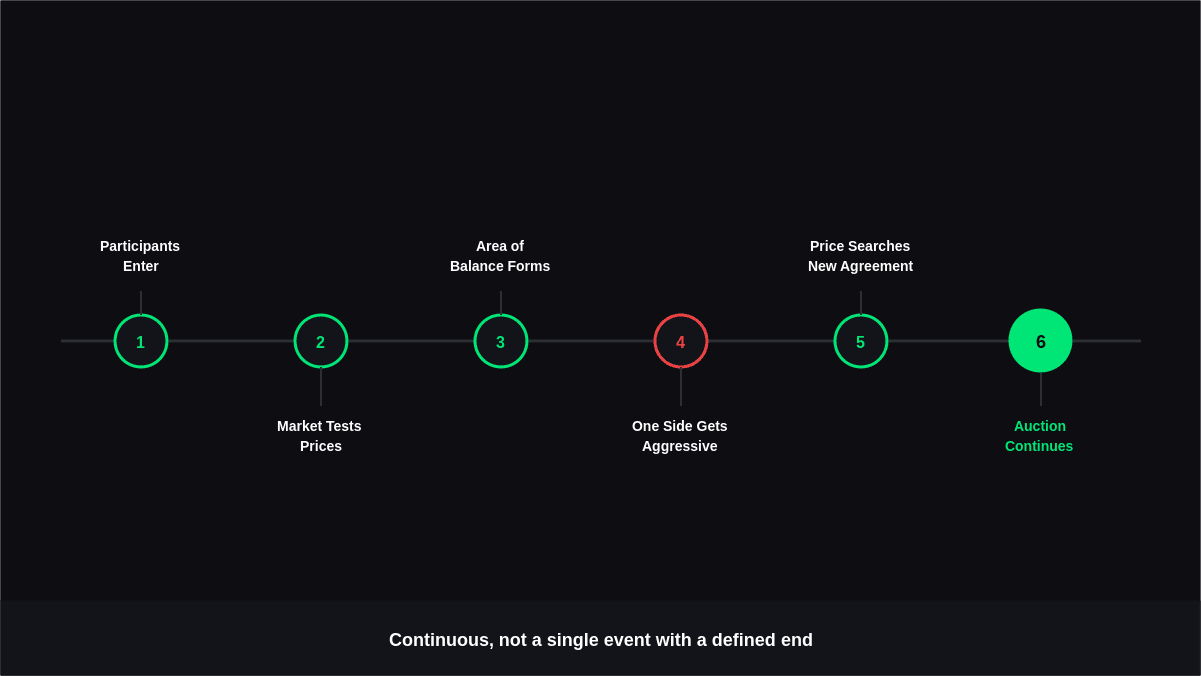
The market auction process is continuous rather than a single event. Buyers place orders according to the prices they are willing to pay, while sellers determine the prices at which they are prepared to offer their positions.
Step 1: Buyers and Sellers Enter the Market
Market participants enter with different expectations about what an asset is worth. Buyers may be willing to pay current prices because they expect higher prices later, while sellers may believe the current price is high enough to exit.
Step 2: The Market Tests Different Prices
As orders are executed, the market tests whether participants are willing to continue trading at those levels. If sufficient buyers and sellers remain active, transactions can continue around the same price range.
Step 3: The Market Establishes an Area of Balance
When neither side has enough conviction to push prices significantly higher or lower, trading can concentrate within a relatively stable range. This balance reflects temporary agreement about where the asset can be traded.
Step 4: One Side Becomes More Aggressive
A shift in buying or selling interest can create an imbalance. For example, aggressive buyers may continue accepting higher prices because they want to enter quickly, forcing the market to search for sellers at increasingly higher levels.
Step 5: Price Searches for a New Area of Agreement
If the market moves away from its previous range, it continues testing prices until enough participants are willing to transact again. Once trading activity becomes more stable, the market may establish a new area of balance.
Step 6: The Auction Continues
The process does not end when a new range forms. New information, changing expectations, and shifts in participation can create another imbalance, causing the market to begin searching for another price level.
The Role of Buyers and Sellers in Price Movement
The relationship between buyers and sellers is central to Auction Market Theory, but every completed transaction has both a buyer and a seller. The key difference is which side is acting more aggressively.
- Aggressive buyers: They accept the prices offered by sellers because they want to enter a position immediately. If enough buyers behave this way, sellers may raise their offers, allowing price to move upward.
- Aggressive sellers: They accept available bids to exit positions quickly. If selling pressure continues, buyers may lower their bids, encouraging the market to move downward.
Simply counting buyers and sellers does not explain price movement. Traders also need to consider where participants are willing to transact and how aggressively they pursue those transactions.
This distinction helps explain why changes in order behavior can influence price even though every completed trade technically includes both a buyer and a seller.
Price Discovery and the Search for Value
Price discovery describes how the market determines an acceptable price through ongoing transactions.
Markets do not have a permanently fixed fair value. Instead, participants continuously reassess an asset based on several factors:
- New information: News, earnings, economic data, or other developments can change how participants value an asset.
- Market expectations: Traders may adjust their willingness to buy or sell based on what they expect to happen next.
- Liquidity: The availability of buyers and sellers can affect how easily transactions occur at different price levels.
- Changing demand: Stronger buying or selling interest can cause the market to test higher or lower prices.
A market may spend significant time within one range because participants broadly agree that prices in that area are acceptable. However, if expectations change, traders may begin accepting transactions at higher or lower levels.
This can cause the market to leave its previous range and search for a new area of agreement.
For traders, the key question is therefore not simply whether price is rising or falling. It is whether the market is accepting or rejecting the prices it is currently testing.
Balance and Imbalance in Market Structure
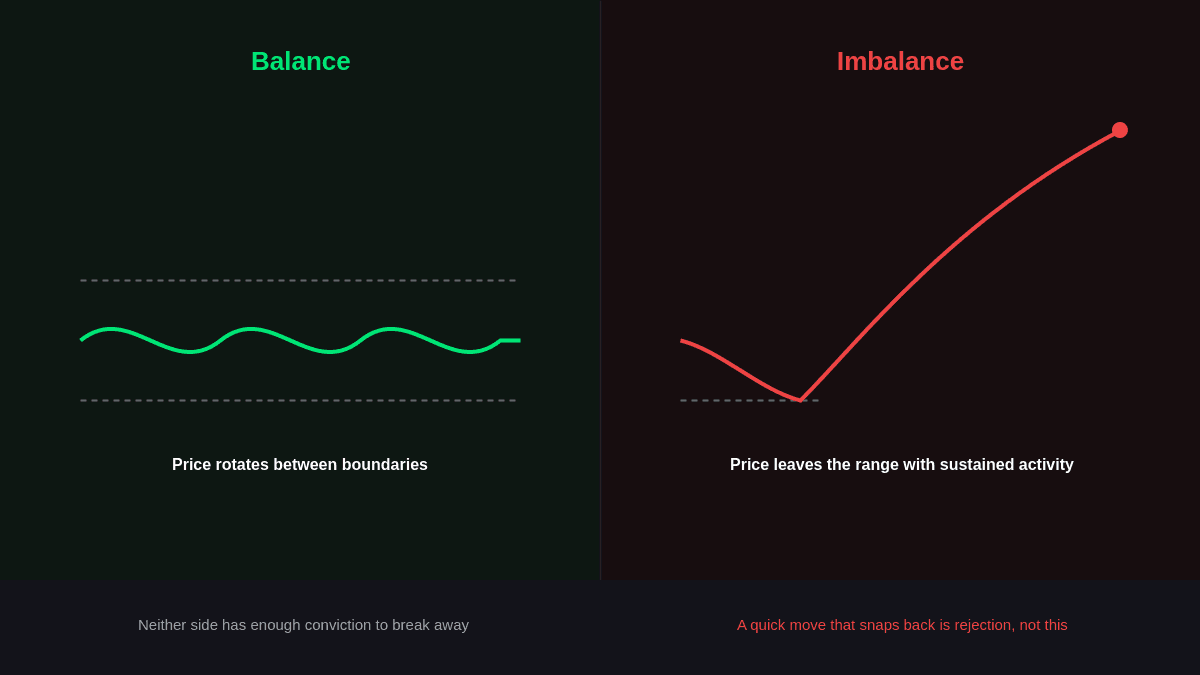
Balance occurs when neither buyers nor sellers have enough conviction to move the market decisively away from its current area.
During balanced conditions, price may rotate repeatedly between established boundaries. Traders often see overlapping candles, slower movement, and repeated tests of similar levels, which can be interpreted alongside signals and overlays.
Imbalance occurs when one side becomes more aggressive or when new information changes participants' expectations.
A market leaving a balanced range with sustained activity may indicate that participants are searching for a new area of value. However, a brief move outside the range followed by a quick return can indicate rejection rather than genuine acceptance.
Understanding this distinction can prevent traders from treating every breakout as evidence of a lasting directional move.
How Auction Market Theory Explains Market Profiles
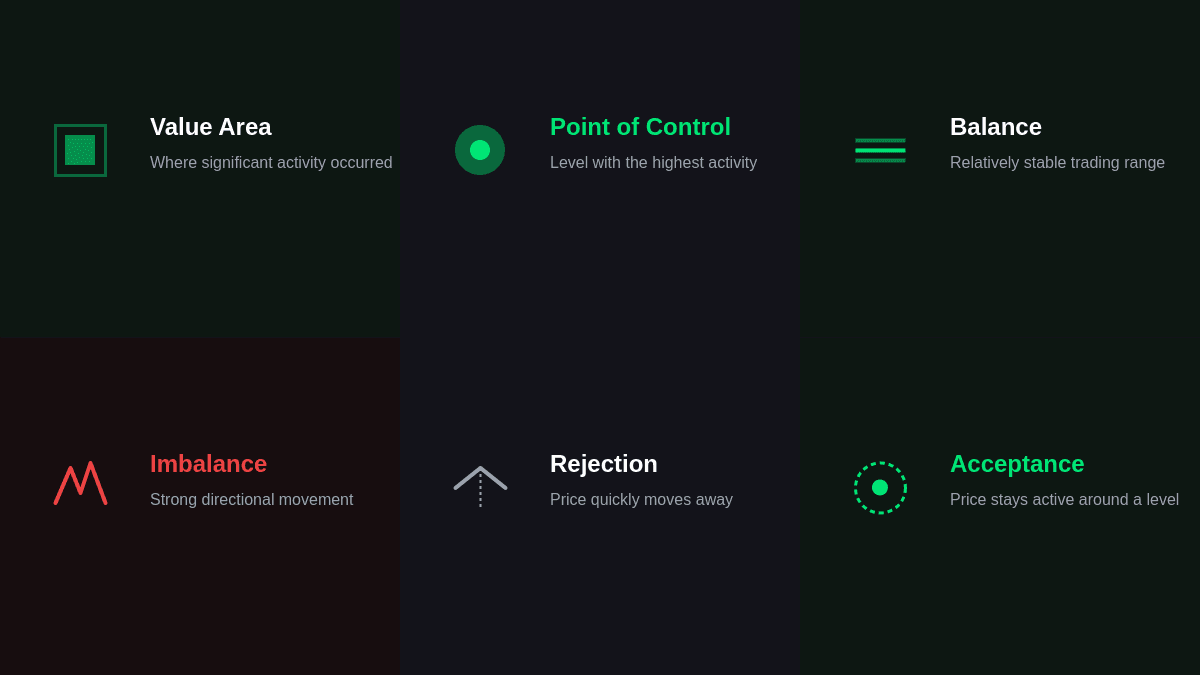
Market Profile-style analysis is often associated with Auction Market Theory because it provides a visual way to examine where trading activity has concentrated.
Rather than focusing exclusively on individual candlesticks, traders can evaluate how much time or activity the market has spent at different price levels.
Common concepts include:
| Concept | What It Represents | Why Traders Watch It |
|---|---|---|
| Value area | Price region where significant activity occurred | Helps identify accepted prices |
| Point of control | Level with particularly high activity | Shows an area of strong participation |
| Balance | Relatively stable trading range | Indicates temporary agreement |
| Imbalance | Strong directional movement | Suggests changing market conditions |
| Rejection | Price quickly moves away from a level | May indicate limited acceptance |
| Acceptance | Price remains active around a level | Suggests participants are comfortable trading there |
These concepts should not be treated as automatic buy or sell signals. They are better used as tools for interpreting market structure and participant behavior.
What Traders Can Learn From Auction Behavior
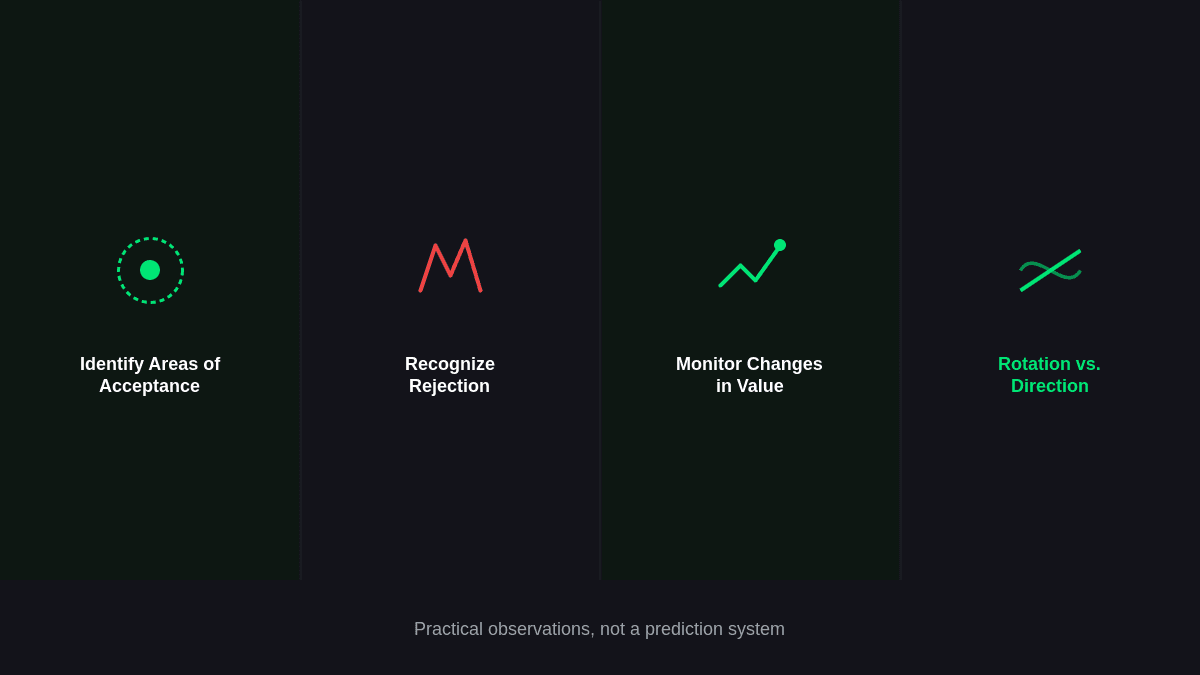
Auction Market Theory can provide several practical observations without requiring traders to predict every move.
Identify Areas of Acceptance
When price repeatedly trades within an area, it may indicate that participants consider those levels reasonable. Such areas can become important reference points for future market behavior.
Recognize Rejection
A rapid move away from a price level can suggest that the market did not find enough interest to continue trading there. Traders can compare the rejection with surrounding volume and subsequent price action for additional context.
Monitor Changes in Value
If the market gradually establishes activity at higher or lower prices, it may indicate that the area considered acceptable by participants is changing.
Distinguish Rotation From Direction
A market moving repeatedly between established boundaries behaves differently from one steadily discovering new prices. Recognizing the difference can help traders adapt their expectations rather than applying the same strategy to every condition.
Limitations of Auction Market Theory
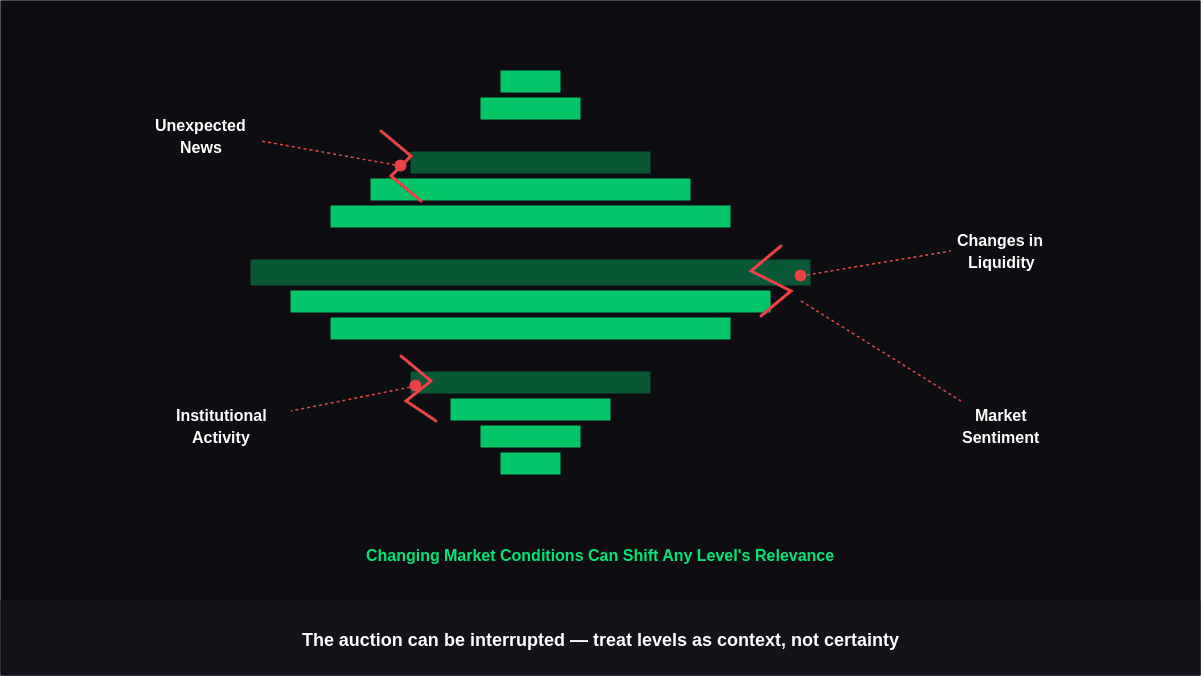
Auction Market Theory is a framework for interpreting market behavior, not a forecasting system that guarantees specific outcomes.
Several factors can complicate an auction:
- Unexpected news: Economic releases, company announcements, or geopolitical events can quickly change market expectations.
- Changes in liquidity: Lower or rapidly changing liquidity can cause price to move more sharply between levels.
- Institutional activity: Large orders can influence short-term price behavior and alter the market's existing structure.
- Market sentiment: Shifts in trader expectations can change where participants are willing to buy or sell.
- Changing market conditions: A price level that previously attracted significant activity can lose relevance as new information enters the market.
Traders should therefore combine auction-based observations with appropriate risk management and other forms of market analysis. Individual price levels should not automatically be treated as certain support or resistance.
How to Apply the Theory to Real Trading
A practical approach is to begin by identifying the market's current condition.
Ask:
- Is the price currently rotating within an established range?
- Where has the market previously shown strong acceptance?
- Are participants rejecting certain price levels quickly?
- Is the market establishing value at a new level?
- Has a recent imbalance changed the broader structure?
These questions encourage traders to interpret price in context. Instead of assuming that every movement represents a trend, they can assess whether the market is continuing an existing auction, remaining balanced, or searching for a new area of agreement.
Conclusion
Auction Market Theory offers a practical way to understand how financial markets continuously negotiate price through participant behavior. By studying acceptance, rejection, balance, imbalance, and price discovery, traders can develop a clearer view of why markets remain within certain ranges or move toward new levels. The theory does not predict every market move, but it provides a framework for interpreting the interaction between buyers, sellers, liquidity zones, and changing perceptions of value.