AI trading strategy builder assists traders in converting trading market theories or ideas into practical and testable trading strategies. This is achieved by using AI to automate the process of creating conditions and not having to write codes from scratch for every signal entry, exit, indicators, and risks involved.
The use of AI doesn’t guarantee the creation of profitable strategies, but rather speeds up the development process while the responsibility lies with the trader for testing, validating and controlling risks.
In this blog you will find out how to develop and test trading systems using technical analysis, backtesting, and risk management and validation.
What Is an AI Trading Strategy Builder?
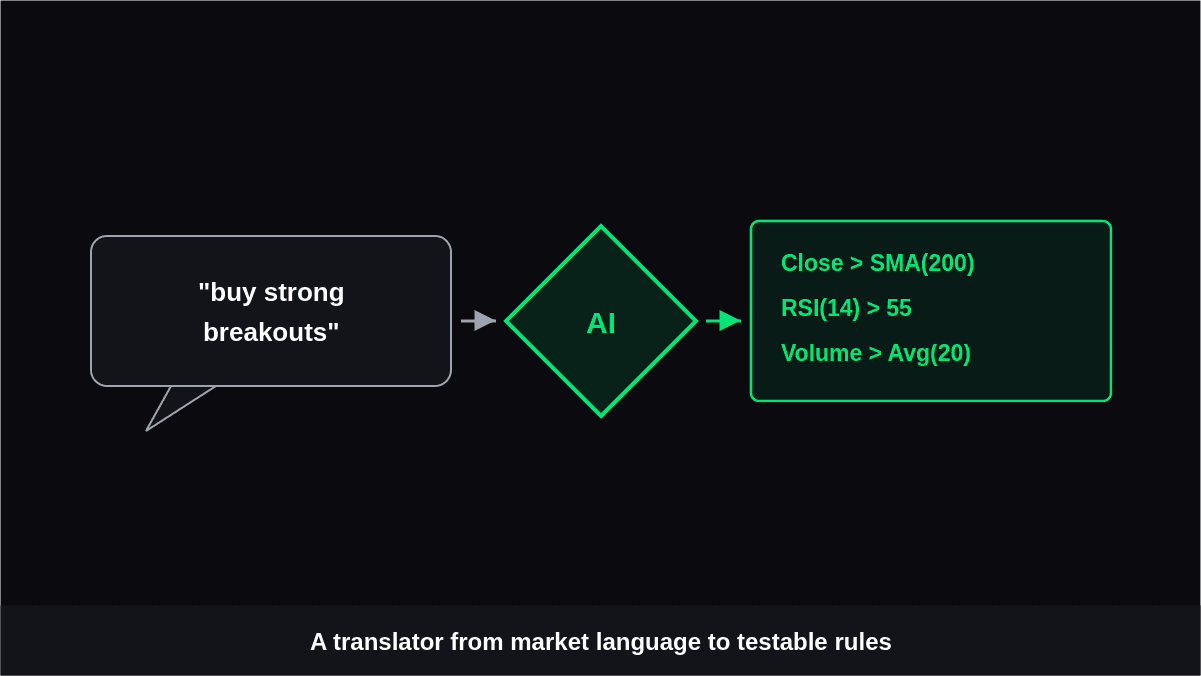
The AI trading strategy builder is a software that leverages artificial intelligence for assisting in creating or changing systematic trading rules. According to the specifics of the tool, the application can translate human language commands into rules, code generation, condition suggestions, or testing.
The basic workflow includes the following steps:
- Develop a trading idea.
- Translate the idea into rules.
- Choose the proper technical indicators.
- Create strategy logic.
- Test the strategy system.
- Verify the findings.
- Manage risks before launch.
The key is turning subjective observations into rules that can be applied consistently.
How AI Trading Strategy Builders Work
AI trading strategy builders can help turn a trader's market idea into a structured, testable strategy. The important point is that AI does not replace the trader's decision-making.
The trader still needs to define what market behavior they want to capture, while AI can help translate that idea into precise rules, implementation logic, and testing procedures.
A practical AI-assisted workflow can be broken into six stages:
Idea → Rules → Implementation → Backtest → Validation → Deployment
Stage 1: Define the Trading Idea
Start with a specific market behavior rather than asking AI to "find a profitable strategy."
For example, a trader may have noticed that an asset tends to continue moving upward when:
- Price remains above its 200-period moving average.
- Short-term momentum is positive.
- Price breaks above a recent resistance level.
- Trading volume increases during the breakout.
- Volatility is sufficient to support the expected price movement.
The initial idea might therefore be:
- Buy when an established uptrend produces a confirmed breakout with positive momentum.
- This is still a trading hypothesis, not a strategy. It needs measurable rules before it can be tested.
Stage 2: Convert the Idea Into Explicit Rules
AI can help convert the trader's description into objective conditions that a computer can evaluate.
For example:
Market condition
- Close > SMA(200)
Momentum condition
- RSI(14) > 55
Breakout condition
- Close > Highest High of the Previous 20 Bars
Volume confirmation
- Volume > 1.2 × Average Volume(20)
Entry
- Enter long at the next bar's open after all conditions are confirmed.
Stop-loss
- Place the initial stop at 1.5 × ATR(14) below the entry price.
Exit
- Exit when price closes below the 20-period moving average, or when the stop-loss is triggered.
This step is critical because vague statements such as "buy when momentum is strong" cannot be reliably backtested. The strategy needs numerical definitions, lookback periods, entry timing, and exit conditions.
Stage 3: Implement the Strategy
Once the rules are defined, they can be translated into a trading environment such as Pine Script or Python.
The implementation should specify:
- Indicator calculations
- Lookback periods
- Entry conditions
- Exit conditions
- Stop-loss and take-profit logic
- Position sizing
- Commission and trading fees
- Lippage assumptions
- Maximum number of open positions
For example, the logical structure could be represented as:
Trend + Momentum + Breakout + Volume → Entry
Entry + Risk Rule → Position
Stop-Loss OR Exit Signal → Position Closed
AI can assist with generating or explaining the code, but the trader still needs to verify that the code accurately represents the intended rules.
Stage 4: Backtest the Strategy
The next step is to evaluate the rules against historical market data.
A basic backtest should answer questions such as:
- How many trades were generated?
- What was the win rate?
- What was the average profit per trade?
- What was the maximum drawdown?
- How did the strategy perform after commissions and slippage?
- Did performance remain consistent across different market conditions?
- How sensitive are the results to the chosen parameters?
For example, if the strategy produces a 35% return but requires a 40% maximum drawdown, the return cannot be evaluated in isolation.
Stage 5: Validate the Results
A profitable backtest does not automatically mean that the strategy is robust.
The trader should test whether the results survive different conditions, including:
- Out-of-sample data
- Different market regimes
- Different time periods
- Reasonable parameter changes
- Realistic transaction costs
- Walk-forward testing
Parameter sensitivity is particularly important. If changing the RSI threshold from 55 to 54 causes the strategy to become unprofitable, the original result may depend too heavily on a specific parameter rather than representing a stable market relationship.
Stage 6: Prepare for Deployment
Only after the strategy has passed the testing and validation stages should it be considered for live or paper trading.
Before deployment, define:
- Position size
- Maximum account risk per trade
- Maximum daily or weekly loss
- Execution rules
- Data source
- Alert or order conditions
- Monitoring requirements
The final workflow should therefore be treated as an iterative process rather than a one-click AI solution:
Trading Idea → Objective Rules → Code → Historical Backtest → Robustness Testing → Paper Trading → Live Deployment
This approach gives the trader a clear way to determine whether AI has helped transform an idea into a reproducible trading system rather than simply producing a strategy that looks profitable on historical data.
Building AI Trading Strategies With Technical Analysis
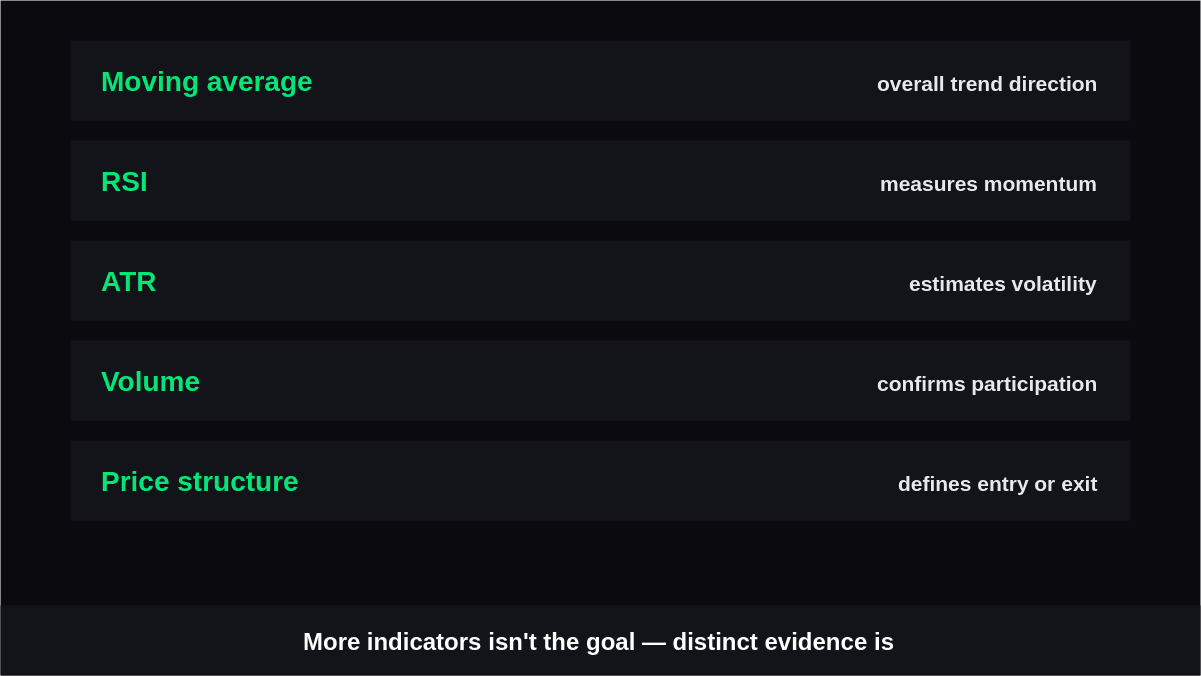
Each condition for the AI trading strategies must be explained with purpose. The addition of many more indicators doesn’t automatically mean the system is improved.
Below you will find some tools and their purpose to better understand why each tool is different:
| Tool | Purpose | Example Use |
|---|---|---|
| Moving average | Identify the overall trend direction | Price > SMA(200) |
| RSI | Measure momentum | RSI(14) > 55 |
| ATR | Estimate volatility | Stop = 1.5 × ATR |
| Volume | Confirm market participation | Volume > Average Volume |
| Price structure | Define entry or exit | Break above 20-bar high |
For example, a trader starting with the idea “buy strong breakouts in an uptrend” could build the strategy as:
- Trend: Close > SMA(200)
- Momentum: RSI(14) > 55
- Entry: Close > previous 20-bar high
- Confirmation: Volume > 20-bar average
- Risk: Stop-loss = 1.5 × ATR(14)
These conditions can then be implemented, backtested, and validated as a complete strategy.
The key is to avoid redundant indicators. If several tools measure essentially the same characteristic, they may add complexity without adding useful information. Each condition should contribute a distinct piece of evidence to the trading decision.
How to Turn a Trading Idea Into AI Rules
Converting a trading concept into an Automated trading strategy involves removing all subjectivity and formulating the rules in quantitative terms. The phrase “buy when the trend gets strong” is not easy to automate, since “strong” might be defined differently by other traders.
Take the following steps to convert the trading concept into AI rules.
Step 1 Define the Trading Concept
Determine what your strategy will be looking to measure, including trend, momentum, breakout, volatility, or market structure.
Step 2 Convert the Concept Into a Measurable Condition
Replace ambiguous descriptions with precise conditions that the AI-based trading strategy builder will be able to understand and evaluate.
Step 3 Define Entry and Exit Rules
Clearly state the entry and exit timing of the strategy. Do not depend on visual decision-making or subjective decision-making that is not easily repeatable.
Step 4 Add Risk Management Rules
Identify position sizing, stop losses, target profits, and maximum risk before backtesting the strategy.
Step 5 Test and Refine the Rules
Test the strategy using past data and determine if the strategy rules deliver consistent results. Do not keep modifying the rules in order to improve backtest results.
Step 6 Validate the Strategy
Test the strategy on data that was not used during development. This helps determine whether the rules can generalize beyond the original testing period.
Test an AI-Generated Trading Strategy
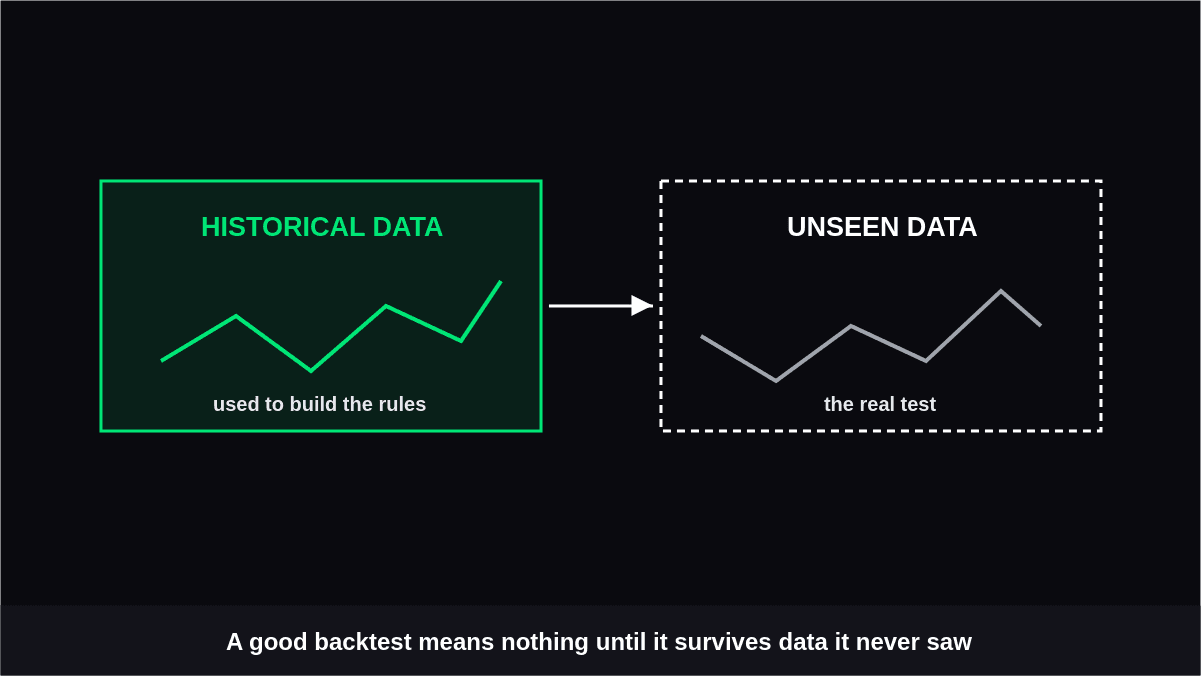
Trading strategy backtesting shows how the system would have performed against historical data in the market.
Important issues that must be addressed while performing the test include:
- Commission and fees
- Spread
- Slippage
- Position sizing
- Stop loss execution
- Historical data
- Diverse market conditions
Once the system is developed, testing using unseen data may prove helpful in finding out if the system generalizes to other time periods.
AI Trading Strategy Builder vs. Traditional Development
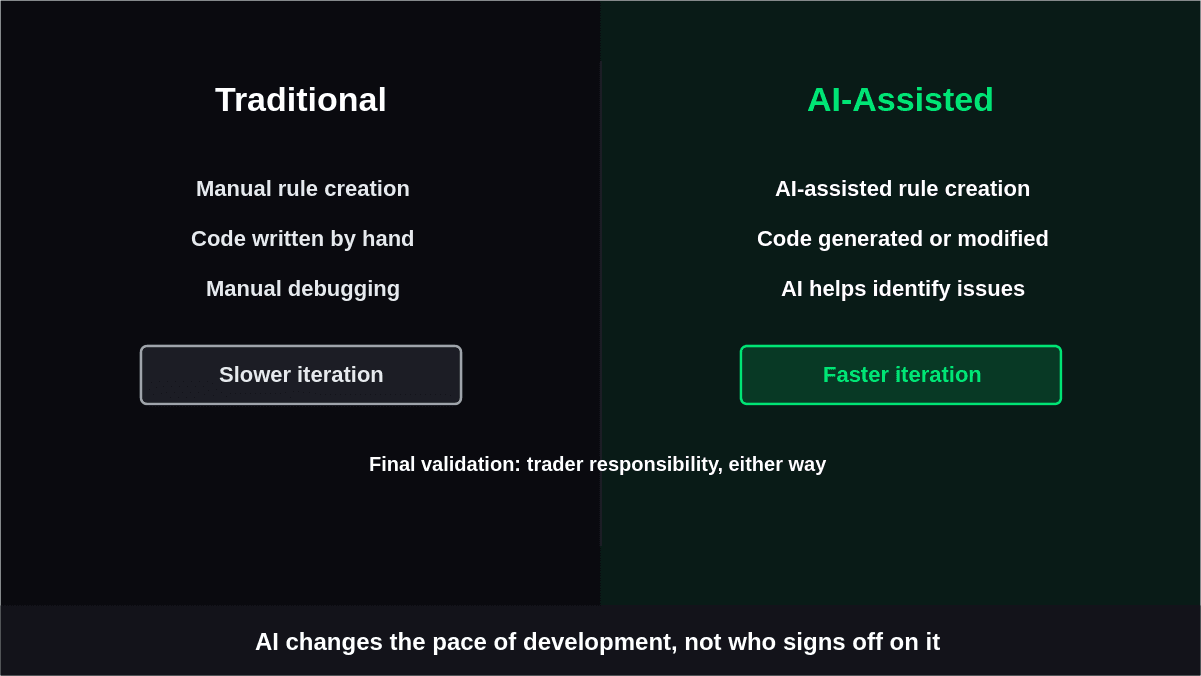
The development of strategies using the traditional approach usually involves manual research of the idea, programming of the strategy and debugging of the same.
Use of AI can help reduce the time taken for some of these processes. By following the below table you can better understand the difference between both approaches:
| Area | Traditional Approach | AI-Assisted Approach |
|---|---|---|
| Rule Creation | Manual | AI-assisted |
| Coding | Must be written | Can be generated or modified |
| Debugging | Manual Investigation | AI can help identify issues |
| Testing | Trader-managed | AI can assist with test design |
| Optimisation | Manual experimentation | Faster iteration |
| Final Validation | Trader responsibility | Trader responsibility |
7 Best Practices for Building AI Trading Strategies
A structured development approach can help avoid some typical errors.
1- Begin with one hypothesis:
Design on the basis of a particular market behavior rather than merging various unrelated signals.
2- Make sure that all rules are objective:
All entry and exit criteria must be quantifiable.
3- Make use of meaningful indicators:
The purpose of each indicator must be defined.
4- Perform realistic assumptions:
Costs, slippage, and other practical aspects must be considered.
5- Minimize optimization:
A strategy must not rely on very specific parameters.
6- Perform validation tests:
Independent tests must be performed before live trading.
7- Monitor performance after implementation:
Market behavior may change over time.
Limitations of AI Trading Strategy Builders
AI trading strategy builders can speed up strategy development, but their output still requires careful review and validation.
- Logical errors can appear in generated strategies, causing rules to behave differently from the original trading idea.
- Unrealistic assumptions about spreads, slippage, execution, or market conditions can make backtest results look better than real-world performance.
- Overfitting can occur when a strategy is repeatedly adjusted to perform well on historical data but fails on new market conditions.
- Look-ahead bias may cause a strategy to use information that would not have been available when a trade was actually placed.
- Candle timing issues can change when signals are generated and potentially produce misleading results.
- Position handling errors may affect entries, exits, position sizing, or multiple open trades.
- Execution differences between backtesting and live trading can lead to significantly different results.
For these reasons, traders should inspect and validate every part of an AI-generated strategy instead of assuming the output is automatically correct.
Common AI Strategy-Building Mistakes
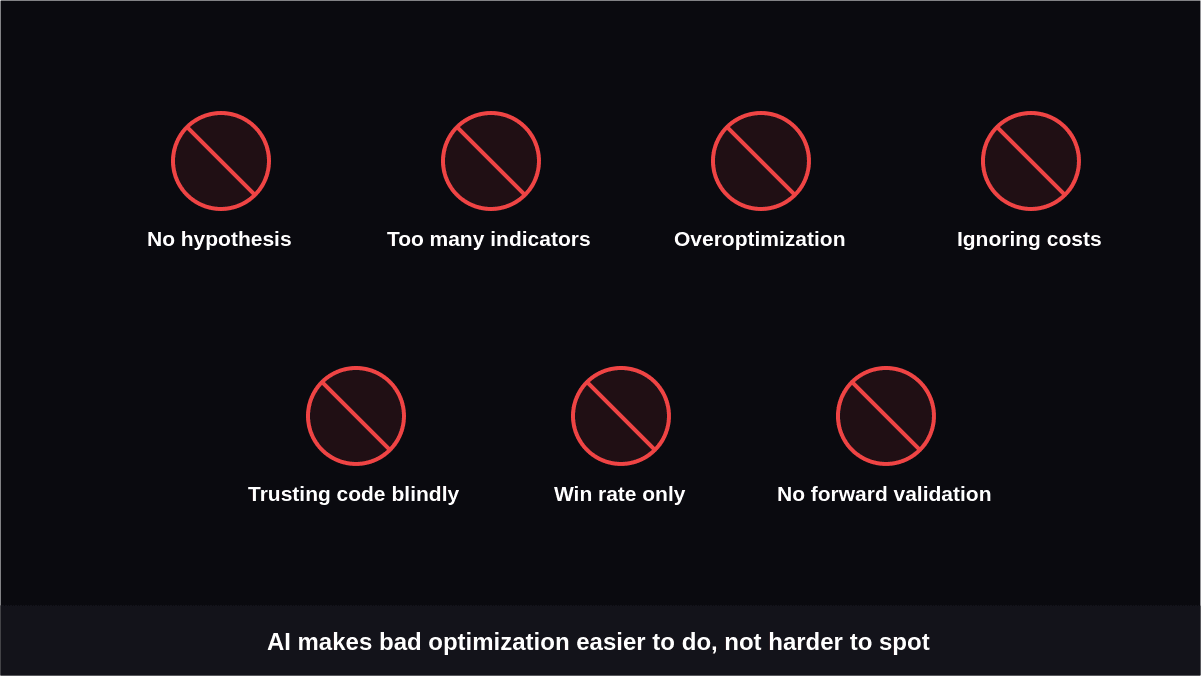
AI speeds up experimentation, but at the same time, it makes bad optimization easier to do.
Examples of errors made by traders include:
- Formulating rules without a hypothesis
- Using too many indicators
- Overoptimization
- Omitting transaction cost evaluation
- Trust without verifying the generated code
- Looking at the win rate only
- Deploying without forward validation
The trader should understand why every rule exists and what evidence supports keeping it.
Final Takeaway
The AI-driven strategy builder can help with the systematic development of strategies by making it quicker and easier to translate the ideas into actionable steps and test them out.
However, AI can only aid the development of trading strategies and not replace the need for analysis. The best strategies have to be technically sound, realistically tested, and managed properly.